


EU vs Self-Hosted Translation: 97% Cloud Risks for Defense

Most export control managers assume hosting translation systems in the EU satisfies data sovereignty and defense compliance. Yet 97% of Europe’s cloud infrastructure depends on non-EU providers whose terms expose controlled technical data to extraterritorial laws. EU location alone does not prevent deemed exports under ITAR or safeguard audit trails under AQAP 2110. This guide clarifies how infrastructure choice directly affects your compliance posture for translating defense and dual-use documentation.
Table of Contents
Introduction To Infrastructure Options In Defense Translation
Infrastructure Legal Implications And Data Sovereignty Challenges
Infrastructure Options And Tradeoffs For Defense And Medical Translation
Implementing Compliance: Practical Steps And Quality Assurance
Conclusion: Choosing The Right Infrastructure For Defense Translation Compliance
Key Takeaways
Point | Details |
EU-hosted infrastructure | Offers GDPR and data sovereignty advantages but does not solve ITAR deemed export risk if foreign nationals access controlled data. |
Self-hosted inside cleared facilities | Enables complete access control and audit architecture required for ITAR and NATO compliance. |
Non-EU cloud providers | Expose defense translation data to CLOUD Act and other extraterritorial legal demands, creating audit and export control failures. |
AQAP 2110 and ISO 27001 | Non-negotiable vendor certifications proving NATO-aligned QA and security governance for controlled technical data. |
Hybrid AI+Human workflows | Essential for compliance: proprietary LLM AI constrained by terminology governance plus certified SME review and ISO-aligned QA. |
Introduction to Infrastructure Options in Defense Translation
Defense manufacturers face three primary infrastructure models when selecting translation vendors. EU-hosted infrastructure means translation systems and data physically reside within the EU, managed by providers subject to EU law and sovereignty frameworks. Self-hosted infrastructure places translation capability on-premise within your organization’s controlled environment, maximizing access governance and audit control. Cleared infrastructure refers to cloud or hybrid systems certified to meet EU sovereignty standards and, where relevant, NATO or national security clearances for shared use.
Infrastructure choice determines where data resides, who can access it, and how you prove compliance during audits. For defense translation, the stakes are high. Export control authorities scrutinize not just data location but access patterns and foreign national exposure. Public cloud or non-EU-hosted solutions introduce unacceptable risk because they may allow foreign personnel or governments to reach controlled technical information, triggering deemed export violations even if servers sit in Europe.
Key infrastructure considerations for defense translation include:
Data sovereignty: Physical and legal jurisdiction over translation data under EU frameworks like GDPR and the EU Cloud Sovereignty Framework.
Access control: Ability to restrict foreign national access to controlled technical data to prevent deemed exports under ITAR or dual-use regulations.
Audit trails: Complete visibility into who accessed, modified, or processed translation data, required by AQAP 2110 and ISO 27001.
Certification alignment: Vendor compliance with AQAP 2110 for NATO quality assurance and ISO 27001 for information security governance.
Integrating hybrid AI and human translation workflows into compliant infrastructure ensures that terminology governance, SME review, and audit readiness meet defense sector standards.
EU Cloud Sovereignty Framework and Compliance Standards
The EU Cloud Sovereignty Framework establishes eight sovereignty objectives to guide infrastructure selection: strategic autonomy, legal control, transparency, security, data protection, interoperability, reversibility, and portability. These objectives form the foundation for evaluating whether a translation vendor’s infrastructure protects sensitive defense data from extraterritorial interference and unauthorized access.
The framework introduces SEAL certification tiers that assess provider compliance across these objectives. SEAL levels require providers to demonstrate supply chain transparency, encryption key control held exclusively by EU entities, and legal independence from non-EU jurisdictions. For defense translation, SEAL certification signals that a vendor operates under EU governance without backdoor access by foreign governments or corporations.
GDPR and the Schrems II ruling restrict data transfers to jurisdictions lacking adequate protection. Defense manufacturers must verify that translation vendors not only host data in the EU but also maintain legal and operational independence from non-EU parent companies or cloud platforms. A vendor claiming EU hosting while relying on U.S. hyperscale cloud infrastructure for core processing may still expose your controlled data to CLOUD Act requests.
SEAL Tier | Sovereignty Objectives Met | Compliance Requirements | Relevance to Defense Translation |
Basic | Data protection, security | GDPR compliance, EU data residency | Minimum threshold, insufficient for ITAR or AQAP audit |
Enhanced | Legal control, transparency | Supply chain visibility, encryption key control by EU entities | Suitable for non-controlled defense support documentation |
Advanced | Strategic autonomy, legal independence | No reliance on non-EU platforms, full operational sovereignty | Required for controlled technical data translation |
Key metrics the EU uses to evaluate cloud sovereignty in translation providers include:
Legal jurisdiction: Provider’s incorporation, ownership structure, and governing law exclusively within the EU.
Data residency: Physical location of all translation data and processing infrastructure within EU territory.
Access control: Mechanisms preventing non-EU personnel from accessing data without explicit customer authorization.
Encryption key management: Customer or EU-only entities hold keys, not provider or non-EU third parties.
Supply chain transparency: Full disclosure of subprocessors, infrastructure partners, and data flows.
Reversibility: Ability to extract all translation assets and terminate service without vendor lock-in.
Pro tip: Select translation vendors holding advanced SEAL certification to ensure legal compliance and operational control over controlled defense documentation. Verify that the vendor’s ISO standards certifications align with NATO AQAP 2110 and ISO 27001 requirements.
Infrastructure Legal Implications and Data Sovereignty Challenges
The U.S. CLOUD Act allows American authorities to compel disclosure of data held by U.S. companies regardless of where that data physically resides. For defense translation, this creates a critical risk. If your vendor uses Microsoft Azure, AWS, or Google Cloud for core processing even within EU regions, extraterritorial access demands can force disclosure of controlled technical data without your knowledge or consent. This violates ITAR deemed export rules and GDPR Article 48 prohibiting foreign judicial orders that bypass EU legal process.
GDPR Article 45 restricts transfers to countries without adequate data protection. The Schrems II ruling invalidated the EU-U.S. Privacy Shield, requiring case-by-case assessment of third-country risks. Defense manufacturers cannot rely on standard contractual clauses alone when controlled data is involved. You must verify that no foreign nationals access the data and that no legal mechanism exists for extraterritorial government reach.
Extraterritorial legal access to defense translation data through non-EU cloud infrastructure compromises export control compliance and creates unacceptable audit risk under AQAP 2110 and ISO 27001 governance frameworks.
Key legal risks when using non-EU providers for defense translation include:
Deemed export violations: Foreign national access to ITAR-controlled technical data through vendor personnel or subprocessors triggers deemed export without authorization.
GDPR breach: Transfer of personal data embedded in defense documentation to jurisdictions lacking adequacy decisions violates data protection law.
AQAP 2110 audit failure: Inability to produce complete access logs showing no unauthorized foreign national exposure fails NATO quality assurance requirements.
ISO 27001 non-compliance: Lack of information security governance over third-party subprocessors exposes controlled data to unmanaged risks.
Contract enforceability: Foreign court orders may override contractual protections, leaving you unable to control data access or deletion.
Legal jurisdiction control must align with physical data location. EU-hosted infrastructure managed by an EU-incorporated entity with no non-EU ownership provides the strongest legal posture, but it still does not solve ITAR deemed export risk if the vendor employs foreign nationals with access to your controlled data.

Technical Comparison of Translation AI and Hosting Options
Translation technology choice interacts with infrastructure to determine compliance capability. Legacy machine translation (MT) systems rely on rule-based algorithms that produce literal output with weak context handling. MT carries high error risk for safety-critical or regulated defense text because it cannot interpret technical nuance, negation, or domain-specific terminology constraints. Hosting MT on compliant infrastructure does not fix its fundamental accuracy limitations.
Neural machine translation (NMT) platforms like Google Translate or DeepL offer improved fluency but present governance challenges. Public NMT engines lack robust terminology control, handle negation and technical context variably, and provide limited audit trails. For defense translation, public NMT introduces compliance gaps because you cannot enforce terminology governance or verify that controlled data does not train the vendor’s broader models. Even enterprise NMT requires careful configuration and access controls to meet AQAP 2110 and ISO 27001 standards.
Proprietary EU-hosted LLM-based AI translation systems offer context-sensitive generation with explicit terminology enforcement and document-level coherence. When embedded in hybrid AI+Human workflows, these systems constrain output using client Translation Memories and Term Bases, then route all translations through certified SME review and ISO-aligned QA. This architecture addresses compliance requirements that MT and public NMT cannot meet.
Technology | Compliance Capability | Terminology Control | Auditability | Best Use Case |
Legacy MT | Low: high error risk for regulated content | Weak: limited customization | Minimal: basic logs only | Non-critical general text |
Public NMT | Moderate: requires robust enterprise controls | Variable: inconsistent domain handling | Limited: depends on vendor | Internal drafts, low-risk content |
Proprietary EU-hosted LLM AI | High: with SME review and ISO QA | Strong: enforces client TM/TB | Complete: full audit trail | ITAR-controlled, AQAP-governed defense documentation |
Compliance risks and benefits by technology include:
MT: Fast and inexpensive but unsuitable for defense translation due to accuracy and governance gaps.
Public NMT: Improved quality but lacks terminology enforcement and auditability for controlled data.
Proprietary LLM AI on EU infrastructure: Combines advanced linguistic capability with data sovereignty, terminology governance, SME oversight, and ISO-aligned QA.
Pro tip: Pair EU-hosted proprietary LLM AI with 100% SME review by cleared engineers or subject matter experts to maximize compliance and audit readiness. Verify that the vendor’s workflow aligns with AI vs MT compliance standards before processing controlled technical data.
Infrastructure Options and Tradeoffs for Defense and Medical Translation
Each infrastructure model presents distinct operational, cost, and auditability tradeoffs. EU-hosted infrastructure managed by a compliant vendor offers strong data sovereignty, GDPR alignment, and lower operational burden compared to self-hosting. You benefit from vendor expertise in maintaining ISO 27001 security controls and AQAP 2110 quality processes without building that capability in-house. However, EU hosting alone does not prevent deemed exports if the vendor employs foreign nationals with access to your controlled data.
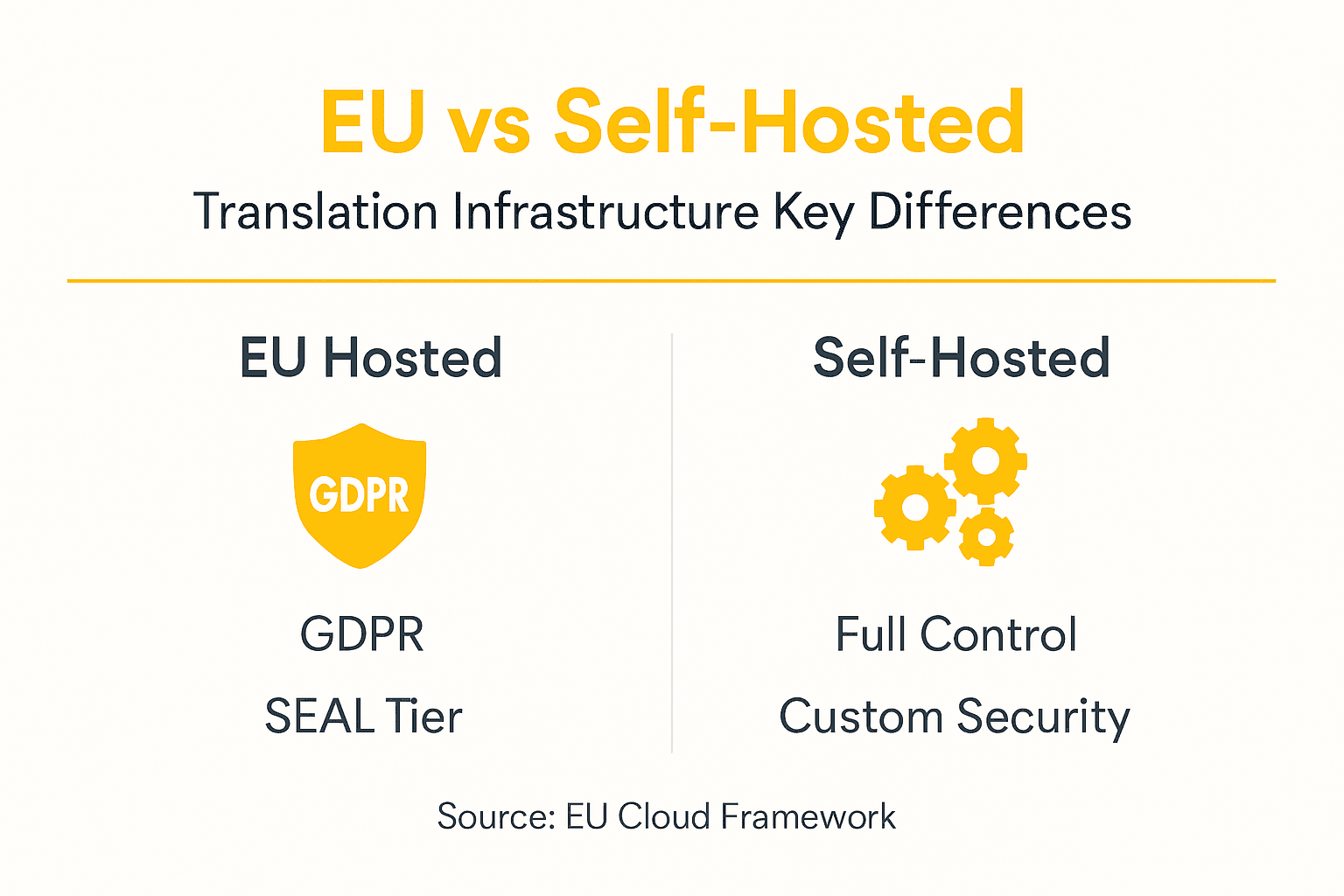
Self-hosted infrastructure inside your cleared facility provides maximum control. You manage access permissions, audit trails, and physical security, ensuring only cleared personnel touch ITAR-controlled technical data. Self-hosting eliminates third-party access risk but requires substantial investment in IT infrastructure, security governance, and translation technology expertise. Most defense manufacturers lack the resources to maintain translation systems at the scale and quality level needed for complex multilingual documentation.
Cleared infrastructure offers a middle path. Some vendors operate certified environments where only security-cleared personnel access controlled data, and infrastructure meets NATO or national security standards. This model balances control with operational efficiency, but availability is limited and cost is typically higher than standard EU-hosted services.
Key decision criteria for selecting infrastructure include:
Data classification: ITAR-controlled technical data requires self-hosted or cleared infrastructure to prevent deemed exports; CUI or non-controlled defense documentation may use EU-hosted with foreign national access restrictions.
Audit requirements: AQAP 2110 and ISO 27001 demand complete access logs and security governance; verify vendor capability before contract.
Operational complexity: Assess your internal IT and translation expertise to determine if self-hosting is sustainable.
Cost constraints: Self-hosting carries highest total cost of ownership; EU-hosted offers best cost-efficiency with acceptable risk for non-controlled data.
Scalability needs: Cloud-based EU-hosted infrastructure scales faster than self-hosted for fluctuating translation volume.
Security considerations by hosting type include:
EU-hosted: Requires vendor ISO 27001 certification, GDPR compliance, encryption in transit and at rest, and contractual foreign national access restrictions.
Self-hosted: Demands internal security policies, physical access controls, network segmentation, and regular penetration testing to maintain compliance.
Cleared: Vendor must hold relevant NATO or national security certifications and employ only cleared personnel with need-to-know access.
Choosing the right infrastructure depends on your specific regulatory profile. For ITAR-controlled translation, prioritize compliant hybrid translation providers offering cleared environments or accept the operational burden of self-hosting. For non-controlled defense and medical documentation, EU-hosted proprietary LLM AI with SME review and ISO certification delivers optimal compliance and efficiency.
Implementing Compliance: Practical Steps and Quality Assurance
Implementing compliant translation workflows requires structured process alignment with AQAP 2110, ISO 17100, ISO 18587, ISO 27001, GDPR, and where applicable MDR. The AI+Human hybrid workflow sequence ensures terminology governance, regulatory validation, and audit readiness at every stage.
Compliant translation workflow sequence:
Asset integration: Ingest client Translation Memories ™ and Term Bases (TB) into the proprietary LLM-based system to enforce terminology consistency from the start.
LLM generation: The EU-hosted AI produces target language output constrained by client terminology, style guidance, and document context.
Certified SME review: Subject matter experts with relevant domain credentials (engineers, medical professionals, legal scholars) review for technical accuracy, regulatory compliance, and contextual nuance.
Quality assurance: Final QA aligned to ISO 17100 and ISO 18587 standards, plus sector-specific requirements like MDR for medical devices or AQAP 2110 for NATO documentation.
Audit trail generation: Complete logs capturing access, changes, review outcomes, and QA results to satisfy ISO 27001 and export control audits.
Compliance checkpoints to validate at each stage include:
GDPR: Data minimization, lawful basis for processing, data subject rights, and no unauthorized transfers to third countries.
ISO 27001: Access controls, encryption, incident response, and vendor risk management for subprocessors.
ISO 17100: Translator qualifications, review processes, client feedback mechanisms, and quality metrics.
ISO 18587: Post-editing workflow, MT output evaluation, and human review standards when AI translation is used.
MDR: For medical device translation, terminology accuracy, traceability, and regulatory alignment per EU Medical Device Regulation.
AQAP 2110: For NATO documentation, quality management system, personnel qualifications, and audit trail completeness.
Terminology governance is non-negotiable. Your Translation Memory and Term Base must constrain AI output to prevent unapproved term variants that create safety or compliance risk. Certified SME review catches contextual errors and regulatory nuances that AI cannot detect. For defense translation, SMEs should hold relevant security clearances when working with controlled data.
Quality assurance must align with ISO translation standards and sector-specific regulations. Document QA outcomes, corrective actions, and continuous improvement metrics to satisfy auditors that your translation process meets AQAP 2110 and ISO 27001 governance requirements.
Common Misconceptions about Infrastructure and Compliance
Export control managers often hold misconceptions that create audit risk and compliance failures. Correcting these misunderstandings is essential for informed infrastructure decisions.
Misconceptions and corrections include:
Misconception: Hosting translation data in the EU guarantees full compliance with ITAR and GDPR. Correction: EU location satisfies GDPR data residency but does not prevent deemed exports if foreign nationals access ITAR-controlled technical data through vendor personnel or subprocessors.
Misconception: Public cloud platforms like Azure or AWS EU regions provide sufficient sovereignty for defense translation. Correction: U.S.-based hyperscalers remain subject to the CLOUD Act, allowing extraterritorial access that violates GDPR Article 48 and creates export control risk even when infrastructure is physically in Europe.
Misconception: AI translation alone meets defense compliance standards. Correction: AI without certified SME review and ISO-aligned QA cannot satisfy AQAP 2110, ISO 17100, or regulatory validation requirements for safety-critical and controlled documentation.
Misconception: Standard contractual clauses (SCCs) eliminate GDPR transfer risk for non-EU vendors. Correction: Post-Schrems II, SCCs require case-by-case adequacy assessment and supplementary measures; for ITAR-controlled data, SCCs provide no safe harbor against deemed export violations.
Misconception: ISO 27001 certification alone proves a vendor can handle defense translation securely. Correction: ISO 27001 demonstrates information security governance but does not address export control, terminology governance, or AQAP 2110 quality requirements; verify that the vendor holds relevant defense and NATO certifications.
Legal versus physical data sovereignty distinction matters. A vendor may host servers in the EU while maintaining corporate headquarters, ownership, or key personnel in non-EU jurisdictions. This creates legal exposure because foreign court orders can compel data disclosure regardless of server location. For defense translation, you need both EU physical hosting and EU legal jurisdiction with no non-EU parent company control.
Strict access controls, hybrid AI+Human workflows, and adherence to ISO standards and AQAP 2110 are not optional. Audit failures most commonly stem from inadequate access logs, lack of SME review documentation, or inability to prove that foreign nationals never accessed controlled technical data.
Conclusion: Choosing the Right Infrastructure for Defense Translation Compliance
Infrastructure choice directly determines your compliance posture for translating defense and dual-use documentation. Match infrastructure to your data classification, regulatory obligations, and operational constraints using these scenario-based recommendations:
ITAR-controlled technical data requiring strict audit and deemed export prevention: Self-hosted infrastructure inside cleared facilities or vendor-operated cleared environments with only security-cleared personnel access.
Non-controlled defense documentation with AQAP 2110 and ISO 27001 requirements: EU-hosted proprietary LLM AI with foreign national access restrictions, certified SME review, and ISO-aligned QA.
Medical device translation under MDR and GDPR: EU-hosted infrastructure with ISO 13485 and ISO 27001 certification, terminology governance, and regulatory validation by medical SMEs.
Lower-risk defense support content without export control sensitivity: Cleared cloud solutions or EU-hosted platforms meeting SEAL enhanced tier standards.
Balancing cost, complexity, and compliance risk requires understanding the true capabilities and limitations of each infrastructure model. EU hosting provides strong GDPR and data sovereignty advantages but does not solve ITAR deemed export risk without access controls preventing foreign national exposure. Self-hosting offers maximum control at the expense of operational burden and cost. Cleared infrastructure from qualified vendors delivers the best balance for most defense translation needs.
Integrated AI+Human workflows combining proprietary EU-hosted LLM AI with certified SME review and ISO-certified QA are essential regardless of infrastructure choice. Terminology governance through Translation Memories and Term Bases prevents compliance failures from term inconsistency. Complete audit trails satisfy AQAP 2110 and ISO 27001 governance requirements during regulatory inspections.
Optimize Your Defense Translation Compliance with AD VERBUM
AD VERBUM operates proprietary EU-hosted LLM-based translation infrastructure certified to ISO 27001 and aligned with AQAP 2110 NATO quality standards. Our AI+Human hybrid workflow integrates client Translation Memories and Term Bases, generates context-sensitive output through our LangOps System, and routes 100% of translations through certified SME engineers and domain experts for regulatory validation and technical accuracy.
With 25+ years serving defense, medical, and regulated sectors, we maintain complete audit trails proving data sovereignty and access control throughout translation lifecycles. Our 3,500+ subject matter expert network includes cleared engineers and medical professionals qualified to handle ITAR-controlled and MDR-governed documentation. Explore how our AI+Human translation process ensures compliance while delivering 3x to 5x faster turnaround than traditional workflows. Discover strategies for optimizing hybrid translation in regulated environments, and review medical translation compliance requirements relevant to defense sector documentation.
FAQ
What does EU-hosted infrastructure mean for translation compliance?
EU-hosted infrastructure means translation data and processing systems physically reside within EU member states and operate under EU legal jurisdiction. This satisfies GDPR data residency requirements and protects against some extraterritorial access risks. However, EU hosting alone does not prevent ITAR deemed exports if foreign nationals access controlled technical data through vendor personnel.
Why is SME review critical in AI-based translation workflows?
Certified subject matter expert review detects contextual nuances, regulatory requirements, and technical accuracy issues that AI systems cannot identify. For defense translation, SMEs ensure terminology aligns with controlled specifications and catch safety-critical errors before publication. AI+Human workflows combining proprietary LLM AI with SME validation are mandatory for AQAP 2110 and ISO 17100 compliance.
What are the risks of using non-EU cloud providers for defense translation data?
Non-EU cloud providers subject to the CLOUD Act can be compelled to disclose data to foreign governments without customer notification, violating GDPR Article 48 and creating deemed export risk under ITAR. This exposure compromises audit trails required by AQAP 2110 and ISO 27001, and may breach export control regulations even if servers are physically located in Europe.
Which ISO standards are most relevant for compliant translation services?
ISO 17100 governs translation service quality management and translator qualifications. ISO 18587 covers post-editing of machine translation output. ISO 27001 establishes information security governance over translation data and systems. For medical device documentation, ISO 13485 applies. Defense translation should verify vendor holds all relevant ISO certifications plus AQAP 2110 for NATO work.
How do I verify a translation vendor can handle ITAR-controlled technical data?
Request proof of ISO 27001 certification, AQAP 2110 alignment, and security clearances for personnel who will access your data. Verify infrastructure is either self-hosted in your cleared facility or vendor-operated in a certified cleared environment. Confirm complete audit trail capability and contractual guarantees that no foreign nationals access controlled data without explicit authorization.
Recommended