


Why Human Expertise in Translation Matters Most

Professional translation is about much more than swapping words between languages. In sectors like healthcare and law, a mistranslation can expose American organizations to costly risks, and over 75 percent of global companies cite compliance as their top translation concern. As digital tools grow smarter, the demand for experienced human translators who ensure accuracy, cultural sensitivity, and legal protection becomes even more urgent. This article breaks down why true expertise matters when precision cannot be compromised.
Table of Contents
Key Takeaways
Point | Details |
Human Expertise is Essential | Translation requires deep domain knowledge and cultural intelligence that machines cannot replicate. |
Critical Sectors Demand Accuracy | Industries like Life Sciences, Legal, and Government require meticulous human oversight to prevent catastrophic errors. |
AI Tools Have Limitations | Public AI and NMT tools often fail to capture nuanced meanings and can compromise the integrity of specialized translations. |
Security is Crucial | Relying on public platforms exposes organizations to data security risks; a secure translation workflow is necessary for sensitive information. |
Human Expertise in Translation Defined Clearly
Translation expertise represents a sophisticated cognitive process far beyond simple linguistic conversion. It involves deep domain knowledge, advanced problem-solving skills, and nuanced contextual understanding that machines cannot independently replicate. At its core, translation expertise requires professionals who can navigate complex linguistic landscapes with precision and cultural intelligence.
Professional translators bring critical capabilities that elevate translation from mere word-for-word conversion to meaningful communication. Translation expertise encompasses extensive domain knowledge, heuristic problem-solving rules, and metacognitive abilities that enable skilled performance beyond basic language competence. These experts integrate multiple cognitive domains, analyzing not just words but underlying cultural contexts, technical nuances, and communicative intent.
The AI+HUMAN workflow at AD VERBUM recognizes that true translation mastery involves more than algorithmic processing. Expertise is characterized by a combination of experience, specialized knowledge, and adaptive problem-solving skills. Our network of 3,500+ subject-matter expert linguists includes professionals from specialized fields like medicine, engineering, and legal scholarship who understand industry-specific terminology and regulatory requirements.
Pro Translation Strategy: Build deep domain expertise by continuously studying industry-specific terminology, regulatory frameworks, and cultural communication nuances to elevate your translation capabilities beyond basic linguistic skills.
Critical Industries Requiring Human Oversight
Some industries demand absolute precision where even the slightest translation error could result in catastrophic consequences. These high-stakes sectors require meticulous human expertise to ensure accuracy, compliance, and risk mitigation. Why AI+Human Translation: Complete Industry Guide highlights the critical nature of specialized human oversight in sensitive translation contexts.
In Life Sciences, regulatory translations for clinical trials, medical device instructions, and pharmaceutical documentation require extraordinary attention to detail. A single mistranslated medical term could potentially compromise patient safety or invalidate critical research documentation. Human experts with specialized medical backgrounds understand nuanced terminology, regulatory frameworks, and the precise language required in these environments.

Legal and financial industries present equally complex translation challenges. Patent filings, international contracts, regulatory compliance documents, and financial reports demand linguistic precision that goes far beyond literal word conversion. Professional translators with domain-specific expertise understand contextual implications, legal terminologies, and industry-specific communication protocols that automated systems cannot replicate.
Government and defense sectors represent another domain where human translation expertise becomes non-negotiable. Intelligence reports, diplomatic communications, and sensitive international documentation require linguistic professionals who comprehend geopolitical nuances, cultural context, and potential communication subtleties that could dramatically impact international relations.
The following table summarizes key translation risks in high-stakes industries:
Industry | Main Translation Risk | Potential Impact |
Life Sciences | Mistranslated medical terms | Patient safety compromised |
Legal/Financial | Incorrect legal terminology | Legal liability, compliance loss |
Government | Geopolitical nuance missed | Diplomatic or security fallout |
Pro Translation Strategy: Develop deep specialization in your target industry by obtaining professional certifications, participating in continuous learning programs, and maintaining active knowledge of emerging regulatory and linguistic trends in your specific translation domain.
The Limitations of Public AI and NMT Tools
Public AI and Neural Machine Translation (NMT) tools represent significant technological advancements, but they fundamentally lack the sophisticated contextual understanding required for precision translation. Machine Translation Risks 2025: Security and Compliance Impact reveals critical vulnerabilities that make these tools unreliable for high-stakes communication.
Linguistic precision demands more than literal word substitution. Recent research demonstrates that advanced AI models like GPT-4 achieve only junior-level translation competency, frequently producing overly literal translations with persistent lexical inconsistencies. These tools struggle to capture nuanced contextual meanings, rhetorical subtleties, and discipline-specific communication standards that human experts inherently understand.
In specialized fields like scientific research, legal documentation, and medical communications, public translation tools catastrophically fall short. These automated systems cannot comprehend discipline-specific terminology, regulatory frameworks, or the intricate cultural implications embedded within professional communication. They frequently misinterpret technical language, potentially creating dangerous miscommunications that could compromise research integrity, legal agreements, or patient safety.
AD VERBUM’s AI+HUMAN workflow represents a fundamentally different approach. By combining advanced proprietary AI technology with human subject-matter expertise, we ensure translations that are not just accurate, but contextually precise and professionally refined. Our approach goes beyond mechanical translation, integrating deep domain knowledge with cutting-edge linguistic technology.
Pro Translation Strategy: Always conduct a comprehensive human review of any machine-generated translation, paying special attention to technical terminology, contextual nuances, and potential cultural misinterpretations that automated tools consistently miss.
Precision, Compliance, and Terminology Enforcement
In highly regulated industries, translation is far more than linguistic conversion—it’s a critical compliance mechanism that demands extraordinary precision. How to Ensure Translation Accuracy for Regulated Content demonstrates the intricate challenges of maintaining absolute terminology consistency across complex technical documentation.
Terminology enforcement represents the cornerstone of professional translation. Precise language means using exactly the right technical term every single time, with zero deviation. In medical device manufacturing, pharmaceutical research, or legal documentation, a single mistranslated word can invalidate entire research protocols, compromise patient safety, or create significant legal vulnerabilities. AD VERBUM’s AI+HUMAN workflow integrates specialized terminology databases that ensure consistent, exact language reproduction across thousands of pages.
Compliance is not a checkbox—it’s a comprehensive strategy requiring meticulous attention to regulatory frameworks. Different industries demand unique linguistic precision: medical translations must align with FDA and EMA guidelines, legal documents require precise jurisdictional language, and financial communications need absolute numeric and technical accuracy. Our network of 3,500+ subject-matter expert linguists understands these nuanced requirements, creating translations that are not just accurate, but legally and professionally bulletproof.
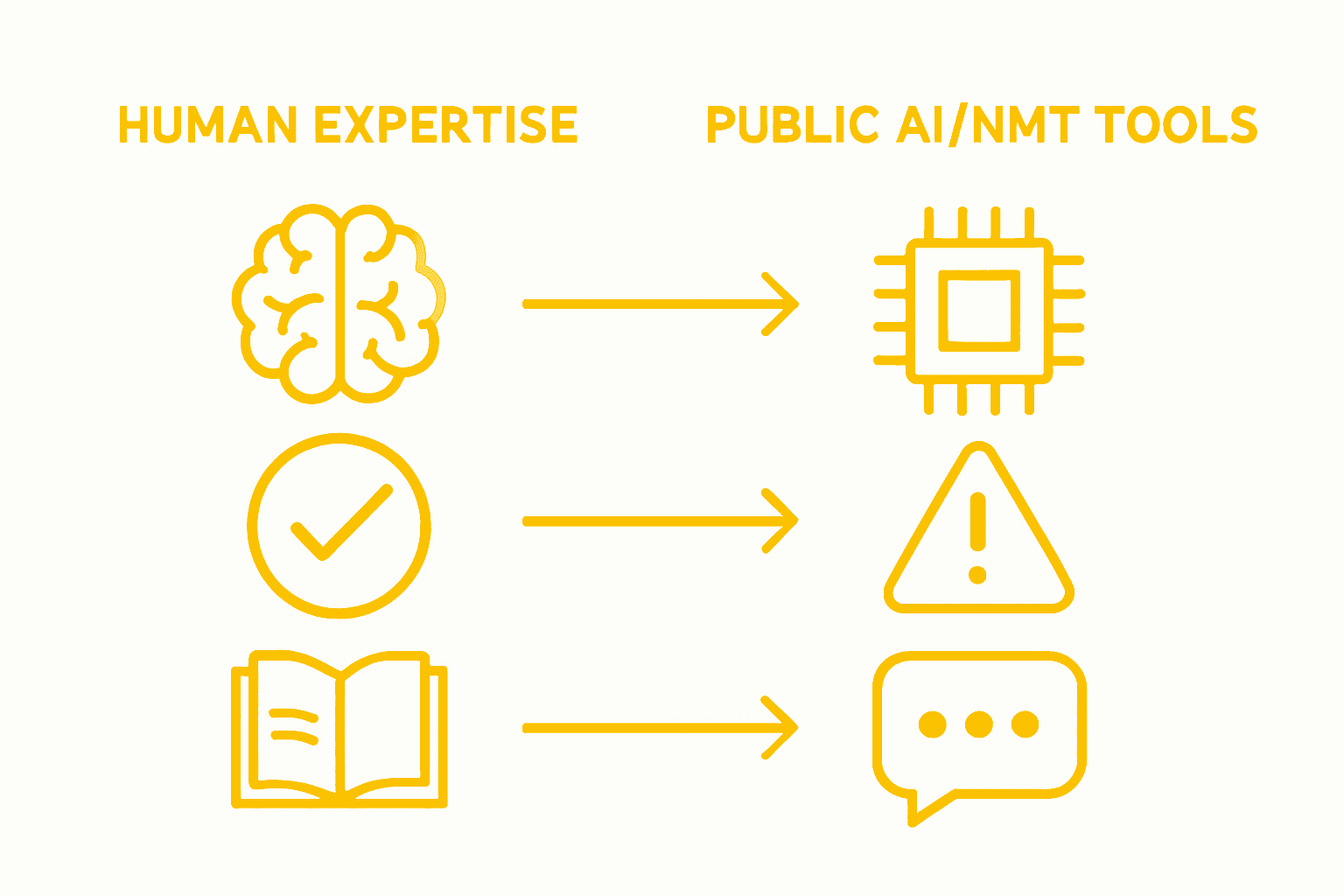
Here’s how human expertise compares to AI translation in regulated industries:
Aspect | Human Expertise | Public AI/NMT Tools |
Contextual Accuracy | Deep cultural understanding | Literal, lacks nuance |
Terminology Handling | Consistent, field-specific | Frequent incorrect terms |
Compliance Assurance | Knows regulations | No regulatory awareness |
Risk Management | Prevents critical mistakes | Can introduce severe errors |
The AI+HUMAN approach represents a quantum leap beyond traditional translation methods. By combining proprietary AI technology with human expertise, we create a translation workflow that adapts to industry-specific requirements, enforces strict terminology controls, and maintains the highest standards of professional communication.
Pro Translation Strategy: Develop a comprehensive terminology management system that includes industry-specific glossaries, standardized term bases, and continuous linguistic validation to ensure absolute translation precision.
Data Security Risks and Legal Exposure Without Experts
Public translation platforms represent a significant legal and security minefield for organizations handling sensitive information. Machine Translation Risks 2025: Security and Compliance Impact underscores the critical vulnerabilities inherent in uncontrolled translation ecosystems.
Data sovereignty becomes fundamentally compromised when organizations rely on public translation tools. These platforms often route sensitive documents through public cloud infrastructures, creating multiple points of potential data leakage. In regulated industries like healthcare, finance, and legal services, such casual approach to translation can trigger catastrophic compliance violations. HIPAA, GDPR, and industry-specific regulatory frameworks demand strict control over information transmission, which public translation platforms categorically cannot guarantee.
Legal exposure extends far beyond simple data transmission risks. Mistranslated documents can create substantial liability scenarios where organizational communication becomes legally problematic. A single mistranslated clause in a contract, medical instruction, or regulatory filing could potentially trigger litigation, invalidate critical agreements, or compromise patient safety. AD VERBUM’s AI+HUMAN workflow provides a closed-loop translation environment hosted entirely on secure EU servers, ensuring absolute data sovereignty and compliance with the most stringent international regulatory standards.
The AI+HUMAN approach represents a comprehensive security strategy. By integrating proprietary AI technology with human expertise, AD VERBUM creates a translation workflow that not only protects sensitive information but also maintains the highest standards of linguistic precision. Our network of 3,500+ subject-matter experts operates within a secure, controlled environment that eliminates the risks associated with public translation platforms.
Pro Security Strategy: Implement a zero-trust translation workflow that includes end-to-end encryption, strict access controls, and comprehensive audit trails to mitigate potential data security and compliance risks.
Why Trust Human Expertise with AD VERBUM’s AI+HUMAN Approach
The article highlights that translation errors in high-stakes industries can lead to serious risks including patient harm, legal liabilities, and compromised security. The demand for deep domain knowledge, terminology enforcement, and absolute compliance calls for more than automated tools. This is where human expertise becomes essential to navigate complex linguistic challenges and ensure precise communication.
AD VERBUM’s proprietary AI+HUMAN workflow answers this call by combining cutting-edge private LLM technology hosted on secure EU servers with the skill of 3,500+ subject-matter expert linguists. This approach prevents data leakage, enforces strict terminology guidelines, and meets rigorous standards such as ISO 17100 and HIPAA compliance. Unlike public NMT tools that risk mistranslation and regulatory violations, our service guarantees translations tailored for regulated sectors including Life Sciences, Legal, and Finance.
Ready to eliminate translation risks and uphold your company’s reputation with scientifically precise, legally compliant, and secure language services? Discover how AD VERBUM’s specialized AI translation can deliver accuracy where it matters most. Learn more about our AI+HUMAN workflow and start securing your multilingual communications today.
Frequently Asked Questions
What are the key benefits of using human translators over machine translation?
Human translators possess deep domain expertise, cultural context understanding, and nuanced problem-solving abilities that ensure accurate and meaningful translations, whereas machine translation can miss subtlety and context.
Why is human expertise crucial in high-stakes industries like life sciences and legal sectors?
In high-stakes industries, a single mistranslation can lead to serious consequences, such as compromised patient safety in healthcare or legal liabilities in contracts. Human experts are trained to navigate these complexities accurately.
How do machine translation tools fall short in comparison to human translation?
Machine translation tools often produce overly literal translations and lack the ability to handle discipline-specific terminology or contextual nuances, resulting in potential miscommunications that human translators effectively avoid.
What role does terminology enforcement play in the translation process?
Terminology enforcement ensures consistent and precise language usage across translations, which is vital in regulated industries to avoid critical errors that could invalidate research or create legal vulnerabilities.
Recommended
