


How to localize IBs and IMPDs for multi-country CTA success
- Apr 16
- 9 min read

Submitting a clinical trial application (CTA) across multiple EU Member States is one of the most document-intensive processes in drug development, and language errors in the Investigator’s Brochure (IB) or Investigational Medicinal Product Dossier (IMPD) are among the fastest ways to trigger a Request for Information (RFI) or stall your assessment clock. Under EU Clinical Trials Regulation 536/2014, the consequences are real: a single missed translation requirement at a participating Member State Concerned (MSC) can cascade into weeks of delay across your entire submission. This guide walks clinical operations and regulatory affairs teams through a stepwise localization approach for IBs and IMPDs, from language mapping to amendment management, so your CTIS submission clears without avoidable friction.
Table of Contents
Key Takeaways
Point | Details |
Local language policies vary | Check each Member State’s requirements early to avoid last-minute delays. |
Master documents drive efficiency | Well-structured English IBs and IMPDs simplify accurate, compliant localization. |
Use professional TEP workflows | Certified medical translation with TEP and back-translation minimizes regulatory risk. |
Plan for amendments | Keep version control and be ready to update translations for protocol changes. |
Proactive mapping prevents RFIs | A language matrix and early planning reduce the likelihood of regulatory queries and setbacks. |
Understand IB and IMPD roles in EU CTA submissions
Before any localization work begins, your team needs a firm grasp of what the IB and IMPD are and where they sit in the CTIS submission architecture. The IB is the sponsor’s compiled clinical and preclinical data on the investigational product, providing investigators with the information they need to run a trial safely. The IMPD is the technical dossier covering the investigational product’s quality, manufacturing, and nonclinical data. Both are scientific documents with direct patient safety implications, which means every word in translation carries regulatory weight.
Under the EU CTR, CTAs for multi-country submissions±+trial+centric+.pdf) are made via the CTIS portal and split into Part I and Part II. Part I covers jointly assessed scientific documents, including the IB and IMPD, reviewed by a Reporting Member State (RMS) on behalf of all MSCs. Part II covers national documents, typically ethics and site-level materials, submitted separately per country. The IB and IMPD live in Part I, but their language requirements can still be triggered at the national level.
Understanding medical translation requirements for these documents is not optional. Misclassifying a document or assuming all Part I content stays in English without verification is one of the most common and costly mistakes teams make.
Document | CTA part | Default language | National translation may be required |
Investigator’s Brochure (IB) | Part I | English | Yes, by some MSCs |
IMPD | Part I | English | Yes, by some MSCs |
Protocol synopsis | Part I | English | Sometimes |
Informed consent form | Part II | National language | Always |
Patient information sheet | Part II | National language | Always |
Common mistakes that create submission problems:
Assuming IB and IMPD require no translation because they are Part I documents
Failing to check each MSC’s current language policy before submission
Submitting outdated translated versions after protocol amendments
Using general-purpose vendors without regulated medical translation credentials
For teams preparing a CTA under CTR, getting the classification and language assumptions right at the start is the single most effective way to avoid assessment delays.
Map language requirements by Member State
With the IB and IMPD’s regulatory footing clear, the next step is understanding how language requirements shift between countries. The default position under EU CTR is that IB and IMPD are generally submitted in English±+trial+centric+.pdf), but some MSCs require translations into official national languages. This is where many sponsors get caught off guard.

France and Germany are the most frequently cited examples. Both can require that at minimum a translated synopsis, and in some cases a full translation, of the IB or IMPD be submitted in French or German, respectively. Finland, by contrast, generally accepts submissions in Finnish, Swedish, or English, giving sponsors more flexibility. These policies are not static, so checking directly with each national competent authority (NCA) or reviewing CTIS national guidance pages before finalizing your submission package is essential.
Member State | IB language policy | IMPD language policy | Notes |
Germany (DE) | English + synopsis in DE may be required | English + German synopsis possible | Confirm with BfArM |
France (FR) | French translation or synopsis often required | French version may be required | Confirm with ANSM |
Finland (FI) | FI, SV, or EN accepted | FI, SV, or EN accepted | Flexible |
Spain (ES) | English accepted; local requirements vary | English generally accepted | Confirm with AEMPS |
Poland (PL) | Polish translation may be required | Polish may be required | Confirm with URPL |
Missing a national language requirement at even one MSC can trigger an RFI that pauses your entire Part I assessment clock, not just the national part. The RMS coordinates across MSCs, so one country’s language gap becomes everyone’s problem.
Pro Tip: Build a language matrix at the start of your trial planning. List every MSC, their confirmed language policy (sourced directly from NCA sites), and the specific documents affected. Update this matrix each time a new country is added or a policy changes. Teams that manage translation risks across EU sites proactively spend far less time firefighting RFIs.
Prepare compliant master documents for localization
Once the regulatory language roadmap is set, preparing a best-practice master document streamlines localization in all scenarios. The English master version of your IB or IMPD is the foundation for every translated output. If the master is inconsistent, redundant, or poorly structured, every translation will inherit those problems and multiply them across languages.
Master versions should comply with CTR Annex I and ICH guidelines, and the CTIS sponsor handbook provides formatting expectations that directly affect how documents are ingested and reviewed.
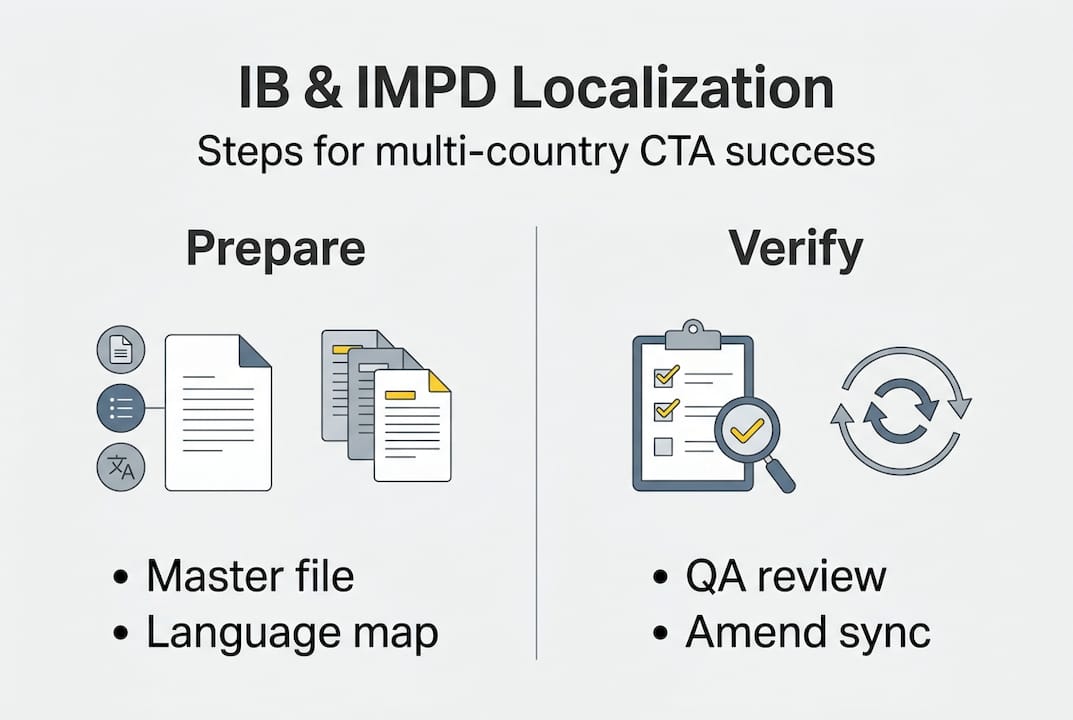
Steps for preparing your IB and IMPD master for localization:
Confirm structure against CTR Annex I requirements and relevant ICH guidelines (E6 for GCP, M4 for CTD format where applicable).
Harmonize terminology throughout the document using a controlled glossary. Every instance of a drug name, dose unit, or safety term must be consistent.
Identify and flag only the sections that require translation per your language matrix. Avoid sending translators unnecessary content.
Implement version control from day one. Use a naming convention that captures document type, version number, language, and date.
Review for translatable unit clarity. Sentences with nested clauses, ambiguous pronoun references, or untranslated abbreviations will slow down translation and increase error risk.
Pro Tip: Structure your IB and IMPD in clearly demarcated sections with no cross-section dependency for meaning. A translator working on Section 4 should not need to read Section 9 to understand what they are translating. Clean source text is the single biggest time-saver in a multi-language workflow.
Strong compliance requirements for medical translation also demand that your master document go through an internal regulatory review sign-off before it enters any translation workflow. Sending a draft for translation and then revising the source mid-process is one of the most common causes of version mismatch.
Execute and verify high-quality localization
With master documents ready, the process moves to accurate, regulator-ready translation and verification. The industry standard for regulated clinical documents is the TEP process. Follow TEP (translation, editing, proofreading) with qualified medical translators, use back-translation for accuracy, and allow 4 to 8 weeks for the process in multi-country setups. That timeline is not conservative; it reflects real-world complexity when multiple languages and regulatory reviewers are involved.
Step-by-step execution workflow:
Assign translators who hold domain expertise in pharmacology, clinical research, or the specific therapeutic area. General medical translators are not sufficient for IMPD chemistry sections.
Run the full TEP cycle: primary translation, independent editing for regulatory accuracy, and proofreading for consistency and format.
Apply back-translation for high-stakes sections, particularly safety data and posology, to verify that meaning is preserved across the language conversion.
Conduct a local regulatory review with a qualified person familiar with each MSC’s submission conventions.
Format the translated document to match CTIS upload requirements, including pagination, headers, and any country-specific layout expectations.
Errors that derail this stage:
Using translation vendors without verifiable qualifications in clinical trial documentation
Skipping back-translation for safety-critical sections to save time
Failing to update terminology bases when the protocol is amended mid-translation
Submitting translations that do not match the current version of the English master
The risks with unvetted translators in EU technical documentation go beyond terminology errors. They include audit trail gaps and accountability failures that become visible only when a regulator asks for the translator’s credentials.
Always plan for amendments before they happen. Build re-validation steps into your localization SOPs so that when a protocol change triggers an IB update, the translation workflow activates immediately rather than being treated as a new project. Check frequent issues in CTA preparation published by the European Commission for an authoritative view of where teams consistently fall short.
Respond to regulatory queries and manage amendments
Even after initial submission, continuous management is essential to keep all parties compliant and responsive. Language-related RFIs are among the most avoidable query types, yet they appear consistently in CTIS assessment cycles. When one arrives, speed and precision in your response directly affect whether your assessment timeline recovers or extends further.
Steps for managing post-submission translation requirements:
Log the RFI immediately and identify which MSC raised the language concern and which document section it affects.
Retrieve the current English master version and confirm it is the same version that was submitted.
Prioritize the translation of only the queried section if a full retranslation is not required, but verify this interpretation with the RMS before proceeding.
Submit the corrected translation via CTIS with a clear cover note documenting the change, version number, and the query it addresses.
Update your language matrix to reflect the resolved requirement so the same gap does not recur in the next submission cycle.
Translations are submitted as needed during validation and assessment and must be updated for amendments. This is not a one-time task. Every substantial modification that affects the IB or IMPD triggers a re-translation obligation for any MSC that required a localized version.
Failing to submit updated translations after a substantial modification is classified as a compliance gap. It can result in regulatory findings during inspection and, in serious cases, affect the trial’s authorization status in that Member State.
Version control is your audit trail. Every translated document must carry a version identifier that links it unambiguously to the corresponding English master. Teams that solve translation bottlenecks early in the process treat version management as a system, not a spreadsheet. Build it into your document management infrastructure before your first amendment arrives.
For more on navigating national language obligations, review guidance on language requirements for CTA submissions as a reference framework alongside NCA-specific instructions.
The real key: Proactive localization planning is your RFI shield
Here is something the standard regulatory guidance will not tell you plainly: most localization-driven RFIs are not caused by bad translation. They are caused by the absence of a plan. Teams that invest in a detailed language matrix, assign document ownership, and integrate translation timelines into the trial schedule before the first CTIS upload almost never face Part I delays from language gaps.
Conventional wisdom treats translation as a downstream task, something you hand off when the science is done. That framing is expensive. By the time a sponsor realizes they need a certified French synopsis of the IMPD, the assessment clock may already be running. Retrofitting localization into a submission that was not designed for it costs two to three times more in both time and resources than building it in from the start.
Operationalizing language requirements means treating them the same way you treat protocol milestones. Put translation triggers in your project plan. Assign a language matrix owner. Set internal deadlines that precede CTIS deadlines by at least four weeks. Teams that manage clinical translation risk as a first-class project management discipline consistently outperform those that treat it as a vendor coordination task.
The hard truth: perfect translation executed too late is as harmful as imperfect translation executed on time. Planning is the differentiator.
Streamline your clinical trial localization with expert support
Managing IB and IMPD localization across five, ten, or fifteen Member States simultaneously requires more than a qualified vendor. It requires a partner with documented regulatory alignment, ISO-certified quality systems, and the infrastructure to support audit-ready workflows.
AD VERBUM’s clinical trial localization services are built for exactly this environment. With ISO 17100, ISO 13485, and ISO 27001 certification, EU-hosted infrastructure, and a network of 3,500+ subject-matter expert linguists, AD VERBUM delivers the AI+HUMAN hybrid translation workflow that regulated documentation demands: terminology governance, SME review, and QA aligned to MDR and ICH standards. Turnaround runs three to five times faster than traditional workflows without compromising audit trail integrity. If your next CTA submission involves multiple MSCs and tight timelines, consult with AD VERBUM to scope your localization requirements before your master documents are finalized.
Frequently asked questions
Which EU Member States require translation of the IB or IMPD for Part I?
Most accept English, but FR and DE can demand local translations or synopses of the IB and IMPD. Always confirm with the relevant NCA before submission.
How early should I plan translations for multi-country submissions?
Begin language mapping at the start of trial planning. Plan 4 to 8 weeks±+trial+centric+.pdf) for translations in multi-country setups to avoid assessment delays.
Do all CTIS Part II documents require local language translation?
Yes. Part II docs must always be localized for each MSC. Informed consent forms and patient information sheets are never accepted in English alone.
What is the TEP process and why is it used?
TEP stands for Translation, Editing, and Proofreading. The TEP process is recommended for medical translations to ensure accuracy, regulatory compliance, and terminological consistency across clinical documents.
How should translations be handled after protocol amendments?
Translations must be updated and resubmitted for each affected MSC after any substantial modification. Maintain version control to link every translated document to its corresponding English master.
Recommended

