Prevent EMA objections: managing nomenclature drift in biosimilar dossiers

One mismatched term between your biosimilar’s translated Summary of Product Characteristics and the reference product’s approved documentation can stop an EMA validation cold. Not because of analytical comparability failures, but because a reviewer’s system flags an apparent discrepancy between two documents that should be speaking the same regulatory language. Most regulatory affairs leads at biosimilar developers spend months on comparability data packages and minutes on translation nomenclature governance. That imbalance is where approval timelines get damaged. This guide targets the specific mechanics of nomenclature drift in multilingual dossier translation, explains why it creates List of Outstanding Issues objections, and lays out a repeatable workflow to prevent it.
Table of Contents
Key Takeaways
Point | Details |
Nomenclature drift risk | Small terminology inconsistencies in translated biosimilar documents can halt EMA approvals. |
Common objection triggers | Most translation-based EMA objections relate to QRD non-compliance and mismatched SmPC/PIL terms. |
Proactive alignment | Early and systematic alignment of terminology using QRD templates and glossaries prevents costly regulatory delays. |
Integrated submission workflow | Embedding compliance checks and cross-team review in your submission process reduces the risk of repeat EMA objections. |
Understanding nomenclature drift and its regulatory impact
Nomenclature drift in biosimilar development means that translated terms describing the same product, pharmacological class, excipient, or indication differ between the biosimilar dossier and the authorized reference product documentation held in the same National Competent Authority database. The words are technically correct in isolation. The problem is they are not consistent with each other across the multilingual record.
Consider a practical example. A reference product’s approved Polish Patient Information Leaflet uses a particular translation for a pharmacological class descriptor. Your biosimilar’s translated PIL, produced by a different vendor two years later, uses a semantically equivalent but lexically different term. Both are accurate. Only one is compliant with the established nomenclature for that product in that market. The EMA’s validation process, and more specifically the CHMP guideline CHMP/437/04 on similar biological medicinal products, expects the comparative documentation to align at the level of terminology, not just at the level of clinical meaning.
Typical drift scenarios include:
Product name and INN formatting: Inconsistent use of the International Nonproprietary Name in different linguistic forms, or inconsistent capitalization and spacing conventions across translated modules.
Pharmacological class descriptors: Different translated equivalents for the same ATC class or mechanism of action phrase, particularly where the source language has no single direct equivalent.
Excipient naming: Translated excipient names that do not match the reference product’s QRD-compliant excipient list in the target language.
Strength and dosage form expressions: Regulatory abbreviations for dosage forms that differ from the reference product’s approved terminology in the NCA’s file.
As the Bildyos EPAR assessment report confirms, QRD compliance is critical for multilingual PI to avoid validation hurdles during the centralized procedure. The chain reaction is direct: one terminology inconsistency generates a validation question, which becomes a List of Outstanding Issues item, which extends your clock, which delays market access.
The real exposure point is the multilingual Product Information package. The EMA requires that SmPC, PIL, and labeling be submitted in all relevant EU languages using QRD templates. Any deviation from the reference product’s established and approved terminology in those languages is a comparability signal, not just a translation quality issue. Understanding EMA translation bottlenecks early is the difference between a clean validation and a prolonged objection cycle. Teams that build compliant translations from the reference product’s approved source materials avoid most of these problems by design.
“Nomenclature drift is not a translation failure. It is a process failure. The language was correct; the reference was wrong.”
Common sources of translation-related EMA objections
When EMA validation teams or CHMP assessors raise translation-related objections, they typically cluster around a predictable set of failure points. Understanding them in advance is how you prevent them.
As confirmed in validation failure patterns, analytical comparability is the primary concern for biosimilar review, but translation and nomenclature errors in supporting documents can still result in validation failures that block the entire submission from advancing.
Trigger area | Typical error | Regulatory consequence |
SmPC Section 1 (Name) | Biosimilar name formatting differs from reference product convention | Validation question on product identity |
SmPC Section 4.1 (Indications) | Indication text uses different phrasing than reference SmPC in target language | List of Outstanding Issues item |
PIL excipient section | Excipient name deviates from QRD-approved term in target language | Objection on labeling compliance |
Module 1.3 labeling | Dosage form abbreviations inconsistent with NCA’s reference record | Hold on Module 1 validation |
Comparability references in Module 3 | Reference product batch data translated with different product name form | Data integrity question |
The numbered escalation path from error to objection typically follows this sequence:
Translated terminology deviates from the reference product’s approved language in a specific EU member state’s record.
QRD template check during validation flags the deviation as non-standard.
EMA or NCA issues a validation question requesting clarification or correction.
The question becomes a formal outstanding issue if not resolved within the response window.
The clock for the review procedure extends, adding weeks or months to the timeline.
For SmPC and PIL errors specifically, the downstream cost of correction is high. Reviewing SmPC and PIL translation errors that generate EMA variation requests shows that most are preventable with front-loaded terminology control.

Pro Tip: Pull the approved reference product SmPC and PIL in every target language from the EMA’s Product Information database before any translation begins. Use those approved documents as the mandatory source for regulated terminology, not the English originals alone. This is the single most effective preemptive step teams can take. For generic and biosimilar programs, translation bottlenecks for generics follow the same root causes. The same applies to clinical evaluation report translation, where notified bodies apply equivalent scrutiny.
Strategies to ensure nomenclature alignment in biosimilar dossiers
The EMA’s expectation under CHMP/437/04 is precise: the biosimilar’s documentation must demonstrate comparability at every level, including the terminology used to describe the reference product in multilingual submissions. Here is how to operationalize that requirement.
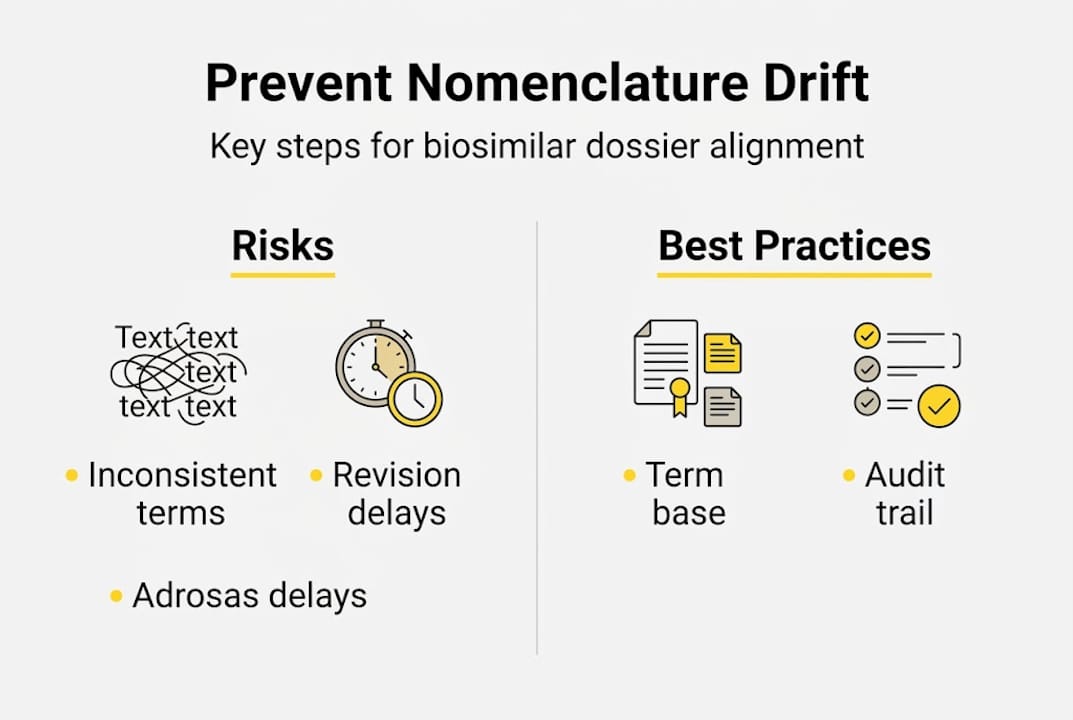
| Approach | Strengths | Compliance risk | Best fit | |—|—|—| | Manual alignment | Full human control | High: labor-intensive, drift probable at scale | Small submissions, single language | | Translation Memory systems | Consistency across repetitions | Medium: requires curated TM against reference product | Multi-language, versioned dossiers | | Terminology-governed AI+Human hybrid | Enforced term consistency, SME review, audit trail | Low when implemented with ISO 17100 and ISO 18587 QA | Centralized procedure, all EU languages |
Essential workflow checks for every biosimilar translation project:
Reference product terminology extraction: Before translation begins, extract all regulated terms from every approved reference product document in every target language.
Controlled glossary creation: Build a term base (TB) from those extracted terms and lock it as the mandatory source for the translation vendor.
Round-trip validation: For high-risk sections (SmPC Sections 1, 4.1, 4.2, 4.3, and labeling), run back-translation on translated output and compare against the reference product’s approved text.
QRD template pre-check: Map your translated SmPC and PIL against the current QRD template for each target language before submission, not after.
Cross-functional pre-submission review: Require sign-off from regulatory affairs, QA, and the translation project lead as a joint gate before dossier finalization.
As the Bildyos EPAR report establishes, the EMA requires precise matching of reference and biosimilar terms, particularly in multilingual contexts for dossier and PI submission.
Pro Tip: Request a blockchain-based audit trail from your translation vendor. When CHMP assessors ask how you guaranteed terminology consistency across 24 EU languages, a timestamped, immutable log of every term decision is the answer that closes the objection.
The real governance question is whether your vendor can enforce the term base you provided, not just receive it. Understanding clinical trial translation risks across EU sites shows the same enforcement gap. Review medical translation compliance requirements and use the eCTD Module 1 translation guide to structure your module-level review process.
Integrating nomenclature compliance into your EMA submission workflow
Strategies only work when they are embedded in how your team actually operates. Here is a submission-ready checklist and a concrete scenario showing how drift gets caught before it costs you.
Submission preparation checklist:
Assign a terminology tree owner: one person is accountable for maintaining the master glossary against the reference product’s approved multilingual documentation.
Source all regulated terms from approved reference product PI documents in each EU language, not from the English source text.
Deliver the finalized term base to your translation vendor before project kick-off, not during review.
Run QRD template compliance checks on every SmPC and PIL translation before dossier assembly.
Conduct a last-mile cross-functional review with regulatory, medical, QA, and translation sign-off as a mandatory gate.
Evaluate vendors against ISO 17100 and ISO 13485 certification and require demonstration of term base enforcement capability, not just acknowledgment.
Document every terminology decision with a date-stamped rationale for the regulatory file.
Case scenario: A biosimilar MAH preparing a centralized procedure submission detected, during the pre-submission QRD review, that the Hungarian PIL used a pharmacological class term that matched the originator’s 2019 approved text but not the 2023 variation-updated version held in the EMA database. The drift was two words. Catching it before submission required a two-day correction cycle. Missing it would have generated a Module 1 validation hold and a minimum six-week delay.
The lesson is that post-market surveillance translation creates the same ongoing risk after approval. Terminology governance cannot stop at initial submission.
“Early process ownership of nomenclature is the only intervention that systematically reduces repeat objections. Correcting drift after validation is damage control, not quality management.”
As the Bildyos EPAR documentation shows, procedural steps that flag documentation inconsistencies early are what keep primary analytical and quality comparability work from being undermined by avoidable documentation problems.
Why regulatory teams still trip on nomenclature—even when translation is ‘perfect’
Here is the uncomfortable pattern we see repeatedly: teams with experienced regulatory leads, strong analytical packages, and genuinely accurate translations still receive EMA objections on nomenclature. The failure is not linguistic. It is contextual.
The root cause is tunnel vision on fluency. When a translation reads correctly in the target language, it passes internal review. What it does not automatically do is match the specific approved terminology in the reference product’s NCA file. Those are two different standards, and conflating them is where even seasoned teams get caught.
Focusing solely on content accuracy, without legally cross-referencing every regulated term against the reference product’s approved multilingual record, creates a compliance gap that tools alone cannot close. A sophisticated NMT engine produces fluent, contextually appropriate output. It does not inherently know that the Hungarian regulatory authority’s preferred term for your pharmacological class changed in a 2022 variation to the originator’s label.
The answer is not better translation technology in isolation. It is a compliance-centered translation process where reference-product terminology alignment is a mandatory, documented workflow step. Understanding technical data translation risks from unvetted vendors shows why process accountability matters more than tool sophistication. Integrated processes, not individual tools, are what produce consistent EMA outcomes across multiple languages and submission cycles.
Expert support for biosimilar EMA submissions
Managing nomenclature alignment across 24 EU languages and multiple dossier modules is not a task that scales well with manual processes or general-purpose translation vendors.
AD VERBUM’s AI+HUMAN hybrid workflow is built for exactly this compliance context. The process starts with ingesting your client Translation Memories and Term Bases, including reference-product-sourced terminology. The proprietary LangOps System then generates output constrained by your approved glossary. A certified subject-matter expert with life sciences regulatory experience reviews for technical accuracy and QRD compliance. QA is aligned to ISO 17100 and ISO 18587, with ISO 13485 and ISO 27001 covering medical and data security requirements. If your biosimilar program needs structured, audit-ready biosimilar dossier translation or broader localization solutions across EU markets, contact AD VERBUM to discuss your submission timeline.
Frequently asked questions
What exactly causes nomenclature drift between reference and biosimilar documents?
Nomenclature drift typically happens when translated terms or regulatory abbreviations differ from those in the originator product’s approved documentation, often due to inconsistent use of QRD templates or uncontrolled glossaries. As the Bildyos EPAR confirms, QRD compliance failures in multilingual PI directly cause EMA validation hurdles.
How can regulatory teams detect nomenclature inconsistencies before submission?
Establishing a terminology alignment workflow, glossary control, and round-trip validation can catch drift before reaching the EMA. The EMA requires alignment for terms across reference and biosimilar dossiers, making pre-submission comparison against approved reference PI the critical control point.
Are there specific EU languages where terminology drift is more common?
Drift is most common in languages with less harmonized medical vocabularies or where non-standard abbreviations appear in local regulatory contexts. The Bildyos EPAR report identifies multilingual PI as a key risk area for nomenclature drift and EMA objections.
What is the EMA’s position on using AI or machine translation for biosimilar dossiers?
The EMA does not prohibit technology use but requires documented, quality-checked translation, especially for compliance-critical sections. As the Bildyos EPAR indicates, EMA assesses process controls and demonstrated compliance, not the specific technology used to produce a translation.
How can we ensure faster EMA validation of multilingual biosimilar dossiers?
By ensuring all nomenclature matches approved reference documents, pre-empting QRD template issues, and running joint regulatory and translation QA before submission. QRD template alignment and proactive pre-submission QA are the most direct levers for compressing the validation timeline.
Recommended