


Proprietary AI Translation: Ensuring Accuracy and Security

Over 60 percent of compliance teams in European companies report concerns about using american AI translation tools due to privacy and regulatory risks. High-stakes sectors like pharmaceuticals and legal services demand more than generic platforms for multilingual accuracy. This article breaks down why proprietary AI solutions built for European needs deliver the security, expert oversight, and terminology management that regulated industries require.
Table of Contents
Key Takeaways
Point | Details |
Proprietary AI Translation Technology | Offers superior context and accuracy through domain-specific training and robust terminology management compared to traditional methods. |
Security in AI Translation | Prioritize solutions with secure, private infrastructures to mitigate data leakage risks often associated with public cloud AI tools. |
Comprehensive Evaluation for High-Stakes Industries | Select translation technologies that meet regulatory standards and incorporate human oversight to ensure compliance and accuracy. |
Importance of Continuous Improvement | Adaptive learning processes enhance translation quality and client satisfaction by integrating expert feedback into workflows. |
Defining proprietary AI translation technology
Proprietary AI translation technology represents a sophisticated approach to language translation that goes far beyond traditional machine translation methods. Unlike public translation tools, these specialized systems are engineered to provide precise, secure, and contextually accurate language conversion for complex professional environments.
At its core, proprietary AI translation technology involves custom machine learning architectures that are specifically designed to understand and translate language with near-human comprehension. These systems differ fundamentally from generic neural machine translation (NMT) by incorporating several critical features:
Domain-specific training: Models trained exclusively on industry-specific datasets
Terminology management: Integrated glossary and style guide enforcement
Privacy controls: Secure, closed-loop translation workflows
Adaptive learning: Continuous improvement through expert feedback
The technological foundation of these systems typically involves advanced deep learning techniques, particularly transformer architectures that enable nuanced contextual understanding. AD VERBUM’s proprietary AI, for instance, can distinguish between technical terminology in medical, legal, and scientific domains with remarkable precision. This approach ensures that critical documents maintain their original meaning, technical accuracy, and regulatory compliance.
Professional Tip: When evaluating AI translation technologies, prioritize solutions that offer domain-specific training and robust terminology management over generic translation tools.
Comparing legacy MT, public NMT, and LLM approaches
Translation technologies have undergone significant evolution, with each generation presenting unique capabilities and limitations. Legacy machine translation systems represent the earliest attempts at automated language conversion, characterized by rule-based and statistical approaches that struggled with contextual nuance and linguistic complexity.
Neural machine translation (NMT) marked a substantial improvement, introducing deep learning techniques that could generate more fluent translations. However, NMT models typically operate at the sentence level, often producing translations that lack document-wide consistency. These public NMT tools, while advanced, frequently encounter challenges with:
Inconsistent terminology across documents
Limited domain-specific understanding
Potential data privacy risks
Inability to maintain complex linguistic context
Large language models (LLMs) represent the most sophisticated translation approach, offering unprecedented linguistic comprehension. Unlike previous technologies, AD VERBUM’s proprietary LLM can understand broader context, adapt to specific professional domains, and maintain terminological consistency across entire documents. These models leverage multitask learning and complex neural architectures to generate translations that approach human-level precision and contextual understanding.
Here’s a concise comparison of key translation technology generations:
Technology Type | Context Awareness | Domain Adaptability | Data Security Approach |
Legacy MT | Minimal, phrase-based | Rarely customizable | Basic, often local storage |
Public NMT | Sentence-level | Limited by training data | Relies on public cloud, risks |
Proprietary LLM | Full document-level | Highly domain-specific | Private, secure infrastructure |
Pro Tip: When selecting a translation technology, prioritize solutions that demonstrate domain-specific training and comprehensive contextual understanding over generic, one-size-fits-all approaches.
How proprietary LLM-driven translation workflows operate
Proprietary AI translation workflows represent a sophisticated approach to language conversion that goes far beyond traditional translation methods. These advanced systems are meticulously designed to emulate human translation processes through a complex, multi-stage approach that ensures both accuracy and security.
The workflow typically begins with comprehensive contextual research, where the AI model performs an in-depth analysis of the source document. This initial stage involves:
Background context investigation
Terminology identification
Potential challenge detection
Domain-specific nuance mapping
Once the contextual groundwork is established, the AI+HUMAN translation process moves into its drafting phase. Unlike traditional neural machine translation systems, AD VERBUM’s proprietary LLM generates an initial translation that prioritizes meaning preservation and contextual integrity. The system employs a hybrid approach, strategically selecting between computationally efficient neural machine translation for straightforward segments and more complex large language model processing for nuanced content.

The final stages involve rigorous quality assurance, including multiple rounds of refinement, terminology enforcement, and expert human review. This ensures that each translation maintains precise technical accuracy, adheres to specific industry terminology, and meets the highest standards of linguistic precision required in regulated fields such as pharmaceutical, legal, and technical documentation.
Pro Tip: Implement a comprehensive review protocol that combines AI precision with human expertise to maximize translation quality and minimize potential errors.
Terminology enforcement and regulatory compliance in practice
Terminology management represents the critical backbone of secure and accurate translation in highly regulated industries. AD VERBUM approaches this challenge through a comprehensive system that integrates specialized translation memory systems with advanced AI technologies, ensuring absolute precision and regulatory adherence.
The terminology enforcement process involves multiple sophisticated layers:
Terminology Database Creation: Developing industry-specific glossaries with precise, approved terminology
AI Model Training: Configuring proprietary language models to strictly adhere to client-specific vocabulary
Contextual Term Validation: Ensuring terms are used correctly across different document contexts
Compliance Mapping: Aligning terminology with specific regulatory requirements
In practice, AD VERBUM’s AI+HUMAN workflow implements rigorous checks to guarantee compliance. The proprietary LLM not only recognizes approved terms but understands their nuanced application across different technical domains. This means a medical device term will be translated differently in a clinical research document versus a manufacturing specification, maintaining both linguistic accuracy and regulatory precision.
The final stage involves expert human review, where certified subject matter experts verify that every translated term meets the strictest industry standards. This multi-layered approach eliminates potential misinterpretations and ensures that translations are not just linguistically correct, but legally and technically robust.
Pro Tip: Develop a comprehensive terminology management strategy that combines AI precision with human expertise to maintain absolute translation accuracy across complex professional domains.
Risks of data leakage with public cloud AI tools
Public cloud AI tools represent a significant security vulnerability for organizations handling sensitive information. Critical security vulnerabilities persist across multiple dimensions, exposing enterprises to substantial data integrity and confidentiality risks that extend far beyond traditional cybersecurity concerns.
These security risks manifest through several critical pathways:
Unintentional Data Exposure: Sensitive information inadvertently shared during AI interactions
Infrastructure Vulnerabilities: Misconfigured cloud services creating unauthorized access points
Prompt Data Retention: Potential storage and indexing of confidential user inputs
Model Inversion Attacks: Techniques that can reconstruct sensitive training data
AD VERBUM’s proprietary approach fundamentally differs from public cloud solutions by implementing a closed-loop system with stringent security protocols. Unlike generic AI platforms that store user prompts and potentially expose organizational data, our AI+HUMAN workflow ensures that every translation interaction remains completely isolated within secure, EU-based infrastructure. This approach eliminates the risk of data leakage, unauthorized access, and potential misuse of sensitive corporate or regulatory information.
The technical infrastructure supporting this security model involves multiple layers of protection, including end-to-end encryption, strict access controls, and continuous security monitoring. By maintaining complete data sovereignty and avoiding public cloud dependencies, AD VERBUM provides a translation solution that meets the most demanding compliance requirements in regulated industries.
Pro Tip: Always conduct a comprehensive security assessment of AI translation tools, prioritizing solutions with dedicated, private infrastructure and transparent data handling practices.
Selecting compliant AI translation for high-stakes industries
Selecting an appropriate AI translation solution for regulated industries requires a meticulous evaluation process that goes beyond standard linguistic capabilities. Top AI+Human hybrid tools must demonstrate robust compliance mechanisms that protect sensitive information while delivering precise, contextually accurate translations.
Critical selection criteria for high-stakes translation technologies include:
Regulatory Certification: Adherence to ISO 17100 and ISO 27001 standards
Expert Human Oversight: Integration of certified domain specialists
Secure Infrastructure: Dedicated, private translation environments
Terminology Management: Strict client-specific vocabulary control
Auditability: Comprehensive translation process traceability
AD VERBUM’s proprietary AI+HUMAN workflow distinguishes itself by implementing a multilayered approach that prioritizes both technological precision and human expertise. Unlike generic translation platforms, our solution provides a comprehensive translation ecosystem engineered specifically for industries with stringent compliance requirements such as pharmaceuticals, legal services, and medical research.
The selection process demands a holistic assessment that evaluates not just translation accuracy, but the entire workflow’s ability to maintain data integrity, protect confidential information, and deliver consistently precise results. This means looking beyond surface-level linguistic performance and examining the underlying technological architecture, security protocols, and human validation mechanisms.
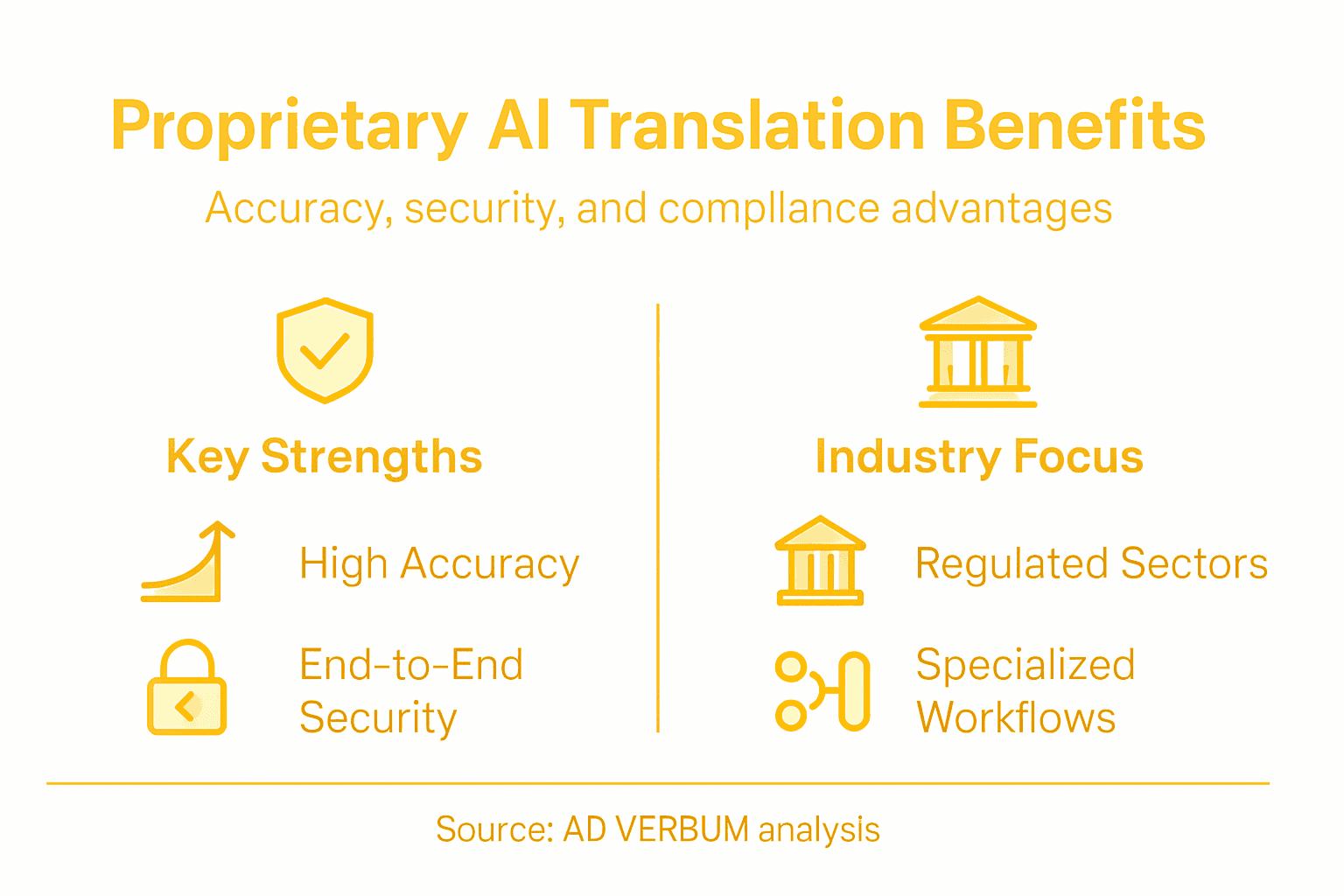
Below is a summary of must-have features for AI translation in regulated industries:
Requirement | Business Value | Example in Practice |
Regulatory Certification | Ensures legal and audit compliance | ISO 17100, ISO 27001 |
Secure Infrastructure | Protects client confidentiality | Private EU-based data centers |
Human Expert Oversight | Catches AI errors in critical content | Certified translators review output |
Terminology Management | Maintains brand and technical accuracy | Custom glossaries for each client |
Pro Tip: Develop a rigorous evaluation framework that assesses AI translation tools across technical capabilities, security infrastructure, regulatory compliance, and domain-specific expertise.
Ensure Accuracy and Security with AD VERBUM’s Proprietary AI+HUMAN Translation
The article highlights critical challenges companies face when handling sensitive, regulated content — the risk of data leakage, inconsistent terminology, and the inability of public AI tools to guarantee compliance and context-aware precision. Readers seeking solutions can trust AD VERBUM’s proprietary LLM-based AI+HUMAN workflow, purpose-built to meet the highest standards in Life Sciences, Legal, Finance, and Manufacturing sectors.
Our secure EU-hosted environment ensures zero data leakage, while domain-specific terminology enforcement eliminates costly errors. Backed by 25+ years of industry experience and rigorous certifications like ISO 17100 and ISO 27001, AD VERBUM transforms translation into a reliable compliance asset rather than a liability. Discover how our process integrates your existing translation memories with AI-driven contextual understanding and expert human refinement.
Explore our comprehensive approach to regulated translation at AD VERBUM and learn why companies demanding precision choose the safest, most accurate AI+HUMAN solution. Don’t risk your critical documents with generic tools when you can partner with technology and expertise built for compliance. Visit AD VERBUM specialized AI translation today to safeguard your content with confidence.
Frequently Asked Questions
What is proprietary AI translation technology?
Proprietary AI translation technology refers to advanced language translation systems designed specifically for professional environments, providing precise, secure, and contextually accurate translations that differ from generic tools.
How does proprietary AI translation differ from traditional machine translation?
Proprietary AI translation systems utilize custom machine learning architectures, domain-specific training, and robust terminology management to achieve better context awareness and accuracy compared to traditional methods.
What are the benefits of using proprietary AI translation for regulated industries?
These systems ensure accuracy, protect sensitive information through privacy controls, and maintain compliance with industry-specific regulations, making them ideal for fields such as pharmaceuticals and legal services.
How do proprietary AI translation workflows ensure data security?
Proprietary workflows implement a closed-loop system with secure, private infrastructures that protect against data leakage and unauthorized access, unlike public cloud AI tools that may expose sensitive information.
Recommended
