Master Regulated Document Translation Workflow for Compliance

Over 80 percent of regulatory delays in European pharmaceutical audits trace back to translation inconsistencies that could have been avoided with comprehensive asset integration. For compliance managers striving to meet American and European standards, every gap in terminology or formatting accuracy brings risk of noncompliance. This guide unpacks each strategic step in building a flawless translation workflow combining human expertise with proprietary AI, helping you protect your organization’s credibility and stay audit-ready at all times.
Table of Contents
Quick Summary
Key Point | Explanation |
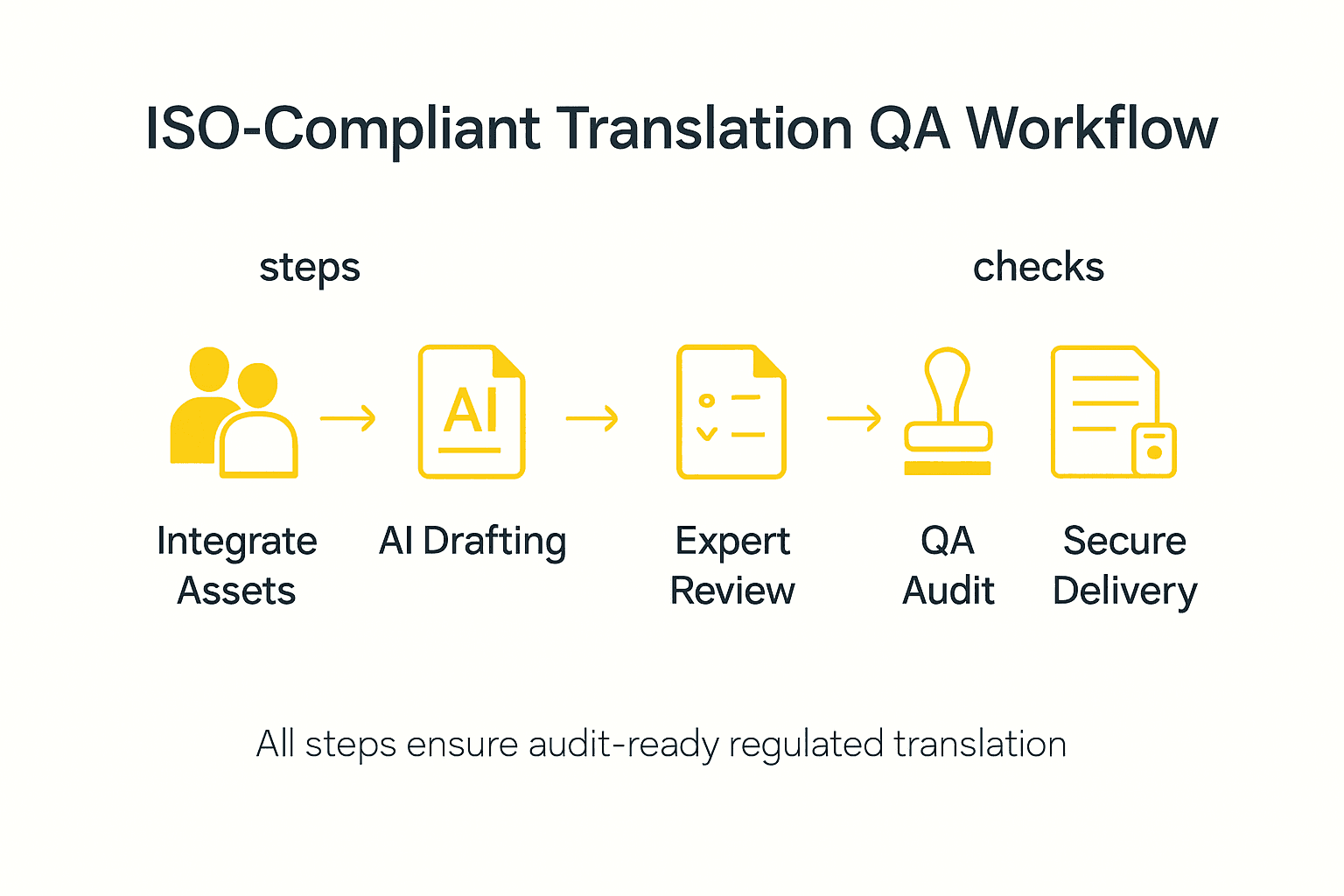
1. Consolidate Translation Assets | Gather and standardize all existing linguistic resources to ensure consistency across multilingual documents. |
2. Implement AI for Drafting | Leverage proprietary Large Language Model technology to draft initial document versions with human oversight to enhance productivity. |
3. Expert Review is Crucial | Engage subject matter experts to meticulously review AI-generated drafts for accuracy and compliance with industry standards. |
4. Enforce Quality Assurance Checks | Implement ISO-compliant verification procedures to validate all translated documents, ensuring they meet international standards. |
5. Final Approval and Secure Delivery | Establish a systematic final review and approval process alongside secure transmission to ensure document integrity and confidentiality. |
Step 1: Integrate Essential Translation Assets
Successfully building a robust translation workflow depends on strategic integration of key language resources. In this critical phase, you will consolidate and prepare essential translation assets that form the foundation of precise multilingual documentation.
The process begins by comprehensively cataloging your existing linguistic resources. Translation ecosystem frameworks recommend analyzing resources across micro, meso, and macro organizational levels, which means examining translation memories, terminology databases, style guides, and review protocols from multiple perspectives. Start by gathering all translation memories from previous projects tracking technical terminology specific to your industry. This includes medical device documentation, pharmaceutical research protocols, or regulatory compliance materials.
Next, consolidate your terminology databases ensuring consistent language usage across different documents and translation projects. Focus on creating a centralized repository that captures industry specific terminology, brand vocabulary, and regulatory language nuances. An integrated AI+HUMAN workflow will leverage these assets to maintain precision and contextual accuracy.
Pro Tip: Invest time in cleaning and standardizing your translation assets before integration to prevent potential inconsistencies in future translation projects.
Here’s a summary of critical translation assets and their business impact:
Asset Type | Key Function | Business Impact |
Translation Memories | Store legacy translations | Ensure terminology consistency |
Terminology Databases | Centralize key vocabulary | Support regulatory compliance |
Style Guides | Maintain formatting rules | Safeguard brand identity |
Review Protocols | Standardize quality checks | Reduce error risk and rework |
Step 2: Deploy Proprietary LLM-Based AI for Drafting
In this critical phase, you will strategically implement AD VERBUM’s proprietary Large Language Model to generate precise initial document drafts for regulated industries. This step transforms your translation workflow by leveraging advanced AI technology with rigorous human oversight.

Researchers are now permitted to use proprietary LLM-based AI tools to draft and improve document readability while maintaining strict accountability. Begin by configuring the AI system with your specific industry terminology and compliance requirements. The AI+HUMAN workflow demands meticulous setup where the proprietary LLM understands domain specific nuances such as medical terminology, regulatory language, or technical specifications unique to your field.
Next, implement a structured drafting process where the AI generates initial content drafts. Recent studies demonstrate that LLM-powered planning facilitates iterative revisions and improves overall productivity without increasing cognitive load. Your subject matter experts will then review and refine the AI-generated drafts ensuring absolute precision and regulatory compliance. This approach combines technological efficiency with human expertise critical for high stakes documentation.
Pro Tip: Configure granular instructions and style guidelines into your proprietary LLM to ensure consistent terminology and formatting across all generated documents.
Step 3: Refine Output with Subject-Matter Expert Review
This critical phase transforms AI generated drafts into precision compliant documents through meticulous human expertise. Your subject matter experts will conduct a comprehensive review ensuring absolute accuracy and regulatory alignment.
Begin the refinement process by assembling a review team with specialized knowledge in your specific regulatory domain. Each expert should systematically evaluate the AI generated draft against multiple critical parameters [using the AD VERBUM benefits of proprietary AI translation framework]. Focus on verifying technical terminology, ensuring regulatory compliance, checking contextual accuracy, and maintaining the precise language nuances required for your industry.
Implement a structured review workflow where experts annotate potential modifications directly within the document. This collaborative approach allows for granular corrections while maintaining the efficiency gains from initial AI drafting. Pay special attention to domain specific language, regulatory requirements, and technical specifications that demand absolute precision. The goal is to combine technological efficiency with human intellectual oversight.
Pro Tip: Create a standardized review checklist with weighted evaluation criteria to streamline the subject matter expert refinement process and ensure consistent quality across different document types.
Step 4: Execute Rigorous ISO-Compliant Quality Assurance
This crucial phase transforms your translation workflow into an audit-ready, precision-driven process that meets the most stringent international standards. Your goal is to implement comprehensive quality controls that validate every aspect of the translated document.
International standards for translation services mandate documented workflows with pre and post production controls that ensure absolute accuracy. Implement a multilayered verification process that includes linguistic validation, technical accuracy checks, and regulatory compliance assessments. Use 7 steps to develop a rigorous translation quality checklist that covers terminology consistency, formatting precision, and contextual integrity. The AI+HUMAN workflow requires systematic human review to validate and refine the AI generated content across multiple dimensions.
Establish a structured quality assurance protocol that includes side by side comparisons with source documents, specialized linguistic forensics, and domain specific expert evaluations. Your review should systematically eliminate potential errors while maintaining the original document’s technical nuance and regulatory compliance. This meticulous approach guarantees that every translated document meets the highest international standards of accuracy and reliability.
Pro Tip: Create a weighted scoring system for quality assessment that assigns different importance levels to various translation elements to streamline your review process.
Step 5: Ensure Final Approval and Secure Delivery
This pivotal stage transforms your meticulously translated document into a fully compliant deliverable ready for official submission. Your objective is to implement a comprehensive final validation process that guarantees absolute accuracy and regulatory adherence.
The Translation Centre workflow emphasizes multi stage quality checks with role based approval protocols to ensure ultimate document integrity. Initiate a structured final review where multiple authorized subject matter experts perform independent assessments. Implement a systematic approval workflow that includes document sign off by technical specialists compliance officers and linguistic experts. The AI+HUMAN process requires rigorous human verification to confirm that every aspect of the translation meets the most stringent regulatory standards.
Execute a secure delivery protocol that maintains full documentation of the translation process. Create comprehensive audit trails tracking each modification review and approval stage. Use encrypted transmission channels to protect sensitive information and ensure that the final document reaches authorized recipients through secure communication pathways. This approach not only safeguards your intellectual property but also demonstrates your commitment to regulatory compliance and data protection.
This table compares traditional human-only workflows against AI+Human workflows in regulated translation projects:
Aspect | Human-Only Workflow | AI+Human Workflow |
Speed | Moderate to slow | Significantly faster |
Consistency | Varies by reviewer | Systematic terminology use |
Compliance | Manual validation needed | Automated assistance, review |
Audit Trail | Limited documentation | Comprehensive records |
Pro Tip: Develop a standardized final approval checklist with digital signature protocols to streamline the review process and create an immutable record of document validation.
Elevate Your Regulated Document Translation with AD VERBUM’s AI+HUMAN Expertise
Mastering a regulated document translation workflow requires more than technology it demands absolute precision, stringent compliance, and airtight data security. This article highlights the complex challenges of integrating translation assets, deploying proprietary LLM-based AI drafting, and ensuring ISO-compliant quality assurance. Companies in Life Sciences, Legal, Finance, and Manufacturing face critical risks if terminology is inconsistent or sensitive data is exposed. AD VERBUM’s proprietary AI ecosystem is designed specifically to address these exact pain points with an industry-leading AI+HUMAN workflow.
Our secure environment guarantees zero data leakage by operating exclusively on ISO 27001 certified EU servers, fully complying with GDPR and HIPAA. Unlike public NMT tools prone to hallucinations and data breaches, AD VERBUM’s proprietary Large Language Model enforces strict terminology control across all document drafts. Supported by over 3,500 subject-matter experts, we integrate your existing Translation Memories and Terminology Databases to deliver precision without compromise.
Take control of your regulated translation process today by partnering with AD VERBUM. Discover how our proven specialized AI translation services align perfectly with the comprehensive workflow steps outlined in this article. Ensure your documents are compliant, secure, and delivered faster than ever. Visit AD VERBUM now for a consultation and elevate your translation compliance to the highest standard.
Frequently Asked Questions
How can I effectively integrate essential translation assets for regulated document translation?
To effectively integrate essential translation assets, start by cataloging existing resources, such as translation memories, terminology databases, and style guides. Focus on creating a centralized repository that captures industry-specific terminology and brand vocabulary to ensure consistency across documents.
What steps should I follow to deploy an AI-based workflow for drafting regulated documents?
Begin by configuring your proprietary Large Language Model with specific terminology and compliance requirements relevant to your industry. Then, implement a structured drafting process where the AI produces initial content drafts, followed by a review by subject matter experts to ensure precision and compliance.
How do I refine AI-generated drafts to meet compliance standards?
Refine AI-generated drafts by assembling a review team of subject matter experts in your regulatory domain. Have them systematically evaluate the drafts against key parameters, such as technical terminology and regulatory compliance, and annotate potential modifications directly within the document.
What does an ISO-compliant quality assurance process for translation involve?
An ISO-compliant quality assurance process involves implementing comprehensive quality controls that validate every aspect of the translated document. This includes multilayered verification checks for linguistic accuracy, technical correctness, and regulatory alignment to ensure the highest standards.
How can I ensure final approval and secure delivery of regulated documents?
Ensure final approval by having multiple authorized subject matter experts perform independent assessments of the document. Implement a secure delivery protocol that maintains documentation of the translation process, including comprehensive audit trails for all reviews and approvals.
Recommended