


Why Regulated Industries Need Specialized Translation

A single translation error in regulated environments can cost organizations millions in penalties. European Regulatory Affairs Managers know the stakes, especially when balancing local requirements with american standards in documentation. Precision is not just preferred, it is non-negotiable for compliance and risk mitigation. This guide sheds light on how specialized translation processes address those high-risk gaps, ensuring accuracy and protection when it matters most.
Table of Contents
Key Takeaways
Point | Details |
Specialized Translation Requirement | Expertise in subject-specific terminology and regulatory frameworks is essential for accurate translation in regulated industries. |
Importance of AI+HUMAN Workflow | Combining AI capabilities with human oversight ensures high accuracy and compliance, making it ideal for high-stakes translations. |
Risks of Public MT Tools | Public machine translation tools pose significant risks in regulated environments due to their lack of domain-specific understanding and potential inaccuracies. |
Terminology Management | Maintaining an updated industry-specific terminology database is crucial for achieving consistent and compliant translations across regulated sectors. |
Defining Specialized Translation for Regulated Industries
Specialized translation is far more than simple language conversion—it represents a precision-engineered linguistic process designed for high-stakes environments where accuracy is paramount. Unlike general translation, specialized translation demands profound subject matter expertise, particularly in regulated industries like healthcare, legal, and technical sectors. Comprehensive translation research underscores the critical nature of this discipline, highlighting how specialized translators must possess deep understanding of sector-specific terminology and regulatory frameworks.
In regulated industries, translation is not merely about linguistic accuracy but about maintaining compliance, preventing potential legal risks, and ensuring absolute fidelity to technical specifications. Translators working in these domains must have advanced qualifications—often including professional certifications, academic backgrounds in specific fields, and extensive industry experience. For instance, a medical device translation requires translators who understand complex medical terminology, regulatory guidelines like MDR, and the intricate technical specifications of healthcare equipment.
The core characteristics of specialized translation include hyper-precise terminology management, strict adherence to industry-specific style guides, and comprehensive understanding of contextual nuances. Translators must navigate complex regulatory landscapes, ensuring that every translated document meets stringent compliance requirements. This means going beyond literal translation to capture regulatory intent, technical precision, and sector-specific communication standards.
Pro tip: Always verify a translator’s specialized credentials and domain-specific certifications before engaging them for high-stakes translation projects.
Types of Regulatory Environments and Impacts
Regulatory environments represent complex ecosystems of legal, technical, and compliance frameworks that fundamentally shape how organizations operate across different industries. A comprehensive comparative analysis of global regulatory regimes reveals significant variations in regulatory structures that can dramatically impact business strategies, innovation potential, and cross-border operational capabilities.
The primary regulatory environments typically include healthcare, financial services, manufacturing, information technology, and environmental sectors. Each domain features unique compliance requirements that demand specialized translation approaches. Healthcare regulations, for instance, mandate absolute precision in medical documentation, where even minor linguistic errors could compromise patient safety or violate international medical device standards. Financial services regulations require translators to understand complex legal terminology, ensuring that investment documents, compliance reports, and contractual agreements maintain their legal integrity across different jurisdictions.
Different regulatory environments also impose varying levels of linguistic complexity and technical specificity. Manufacturing sectors like automotive and aerospace require translations that capture intricate technical specifications, safety protocols, and engineering standards. Information technology regulations increasingly focus on data protection, privacy standards, and cross-border digital compliance, adding layers of linguistic and legal nuance to translation requirements. Environmental regulations present another challenging landscape, demanding translations that accurately convey scientific terminology, policy implications, and technical environmental standards.

Pro tip: Develop a comprehensive understanding of sector-specific regulatory requirements before initiating any specialized translation project to ensure complete compliance and accuracy.
Here’s a comparison of translation requirements across typical regulated industries:
Industry | Regulatory Focus | Key Translation Challenges |
Healthcare | Patient safety, compliance | Complex terminology, risk of clinical errors |
Financial Services | Legal integrity | Legalese, cross-jurisdiction compliance |
Manufacturing | Technical standards | Engineering specs, accuracy in safety instructions |
Information Tech | Data privacy, cybersecurity | Technical jargon, sensitive information handling |
Environmental | Policy adherence | Scientific accuracy, policy implications |
AI+HUMAN Workflow for Compliance and Accuracy
The AI+HUMAN workflow represents a revolutionary approach to translation in regulated industries, combining cutting-edge artificial intelligence with expert human oversight. An advanced compliance framework leveraging large language models demonstrates how this integrated approach can transform traditional translation processes by providing unprecedented accuracy, scalability, and regulatory compliance.
At the core of the AI+HUMAN workflow is a sophisticated process that begins with AI-powered initial translation, followed by meticulous human expert review. This methodology addresses the critical limitations of purely automated or purely human translation approaches. Artificial intelligence can rapidly process vast amounts of technical documentation, generating initial translations with remarkable speed and broad linguistic coverage. However, human experts provide the nuanced contextual understanding, domain-specific expertise, and regulatory knowledge essential for ensuring absolute precision in specialized fields like healthcare, legal, and technical documentation.
The workflow’s effectiveness is particularly evident in highly regulated industries where translation accuracy can have significant legal and operational implications. Professional analysis of AI adoption in compliance functions reveals that combining AI’s computational power with human expertise creates a robust system of checks and balances. This approach not only enhances translation accuracy but also provides enhanced auditability, allowing organizations to track and validate each step of the translation process. The human component becomes a critical quality assurance mechanism, interpreting complex regulatory requirements and ensuring that the AI-generated translations maintain the highest standards of precision and compliance.
Pro tip: Implement a continuous feedback loop in your AI+HUMAN translation workflow to progressively improve translation accuracy and regulatory compliance.
Below is a summary of unique strengths in AI, human, and AI+HUMAN translation workflows:
Approach | Strengths | Limitations |
AI Only | Speed, volume, initial coverage | Lacks nuance, compliance |
Human Only | Context, expertise, precision | Slower, less scalable |
AI+HUMAN Combined | Accuracy, regulatory auditability | Requires integration |
Risks of Public MT Versus Proprietary LLM AI
The landscape of machine translation is dramatically transformed by the critical distinctions between public machine translation (MT) and proprietary large language model (LLM) AI systems. Comparative research in specialized domains reveals profound risks associated with relying on public translation tools, especially in regulated industries where precision is paramount.
Public machine translation platforms like Google Translate and DeepL present multiple critical vulnerabilities for regulated sectors. These systems operate on generalized language models that lack domain-specific understanding, creating significant risks of terminology misinterpretation, contextual errors, and potential data privacy breaches. In technical fields such as medical research, legal documentation, and complex engineering specifications, these translation tools can introduce subtle but potentially catastrophic inaccuracies. The generalized nature of public MT means they often lack the nuanced understanding required to maintain regulatory compliance, potentially exposing organizations to substantial legal and operational risks.
Proprietary LLM AI systems, by contrast, offer a fundamentally different approach to translation. These advanced systems are developed with strict controls, domain-specific training, and integrated human oversight mechanisms. Unlike public MT, proprietary LLM solutions can be precisely calibrated to specific industry requirements, maintaining strict terminology consistency, understanding complex contextual nuances, and adhering to rigorous data protection standards. The machine translation risks analysis highlights how proprietary systems create multiple layers of verification and quality control that public tools simply cannot match, making them essential for industries where translation accuracy directly impacts safety, compliance, and operational integrity.
Pro tip: Always conduct a comprehensive risk assessment of translation tools, prioritizing systems with demonstrable domain-specific expertise and robust privacy protections.
How Specialized Translation De-Risks Compliance
Specialized translation serves as a critical risk mitigation strategy for organizations operating in highly regulated industries, transforming potential linguistic vulnerabilities into robust compliance frameworks. Translation accuracy strategies for regulated content demonstrate that precise language conversion goes far beyond simple word-for-word translation, acting instead as a comprehensive compliance safeguard.
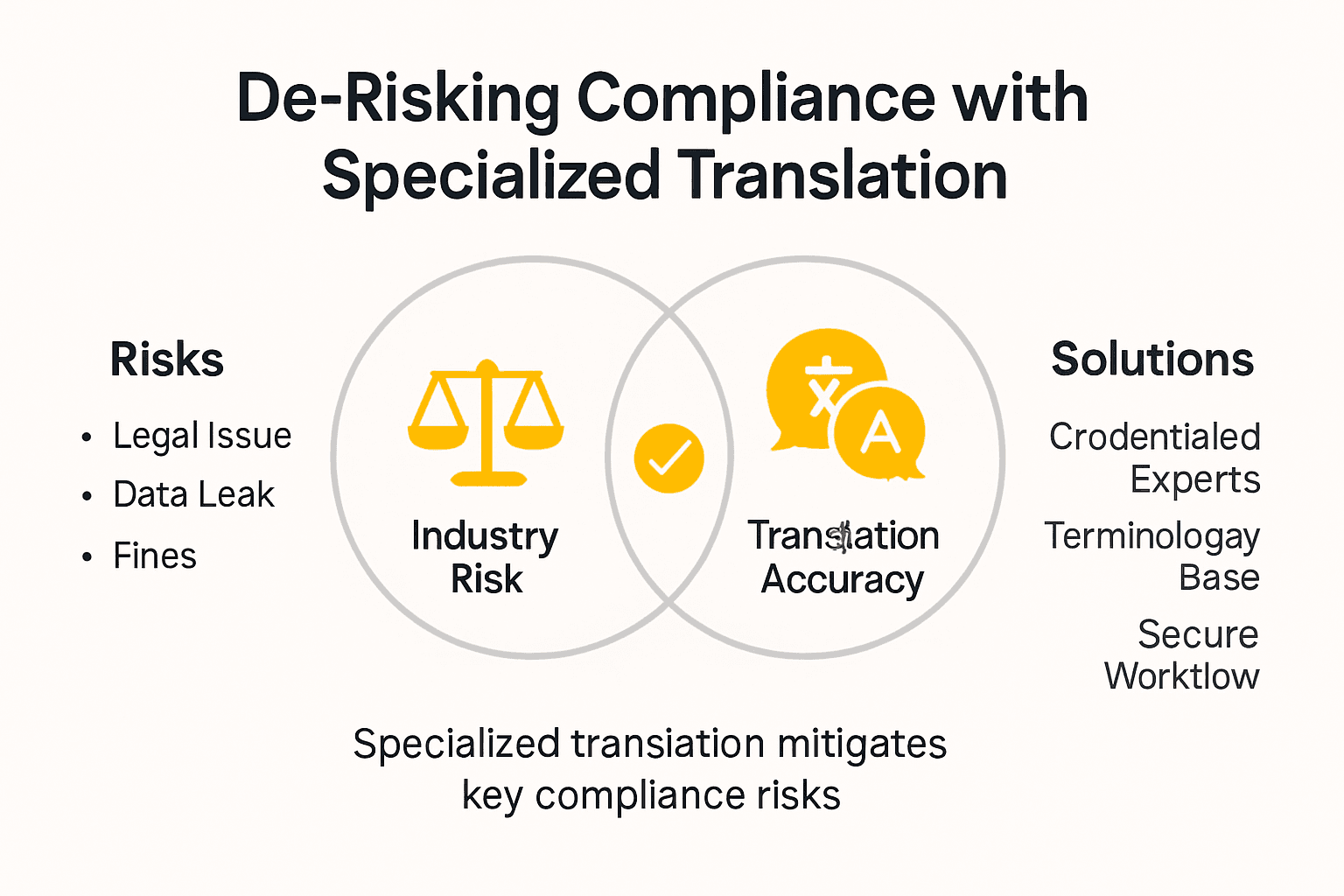
In regulated sectors like healthcare, pharmaceuticals, legal services, and medical devices, even minor linguistic imprecisions can trigger substantial operational, legal, and financial risks. Specialized translation addresses these critical challenges through multiple strategic approaches. First, it employs translators with deep domain-specific expertise who understand not just language nuances, but the intricate regulatory landscape of their specific industry. These professionals possess technical knowledge that allows them to interpret and translate complex terminology with absolute precision, ensuring that regulatory intent is perfectly preserved across linguistic boundaries.
The de-risking process in specialized translation involves multiple sophisticated mechanisms beyond traditional translation practices. This includes comprehensive terminology management, where industry-specific glossaries are meticulously developed and maintained, ensuring consistent and accurate translation of technical terms. Advanced quality assurance processes, including multi-stage review protocols, contextual validation, and expert human oversight, create layers of verification that systematically eliminate potential misinterpretation risks. Particularly in sectors with stringent compliance requirements, such comprehensive translation workflows serve as a proactive defense mechanism against potential regulatory violations, financial penalties, and reputational damage.
Pro tip: Develop a comprehensive terminology database specific to your industry and continuously update it with input from subject matter experts to maintain translation accuracy and compliance.
Ensuring Compliance and Accuracy with AD VERBUM’s Specialized AI+HUMAN Translation
The challenges faced by regulated industries in needing precise, compliant translation are complex and critical. As the article highlights, mistranslations in healthcare, legal, or manufacturing sectors can lead to costly legal risks and jeopardize safety. Key concerns include maintaining strict terminology enforcement and navigating nuanced regulatory requirements. Public machine translation lacks the domain-specific expertise and data security necessary to meet these demands.
AD VERBUM addresses these pain points with a proprietary LLM-based AI combined with expert human oversight in a secure, ISO-certified environment. Our AI+HUMAN workflow guarantees absolute accuracy, enforces your approved terminology, and protects sensitive information without compromise. With over 25 years of experience, 3,500+ subject matter experts, and 150+ supported languages, we provide the precision and compliance demanded by Life Sciences, Legal, Finance, and Manufacturing sectors.
Ready to minimize risk and enhance translation quality for your regulated content Visit us at AD VERBUM to discover how our specialized AI translation services deliver speed and safety that public MT tools cannot match. Take the first step toward secure, compliant multilingual communication with AD VERBUM’s proven AI+HUMAN approach today.
Frequently Asked Questions
What is specialized translation in regulated industries?
Specialized translation refers to the precise linguistic process tailored specifically for high-stakes sectors such as healthcare, legal, and technical fields. It involves a deep understanding of subject-specific terminology and regulatory frameworks to ensure accuracy and compliance.
Why is accuracy crucial in specialized translation for regulated industries?
Accuracy is paramount because even minor linguistic errors can lead to severe consequences, including legal issues, operational failures, and risks to patient safety in healthcare. Maintaining compliance with industry regulations is essential to avoid penalties and liability.
How can organizations ensure compliance when using specialized translation services?
Organizations can ensure compliance by working with translators who possess relevant qualifications and domain expertise. Additionally, implementing rigorous quality assurance processes, including terminology management and multi-stage reviews, helps maintain translation precision and regulatory adherence.
What are the risks of using public machine translation in regulated industries?
Public machine translation tools often lack domain-specific understanding and can introduce significant risks, such as terminology misinterpretation and compliance failures. Using proprietary large language model (LLM) AI systems is recommended for higher accuracy and data protection.
Recommended
