


Translation Memory Explained: Accuracy, Security, Impact

Over 85 percent of regulated American pharmaceutical documentation depends on translation memory for quality and compliance. As global expansion increases, Localization Managers must address misconceptions about how these tools impact regulatory submissions and technical manuals. This article clarifies the real functionality, risks, and security strategies behind translation memory, helping you achieve precision and protect sensitive data in every translated clinical document.
Table of Contents
Key Takeaways
Point | Details |
Translation Memory is a Support Tool | Translation Memory ™ enhances human translation by storing and suggesting previously translated segments, not performing automatic translations. |
Types of Translation Memory | TM can be segment-based or context-aware, with advanced systems integrating AI and terminology databases for improved accuracy. |
AI+HUMAN Workflow | Combining AI capabilities with human expertise leads to high-quality translations, especially in regulated industries requiring precision. |
Risks and Innovations | Challenges of TM include reliance on static data; innovative AI solutions like dynamic memory systems can mitigate these risks. |
Translation memory basics and misconceptions
A translation memory ™ is a sophisticated linguistic database that stores previously translated text segments, enabling translators to leverage past translations for increased efficiency and consistency. Unlike common misconceptions, TM is not an automatic translation tool but a strategic resource that supports human translators in their work.
The fundamental purpose of translation memory is to capture and reuse translated text segments across multiple projects. Understanding translation memory’s core functionality reveals that it serves as a sophisticated linguistic repository, not a replacement for human translation expertise. When a translator encounters a segment similar to a previously translated piece, the TM suggests matching or near-matching translations, which can then be reviewed and adapted by the linguist.
Many professionals misunderstand translation memory as a fully automated solution. In reality, TM is a collaborative tool that enhances human translation processes. It stores translated segments in language pairs, allowing translators to quickly reference and adapt previous work. This approach significantly reduces redundant translation efforts and maintains terminology consistency across complex documents.
Pro tip: When implementing translation memory, invest time in initial setup and maintenance to ensure high-quality segment matches and consistent terminology across your translation workflows.
Types of translation memory and asset integration
Translation memory systems are sophisticated linguistic technologies that extend far beyond simple text storage. These systems encompass multiple types of memory integration, designed to support translators in creating more accurate and consistent translations. Recent research examining TM integration reveals a spectrum of approaches ranging from narrow database definitions to comprehensive translation ecosystems.
Translation memory types can be categorized based on their integration capabilities. The primary types include segment-based memories, which store exact text segments, and context-aware memories that consider surrounding linguistic context. Some advanced systems integrate machine translation and terminology databases to provide translators with multiple contextual translation options, enhancing both productivity and translation quality.

The asset integration process typically involves connecting translation memories with terminology databases, style guides, and quality assurance tools. Proprietary translation memory systems like those used by AD VERBUM allow for deep integration of existing client assets, enabling translators to leverage previous translations while maintaining strict adherence to industry-specific terminology and style requirements. This approach ensures consistency across complex translation projects, particularly in regulated industries like pharmaceuticals and legal services.
Here’s how translation memory types differ in functionality and integration:
TM Type | Core Functionality | Integration Level | Typical Use Case |
Segment-Based | Stores exact text segments | Basic database connectivity | Repetitive legal contracts |
Context-Aware | Considers linguistic context | Advanced system integration | Technical manuals and documentation |
AI-Integrated | Suggests translations using AI | Deep asset and AI linkage | Complex, regulated pharmaceutical |
Pro tip: When building a translation memory system, prioritize comprehensive asset integration and regular maintenance to maximize translation efficiency and maintain high-quality linguistic consistency.
How AI+HUMAN workflows use TM for precision
The AI+HUMAN translation workflow represents a sophisticated approach to leveraging translation memory ™ that maximizes precision and efficiency. Advanced research on human-AI integration demonstrates how translation memories serve as critical bridges between artificial intelligence capabilities and human linguistic expertise, creating a synergistic process that dramatically improves translation quality.
In AD VERBUM’s workflow, translation memory plays a pivotal role in maintaining consistency and accuracy. Professional translators utilize TM to balance AI-generated suggestions with human oversight, carefully selecting and refining machine-generated drafts. This approach allows the system to handle repetitive segments while ensuring that complex linguistic nuances and cultural contexts are expertly managed by human professionals.
The core strength of the AI+HUMAN approach lies in its ability to combine technological efficiency with human judgment. Translation memories store previously translated segments, terminology, and contextual information, which are then intelligently processed by AI systems. Subject matter experts review and validate these suggestions, ensuring that technical precision and linguistic subtlety are maintained across every translation project. This method is particularly critical in regulated industries where accuracy is paramount, such as pharmaceutical documentation, legal contracts, and technical manuals.
Pro tip: Regularly update and curate your translation memory to maintain high-quality linguistic assets and improve long-term translation consistency.
Data security, compliance, and terminology enforcement
Translation memory systems in regulated industries demand extraordinary levels of data security and precision. AD VERBUM’s proprietary approach ensures that sensitive linguistic assets remain completely protected through multiple layers of security infrastructure. Machine translation risks continue to pose significant challenges for regulated sectors, making robust terminology enforcement critical for maintaining compliance.
The core of secure translation memory management involves strict access controls, data encryption, and precise terminology governance. AD VERBUM implements comprehensive security protocols that prevent unauthorized access, data leakage, and potential compliance violations. The system uses advanced encryption mechanisms to protect translation memories, ensuring that confidential information from pharmaceutical, legal, and technical documents remains completely secure throughout the translation process.
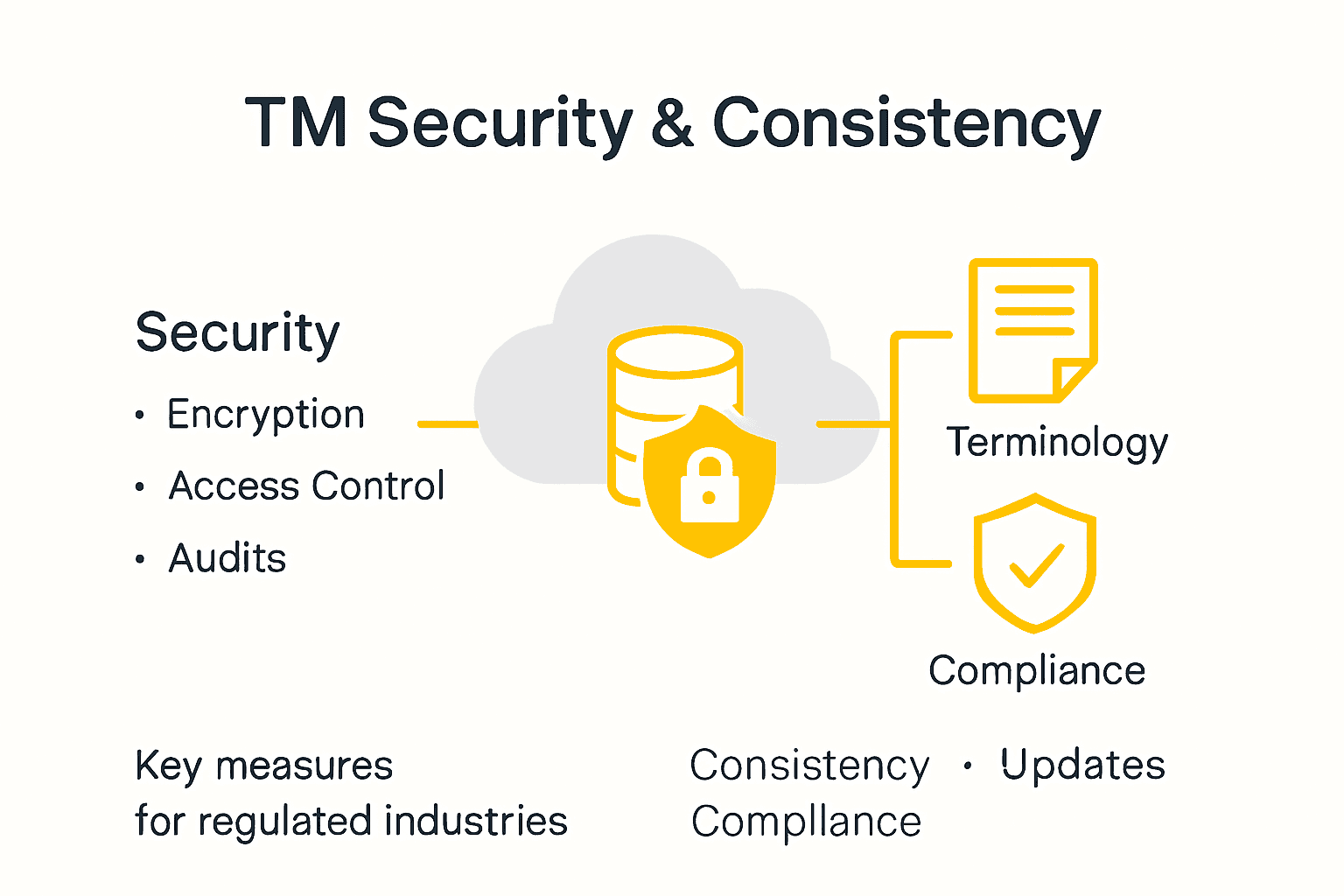
Terminology enforcement represents a critical component of secure translation workflows. By utilizing proprietary AI technologies, AD VERBUM can instantaneously validate and enforce specific terminology across entire document sets. This approach guarantees that industry-specific language remains consistent, accurate, and compliant with regulatory standards. The system automatically flags potential terminology deviations, providing human experts with immediate context and recommendations to maintain absolute precision in regulated documentation.
Pro tip: Conduct regular security audits of your translation memory system to identify and address potential vulnerability points before they become significant risks.
TM risks, limitations, and alternatives
Translation memory systems present complex challenges that require sophisticated strategies to mitigate potential risks. Academic research highlights significant limitations in traditional translation memory approaches, particularly regarding their adaptability and contextual understanding in rapidly evolving linguistic landscapes.
The primary risks associated with translation memory include over-reliance on static data, potential bias from historical translations, and limited adaptability to emerging linguistic nuances. Advanced research suggests exploring alternative models that dynamically integrate translation memories with neural machine translation technologies, creating more flexible and responsive translation ecosystems. AD VERBUM’s proprietary AI approach addresses these challenges by continuously updating and refining translation memories through intelligent machine learning algorithms.
Alternative approaches to traditional translation memory include neural machine translation models augmented with contextual prompting, dynamic memory systems, and AI-powered adaptive translation technologies. These innovative solutions aim to overcome the inherent limitations of static translation repositories by introducing real-time learning capabilities and enhanced contextual understanding. By leveraging advanced AI technologies, AD VERBUM ensures that translation memories remain current, accurate, and responsive to the complex linguistic demands of regulated industries.
Summary of major TM risks and alternative solutions:
Challenge | Description | Innovative Solution |
Static Data Reliance | May repeat outdated translations | Dynamic memory updates with AI |
Context Limitations | Struggles with nuanced language shifts | Neural models with adaptive prompting |
Terminology Drift | Inconsistent use of industry terms | Automated terminology validation tools |
Pro tip: Implement a continuous evaluation process for your translation memory system, regularly assessing its performance and integrating new linguistic data to maintain optimal translation quality.
Unlock Unmatched Accuracy and Security with AD VERBUM’s AI+HUMAN Translation Solutions
The article highlights critical challenges in managing translation memories including data security, terminology consistency, and adapting to evolving linguistic demands. Companies operating in regulated industries must avoid common pitfalls like relying on static translation memories or risking data leakage with public neural machine translation tools. AD VERBUM offers a proprietary, secure AI+HUMAN workflow that integrates your existing Translation Memories and Terminology Databases with a powerful Large Language Model hosted exclusively on EU servers. This approach enforces precise terminology, maintains full compliance with GDPR and HIPAA, and eliminates risks found in conventional machine translation.
By combining the expertise of over 3,500 subject matter experts with state-of-the-art AI, AD VERBUM ensures translations are not just fast but rigorously accurate and secure — essential for pharmaceuticals, legal, medical, and technical documentation. Learn how our Specialized AI Translation service elevates your translation memory usage while safeguarding your sensitive data. Take the next step to safeguard your translations, enforce terminology consistency, and achieve compliance by visiting AD VERBUM today. Harness the full potential of translation memory with confidence and precision.
Frequently Asked Questions
What is translation memory and how does it work?
Translation memory ™ is a linguistic database that stores previously translated text segments to help translators reuse these segments for increased efficiency and consistency. It suggests matching or near-matching translations which can then be reviewed and adapted by human translators.
What are the main types of translation memory systems?
Translation memory systems can be categorized mainly into segment-based memories, which store exact text segments, and context-aware memories that consider the surrounding linguistic context. AI-integrated systems further enhance these capabilities by providing multiple contextual translation options.
How does AI+HUMAN workflow improve translation quality?
The AI+HUMAN translation workflow combines machine-generated suggestions with human expertise. Translation memories are used to balance efficiency with accuracy, allowing professional translators to refine AI-generated drafts while maintaining linguistic nuance and cultural context.
What are the key security measures for translation memory systems?
Key security measures for translation memory systems include strict access controls, data encryption, and precise terminology governance. These protocols help protect sensitive linguistic assets and ensure compliance with regulatory standards, particularly in industries that require high levels of confidentiality.
Recommended
