


Translation Technology 2025: Compliance and Innovation

More than 90 percent of regulated organizations now view translation technology as a core compliance asset, not just a language tool. For Localization Managers in fields like Life Sciences and Legal across Europe, the stakes are higher than ever when balancing data security and multilingual accuracy. With new american and European regulatory pressures, the drive for AI-powered yet human-refined workflows shapes how leaders safeguard content and adapt to global demands. Discover how advanced solutions redefine translation excellence for your sector.
Table of Contents
Key Takeaways
Point | Details |
Hybrid Translation Strategies | The integration of AI with human expertise offers improved accuracy and adaptability for translation workflows. |
Emerging Technologies | Techniques like Machine Translation Post-Editing (MTPE) and Agentic Translation enhance translation quality for complex contexts. |
Data Security | AI+HUMAN workflows provide robust data protection and compliance for organizations operating in regulated environments. |
Terminology Consistency | Advanced terminology enforcement systems ensure precise and consistent language use across multilingual documentation. |
Defining 2025 Translation Technology Landscape
The translation technology landscape for 2025 represents a pivotal moment of transformation, driven by breakthrough advancements in Large Language Models (LLMs) and sophisticated AI+HUMAN translation methodologies. This emerging ecosystem transcends traditional machine translation approaches by integrating contextual understanding, nuanced linguistic comprehension, and rigorous human expertise.
At the core of this technological evolution are hybrid translation strategies that combine advanced AI capabilities with expert human refinement. Recent research from computational linguistics surveys highlights emerging techniques like few-shot prompting and cross-lingual transfer, which enable more adaptive and precise translation processes. These innovations are particularly significant for low-resource languages and specialized domains where traditional translation technologies have historically struggled.
The translation technology landscape now encompasses multiple sophisticated approaches:
MTPE Services: Machine Translation Post-Editing services leveraging LLM AI for initial draft generation
Tiered Translation: Multi-stage translation workflows with specialized human expert review
Agentic Translation: AI systems capable of understanding contextual nuances and making adaptive translation decisions
Hybrid Translation: Integrated workflows combining AI generation with human linguistic expertise
Pro Translation Technology Strategy: Build flexible translation workflows that can dynamically adjust between AI generation and human refinement based on content complexity and regulatory requirements.
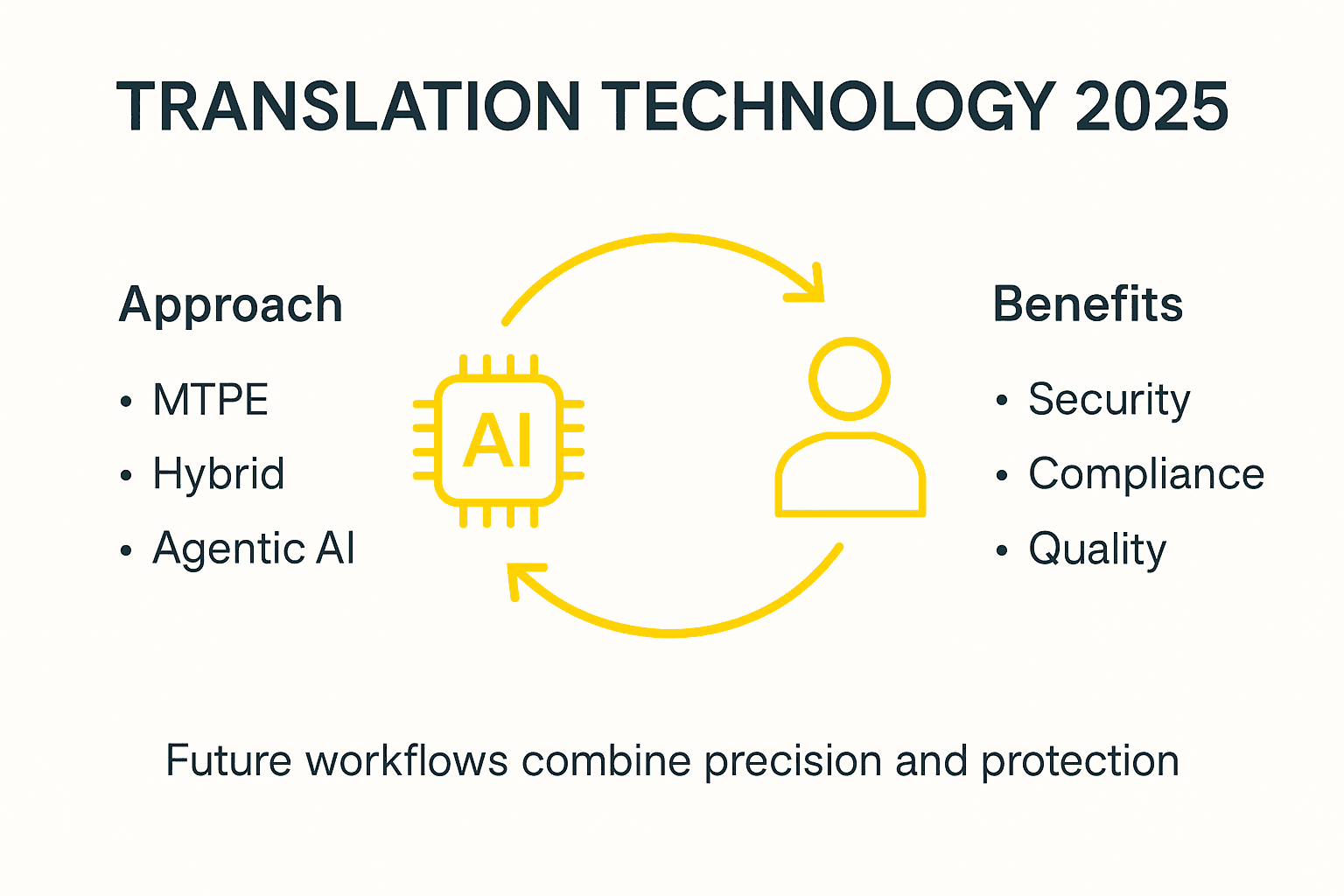
Ultimately, the 2025 translation technology landscape represents a sophisticated convergence of artificial intelligence and human expertise, offering unprecedented levels of accuracy, efficiency, and linguistic precision.
Types: MTPE, Hybrid, and Agentic Translation
The translation technology landscape in 2025 is characterized by three transformative approaches: Machine Translation Post-Editing (MTPE), Hybrid Translation, and Agentic Translation. Each methodology represents a sophisticated evolution in language technology, designed to address complex linguistic challenges with unprecedented precision and adaptability.
Machine Translation Post-Editing (MTPE) services leverage advanced Large Language Models (LLMs) to generate initial translation drafts, which are then meticulously refined by human linguistic experts. Advanced neural machine translation systems now integrate seamlessly with translation management tools, enabling translators to optimize workflow efficiency and maintain high-quality output across diverse language pairs and specialized domains.
The emerging translation approaches offer distinct capabilities:
MTPE Services: Automated draft generation with expert human refinement
Hybrid Translation: Integrated AI and human workflows with dynamic collaboration
Agentic Translation: AI systems with contextual understanding and adaptive decision-making capabilities
Tiered Translation: Multi-stage processes with specialized expert review at each level
Unlike traditional translation methods, these advanced approaches prioritize contextual nuance, linguistic precision, and adaptive learning. Agentic Translation represents the most sophisticated tier, where AI systems can understand complex semantic contexts, make intelligent translation decisions, and learn from human feedback in real-time.
Pro Translation Technology Insight: Develop flexible translation workflows that can dynamically adjust AI and human contributions based on content complexity, regulatory requirements, and linguistic challenges.
Ultimately, these translation technologies signal a transformative era where artificial intelligence and human expertise converge to deliver unprecedented linguistic accuracy and cultural adaptation.
Here’s a comparison of major 2025 translation methodologies and their unique advantages:
Translation Method | Distinct Capability | Ideal Use Case |
MTPE Services | AI drafts with human refinement | Fast, high-quality general translation |
Hybrid Translation | Dynamic AI-human collaboration | Complex or ambiguous content |
Agentic Translation | Adaptive AI with context awareness | Regulated or sensitive industries |
Tiered Translation | Multi-stage expert review | Legal, scientific, or critical documents |
How AI+HUMAN Workflows Ensure Data Security
Data security represents a critical cornerstone in modern translation technologies, particularly for organizations operating in highly regulated industries. The AI+HUMAN workflow emerges as a sophisticated solution that addresses complex security challenges through integrated technological and human oversight mechanisms, ensuring comprehensive protection of sensitive linguistic assets.

Empirical research comparing translation methodologies highlights the paramount importance of human oversight in maintaining translation accuracy and security. Unlike traditional machine translation approaches that expose confidential content to public neural networks, AD VERBUM’s proprietary workflow ensures complete data sovereignty through multiple strategic layers of protection.
The key data security components of AI+HUMAN workflows include:
Closed-Loop Processing: Translation occurs entirely within secure, private infrastructure
Subject Matter Expert Validation: Human experts review and verify AI-generated translations
Encryption Protocols: Advanced end-to-end encryption for all translation assets
Access Control: Granular permissions limiting data exposure
Compliance Tracking: Comprehensive audit trails for regulatory requirements
Agentic Translation technologies powered by Large Language Models (LLMs) introduce unprecedented security capabilities. These systems can dynamically adapt to specific compliance requirements, automatically identifying and protecting sensitive information while maintaining linguistic precision and contextual integrity.
Pro Cybersecurity Strategy: Implement multi-layered authentication and continuous monitoring protocols within your translation workflows to create robust defense mechanisms against potential data vulnerabilities.
Ultimately, AI+HUMAN workflows represent the gold standard in translation technology, delivering unparalleled security, compliance, and linguistic accuracy for organizations operating in high-stakes, regulated environments.
Terminology Enforcement and Regulatory Compliance
Terminology enforcement represents a critical linchpin in translation technologies, particularly for highly regulated industries where precision can mean the difference between compliance and catastrophic legal consequences. AD VERBUM’s proprietary AI+HUMAN workflow introduces unprecedented capabilities in maintaining absolute terminological consistency across complex multilingual documentation.
Advanced automation techniques for terminology management demonstrate how sophisticated language technologies can dramatically improve translation accuracy and reduce processing time. These methodologies enable organizations to create robust terminology enforcement mechanisms that go far beyond traditional translation memory approaches, ensuring that specialized technical and regulatory language remains consistent across all translated materials.
The core components of effective terminology enforcement include:
Centralized Term Bases: Comprehensive repositories of approved terminology
Real-Time Validation: Instant cross-referencing against authorized glossaries
Contextual Understanding: AI systems that comprehend nuanced term applications
Dynamic Learning: Continuous refinement of terminology rules
Compliance Tracking: Comprehensive audit trails for regulatory documentation
Large Language Models (LLMs) powered by Agentic Translation technologies represent a quantum leap in terminology management. These advanced systems can dynamically adapt to sector-specific linguistic requirements, automatically identifying and enforcing precise terminological standards with unprecedented accuracy and contextual intelligence.
Pro Terminology Strategy: Develop a comprehensive, regularly updated centralized term base that captures domain-specific nuances and integrates seamlessly with your translation workflow.
Ultimately, robust terminology enforcement is not just about linguistic precision—it is about creating a reliable, compliant communication framework that protects organizations from potential regulatory risks and misinterpretations.
Risks of Public NMT vs. Proprietary LLM AI
The translation technology landscape is fraught with critical risks when organizations rely on public Neural Machine Translation (NMT) systems, particularly in regulated industries where precision and confidentiality are paramount. AD VERBUM’s proprietary Large Language Model (LLM) AI represents a transformative approach that fundamentally mitigates the inherent vulnerabilities of public translation technologies.
Scientific research investigating LLM translation challenges reveals significant risks associated with public neural machine translation systems, including problematic overtranslation of technical terminology and lack of domain-specific contextual understanding. These limitations can lead to catastrophic miscommunications in sectors like healthcare, legal, and scientific research where linguistic accuracy is not just preferred—it is mandatory.
The key risks of public NMT systems include:
Data Exposure: Confidential content processed through public neural networks
Terminological Inconsistency: Lack of precise domain-specific vocabulary control
Contextual Misinterpretation: Inability to understand nuanced linguistic contexts
Compliance Violations: Potential breaches of regulatory documentation standards
Security Vulnerabilities: Uncontrolled data transmission through third-party platforms
Proprietary LLM AI technologies, by contrast, offer a fundamentally different approach. These advanced systems are designed with built-in compliance mechanisms, allowing for granular control over translation processes, terminology enforcement, and data security. Unlike public NMT systems, proprietary solutions like AD VERBUM’s can be precisely calibrated to meet the most stringent industry-specific regulatory requirements.
Pro Security Strategy: Implement a comprehensive assessment of your translation technology’s data handling protocols, focusing on end-to-end encryption, access controls, and compliance tracking mechanisms.
Ultimately, the choice between public NMT and proprietary LLM AI is not just a technological decision—it is a critical risk management strategy that can protect organizations from potential legal, financial, and reputational consequences.
Below is a summary of how proprietary LLM AI addresses translation risks compared to public NMT systems:
Risk Factor | Public NMT Systems | Proprietary LLM AI |
Data Security | Exposes information to third parties | Secures data in private infrastructure |
Terminology Consistency | Inconsistent vocabulary | Enforced domain-specific terms |
Regulatory Compliance | Limited or unreliable | Built-in compliance management |
Contextual Accuracy | Risks misinterpretation | Maintains nuanced understanding |
Practical Impacts for Regulated Industry Leaders
For regulated industry leaders, translation technology represents far more than a linguistic challenge—it is a critical strategic imperative that directly impacts global compliance, operational efficiency, and organizational risk management. The landscape of international business demands sophisticated translation solutions that go beyond traditional linguistic conversion, requiring intelligent, adaptive technologies that can navigate complex regulatory environments.
Emerging trends in global content localization underscore the increasing complexity of managing multilingual communication across diverse regulatory frameworks. Organizations in highly regulated sectors like pharmaceuticals, medical devices, and financial services must now view translation not as a peripheral service, but as a core strategic function that directly influences market expansion, regulatory compliance, and brand integrity.
The practical implications for industry leaders include:
Compliance Risk Management: Proactively mitigating potential regulatory violations
Operational Efficiency: Streamlining translation workflows with advanced AI technologies
Global Market Adaptation: Rapidly localizing content while maintaining precise terminology
Data Security: Protecting sensitive information through secure translation infrastructures
Continuous Learning: Developing adaptive translation systems that evolve with regulatory changes
Agentic Translation technologies powered by Large Language Models (LLMs) represent a transformative approach for regulated industries. These advanced systems can dynamically understand complex regulatory contexts, automatically enforce industry-specific terminological standards, and provide comprehensive compliance tracking mechanisms that traditional translation services cannot match.
Pro Strategic Adaptation: Develop a cross-functional translation governance framework that integrates legal, compliance, and technology teams to create a holistic approach to multilingual communication.
Ultimately, translation technology in 2025 is not just about converting words—it is about creating intelligent, secure, and compliant communication ecosystems that enable global business success.
Secure Your Compliance with AD VERBUM’s Advanced AI+HUMAN Translation Solutions
The article highlights critical challenges faced by companies in regulated industries today: ensuring data security, enforcing precise terminology, and maintaining strict regulatory compliance in translation workflows. Traditional public NMT or MT systems risk exposing sensitive data and producing costly errors through terminology inconsistency or contextual misunderstanding. This places organizations at risk of compliance violations and operational setbacks.
AD VERBUM addresses these pain points through its proprietary LLM-based AI integrated with a 100% AI+HUMAN workflow. Our private AI ecosystem operates entirely on secure EU servers, ensuring zero data leakage while delivering uncompromising terminology enforcement tailored for Life Sciences, Legal, Finance, and Manufacturing sectors. With over 25 years of expertise, certified standards such as ISO 27001 and GDPR compliance, and a network of 3,500+ subject matter experts, AD VERBUM transforms translation technology into a strategic compliance asset.
For organizations demanding precision and security, explore how AD VERBUM Specialized AI Translation empowers you to stay ahead of evolving regulatory challenges. Don’t risk your compliance with public machine translation. Discover the safest path forward now at https://adverbum.com and secure your communication with technology built for tomorrow’s global regulations.
Frequently Asked Questions
What are the main types of translation methodologies in 2025?
The main types of translation methodologies in 2025 include Machine Translation Post-Editing (MTPE), Hybrid Translation, and Agentic Translation. Each method utilizes advanced AI technologies combined with human expertise to enhance accuracy and efficiency.
How do AI+HUMAN workflows ensure data security in translation?
AI+HUMAN workflows ensure data security by implementing closed-loop processing, subject matter expert validation, encryption protocols, access control, and compliance tracking, protecting sensitive data throughout the translation process.
What is the significance of terminology enforcement in regulated industries?
Terminology enforcement is crucial in regulated industries as it ensures precise and consistent use of specialized language, which is vital for compliance and avoiding legal consequences. It integrates real-time validation and centralized term bases to maintain accuracy.
What are the risks associated with using public Neural Machine Translation (NMT) systems?
Risks associated with public NMT systems include data exposure, terminological inconsistency, contextual misinterpretation, compliance violations, and security vulnerabilities, which can lead to significant miscommunications in regulated sectors.
Recommended