


Why Choose ISO Certified Translation for Compliance

Most American businesses dealing with global partners are surprised to learn that only a small fraction of translation services actually meet strict international quality standards. When language can be the difference between securing a deal and making a costly error, understanding what makes a translation ISO certified becomes essential. This guide breaks down what ISO certification means in translation, why it matters for American organizations, and how it protects your company from serious risks.
Table of Contents
Key Takeaways
Point | Details |
ISO Certified Translation Ensures Quality | ISO Certified Translation follows stringent standards, guaranteeing professional accuracy and reliability in translation services. |
Multi-Step Workflow Enhances Accuracy | The ISO 17100 standard mandates a multi-step translation process that minimizes errors and reinforces linguistic precision. |
Critical for Regulated Industries | Organizations in regulated sectors must prioritize ISO certification to mitigate risks associated with compliance and accuracy. |
Provider Verification is Essential | Always request documentation of a provider’s ISO certification to ensure quality and accountability in their translation services. |
What Is ISO Certified Translation?
ISO Certified Translation represents a rigorous quality standard that ensures precise, professional translation services meet international benchmarks for accuracy, process management, and linguistic expertise. At its core, ISO 17100 certification establishes comprehensive requirements for translation service providers, defining strict protocols that govern every aspect of language conversion.
The certification process demands exceptional standards across multiple dimensions. Translation service providers must demonstrate robust capabilities in several critical areas:
Linguist qualifications and professional credentials
Comprehensive project management infrastructure
Precise translation workflow management
Quality control and validation processes
Resource allocation and technological capabilities
Unlike standard translation services, ISO Certified Translation requires a systematic approach where every translation undergoes meticulous scrutiny. The certification mandates minimum requirements for translators’ fitness, knowledge, and professional experience, ensuring that only highly qualified professionals handle complex linguistic tasks. This means translators must possess not just language skills, but deep understanding of subject matter, cultural nuances, and industry-specific terminology.
Pro Tip: Translator Validation: Always request documentation confirming a translator’s ISO 17100 certification and specific subject matter expertise before entrusting critical translation projects.
Types of ISO Certification Standards Explained
ISO Certification Standards represent a comprehensive framework of quality management protocols designed to ensure consistency, reliability, and excellence across various professional domains. In the translation industry, these standards play a critical role in establishing rigorous benchmarks for service delivery and linguistic precision. The evolution of translation standards began with EN 15038, which was later replaced by ISO 17100, marking a significant milestone in global translation quality management.
The primary ISO certification standards relevant to translation services include:
ISO 17100: The primary standard for translation services
Defines requirements for translation process management
Establishes minimum qualifications for translators
Specifies resource management protocols
ISO 9001: Quality Management Systems
Focuses on overall organizational quality processes
Applicable across multiple industries
Ensures consistent service delivery and continuous improvement
ISO 18587: Post-Editing of Machine Translation Output
Specific standard for AI and machine translation processes
Provides guidelines for human review and validation
Addresses quality control in automated translation workflows
ISO Certification goes beyond mere linguistic accuracy. The comprehensive standard specifies detailed requirements for managing core translation processes, including project management, resource allocation, and quality validation. These standards ensure that translation providers maintain a systematic approach to language conversion, protecting clients from potential errors and miscommunications.
Here’s a quick comparison of major ISO translation standards and their key industry applications:
ISO Standard | Main Focus | Primary Users | Example Application |
ISO 17100 | Translation quality process | Language service providers | Legal and medical document translation |
ISO 9001 | Overall organizational quality | Any industry | Quality management in manufacturing |
ISO 18587 | Post-editing machine translation | Companies using AI translation | Automated website localization |
Pro Tip: Certification Verification: Always request a current ISO certification document directly from your translation provider, and verify its authenticity with the issuing certification body.
How ISO Certified Workflows Ensure Accuracy
ISO Certified Translation Workflows represent a meticulously designed system that transforms translation from a simple linguistic conversion into a comprehensive quality assurance process. The ISO 17100 standard defines a multi-step approach to translation that goes far beyond simple word-for-word conversion, creating a rigorous framework that systematically eliminates potential errors and ensures maximum accuracy.
The typical ISO-certified translation workflow incorporates multiple critical stages:
Initial Translation
First translation performed by a qualified linguist
Translator conducts immediate self-review
Checks for linguistic and contextual accuracy
Independent Revision
Second linguist reviews the initial translation
Compares translation against original source document
Verifies terminology, style, and technical consistency
Optional Review Stages
Technical review by subject matter expert
Client-specific terminology validation
Final proofreading to catch remaining nuances
The validation process emphasizes interfaces between service providers and clients, ensuring that the final translation precisely meets specific requirements. This multi-layered approach dramatically reduces the risk of errors, misinterpretations, and potential compliance issues that could arise from less structured translation methodologies.

Pro Tip: Quality Verification: Request a detailed translation workflow documentation from your language service provider to understand their specific ISO-compliant quality assurance steps.
Regulatory Compliance and Data Security Impact
Data security and regulatory compliance represent critical concerns for organizations operating in highly regulated industries. ISO certification establishes stringent protocols for protecting confidential information throughout the translation process, creating a comprehensive framework that goes far beyond simple linguistic conversion.
Key regulatory compliance mechanisms include:
Confidentiality Protocols
Strict data handling procedures
Secure document management systems
Limited access to sensitive materials
Archival Requirements
Mandatory documentation preservation
Structured record-keeping processes
Traceable translation workflows
Client Feedback Mechanisms
Systematic quality assessment processes
Continuous improvement tracking
Transparent communication channels
Translation service providers must implement rigorous methods for archiving materials, obtaining quality feedback, and maintaining absolute confidentiality, addressing critical compliance requirements across multiple regulatory frameworks. These standards become especially crucial in industries like healthcare, legal services, and financial sectors, where even minor translation errors can result in significant legal and financial consequences.
Pro Tip: Compliance Documentation: Always request a comprehensive compliance documentation package from your translation provider, detailing their specific data protection and regulatory adherence strategies.
Comparing ISO Certified to Non-Certified Providers
Translation quality represents a critical differentiator between ISO-certified and non-certified language service providers. ISO 17100 establishes a comprehensive framework that dramatically elevates translation standards, creating a stark contrast between providers who adhere to rigorous quality protocols and those operating without structured processes.
Key differences between ISO-certified and non-certified providers include:
ISO-Certified Providers
Standardized translation workflows
Mandatory multi-step quality checks
Documented linguist qualifications
Systematic error prevention mechanisms
Transparent quality management systems
Non-Certified Providers
Inconsistent translation processes
Limited or absent quality verification
Undefined linguist screening
Reactive error management
Minimal accountability for translation accuracy
The certification process raises the fundamental threshold for translation service quality, transforming translation from a potentially unpredictable linguistic task into a structured, measurable professional service. Organizations operating in regulated industries cannot afford the risks associated with non-certified translation providers, where potential errors can lead to significant legal, financial, and reputational consequences.
Pro Tip: Provider Verification: Request formal documentation of ISO certification, including the specific standard (such as ISO 17100) and current certification validity before engaging any translation service.
Avoiding Common Translation Risks in Regulated Sectors
Translation risks can have devastating consequences in regulated industries where precision is paramount. ISO 17100 provides a comprehensive framework for managing core translation processes, establishing critical safeguards against potential linguistic and compliance vulnerabilities.
Common translation risks in regulated sectors include:
Linguistic Risks
Terminology mistranslation
Contextual misinterpretation
Grammatical inconsistencies
Cultural communication gaps
Technical inaccuracies
Compliance Risks
Regulatory documentation errors
Patient safety information misrepresentation
Legal document misinterpretation
Medical device instruction inaccuracies
Financial reporting mistranslations
Systematic validation of translated materials helps organizations mitigate potential risks through structured resource management and quality control protocols. By implementing rigorous translation workflows, companies can significantly reduce the potential for costly mistakes that could result in legal challenges, reputational damage, or regulatory penalties.
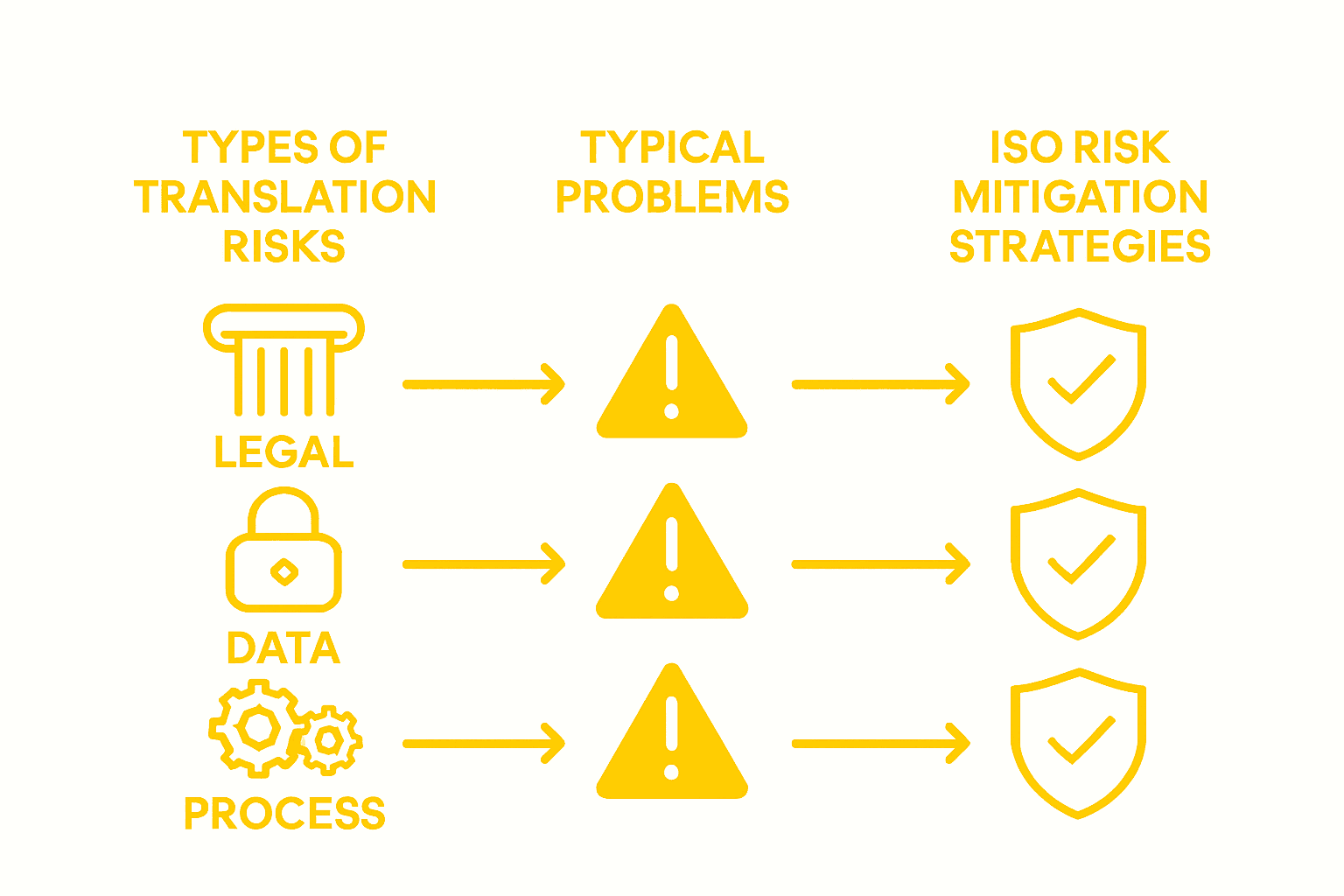
This table highlights common risks in translation for regulated industries and how ISO certification addresses them:
Translation Risk Type | Typical Problem | ISO Mitigation Strategy |
Linguistic errors | Incorrect terminology usage | Multi-step review by experts |
Compliance failures | Regulatory reporting mistakes | Structured documentation and workflows |
Data breaches | Loss of confidential information | Enforced confidentiality protocols |
Documentation gaps | Missing or outdated records | Mandatory archiving and traceability |
Pro Tip: Risk Mitigation: Develop a comprehensive translation review process that includes multiple linguistic experts, subject matter specialists, and final compliance verification before releasing critical documents.
Ensure Absolute Compliance with AD VERBUM’s ISO Certified AI+HUMAN Translation
Navigating the stringent demands of regulated industries requires more than basic translation. The article highlights critical challenges such as maintaining terminology accuracy, upholding multi-step quality controls, and securing sensitive data as defined by ISO 17100 standards. Avoid risks like compliance failures, linguistic errors, and data breaches by choosing a translation partner that seamlessly integrates these protocols within a certified workflow.
At AD VERBUM, we address these exact challenges through our proprietary AI+HUMAN workflow, combining the precision of a secure Large Language Model with expert human oversight. Unlike typical providers relying on public machine translation, our fully EU-hosted system ensures zero data leakage and strict terminology enforcement — essential for Life Sciences, Legal, Finance, and Manufacturing sectors requiring ISO 17100 and ISO 27001 compliance. Leverage over 25 years of specialist expertise and 3,500+ certified linguists to safeguard your most critical content.
Take control of your regulated translation processes today. Discover how AD VERBUM’s precision-driven solutions exceed basic ISO certification requirements at AD VERBUM. Learn more about our Specialized AI Translation Services designed for compliance and security. Don’t settle for less when accuracy and confidentiality matter — partner with the proven leader in ISO certified translation.
Frequently Asked Questions
What is ISO Certified Translation?
ISO Certified Translation ensures that translation services meet rigorous international standards for accuracy, process management, and linguistic expertise, primarily governed by ISO 17100 certification.
How does ISO certification benefit compliance in regulated industries?
ISO certification establishes strict protocols for translation workflows, ensuring linguistic accuracy and regulatory compliance. This minimizes the risk of errors that could lead to legal or financial consequences.
What are the key differences between ISO certified and non-certified translation providers?
ISO certified providers have standardized workflows, mandatory multi-step quality checks, and documented linguist qualifications, while non-certified providers often lack these structured processes and accountability.
What risks can ISO Certified Translation help mitigate?
ISO Certified Translation helps mitigate linguistic risks, such as terminology mistranslation and contextual misinterpretation, as well as compliance risks, like reporting errors and data breaches, through structured validation and quality assurance processes.
Recommended
