


AI Translation in Regulated Industries: 2026 Compliance Guide

AI translation in regulated industries is defined as the use of artificial intelligence tools, combined with certified expert human review, to produce accurate, secure, and compliant translations of regulated documents such as clinical trial submissions, legal contracts, and financial filings. The industry term for this practice is AI+HUMAN hybrid translation, and it is the only model that satisfies both speed requirements and the auditability mandates of frameworks like the EU AI Act, GDPR, ISO 18587, and HIPAA. Generic machine translation (MT) and consumer-grade neural machine translation (NMT) engines do not meet these requirements. Providers like AD VERBUM, with 25+ years of experience and ISO 27001 certified infrastructure, demonstrate what a compliant workflow looks like in practice.
What regulatory and quality standards govern AI translation in regulated industries?
AI translation systems used in legal or regulated decision-making are classified as high-risk AI under the EU AI Act, triggering mandatory human oversight, documentation requirements, and full audit trails. That classification has direct operational consequences for any organization translating clinical, legal, or financial content at scale.
The key frameworks you must account for in 2026 are:
EU AI Act. High-risk AI systems, including translation tools used in regulatory submissions, must support automatic logging and full auditability by August 2026. Non-compliance carries fines up to €20 million or 4% of global annual revenue.
GDPR. A Data Protection Impact Assessment (DPIA) is mandatory before deploying any AI system that processes personal data, including AI translation platforms. Skipping this step is a compliance failure, not a procedural gap.
ISO 18587. This standard requires machine translation post-editing by qualified subject-matter experts to meet safety-critical documentation standards. It is the quality baseline for any regulated translation workflow.
HIPAA. Healthcare organizations must apply strict controls and non-retention policies to any AI translation tool handling protected health information. End-to-end encryption and private infrastructure are not optional features.
ISO 13485 and MDR. Medical device manufacturers face additional sector-specific requirements for translation of technical files and instructions for use.
The distinction between high-risk and limited-risk AI translation matters for resource allocation. A patient-facing clinical label translated by an AI system is high-risk. An internal HR policy translated for a non-regulated audience is limited-risk. The former requires full audit trails, SME review, and documented QA. The latter requires transparency but not necessarily the same level of oversight.
Pro Tip: Before selecting any AI translation vendor, request their EU AI Act risk classification documentation and their DPIA template. If they cannot produce either, they are not ready for regulated content.
How do AI+HUMAN hybrid translation workflows ensure compliance and accuracy?
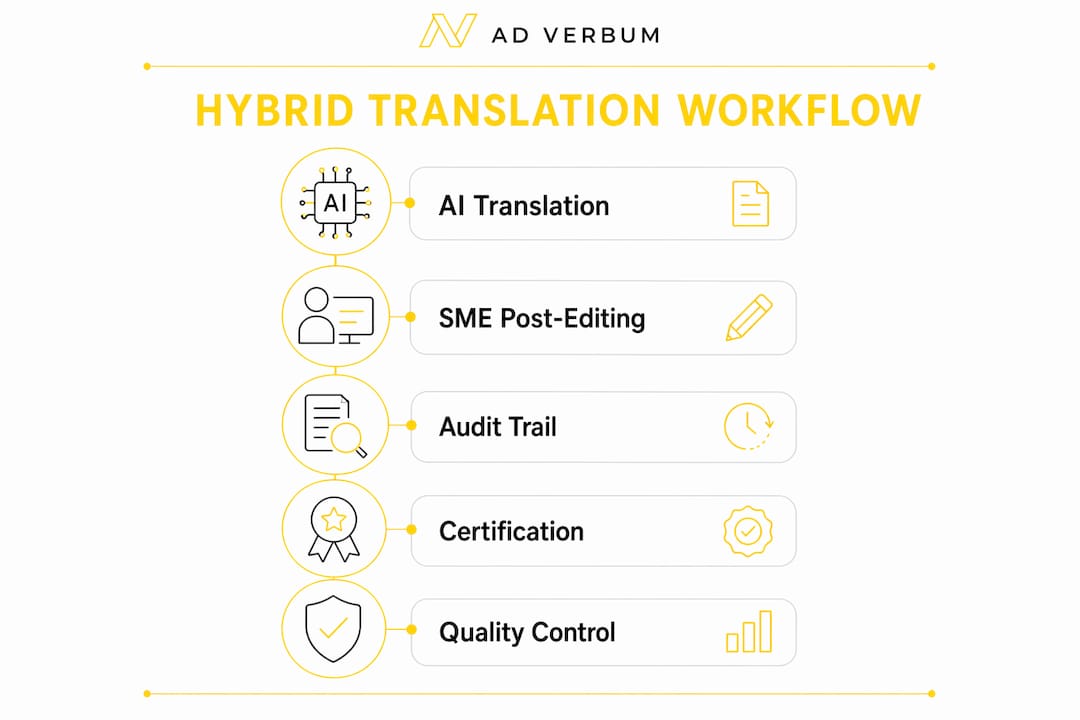
The AI+HUMAN hybrid translation model is the most effective approach to meeting both speed and compliance requirements in regulated sectors. It combines the throughput of AI generation with the domain authority of certified human post-editors. Here is the workflow sequence that AD VERBUM uses, which reflects ISO 17100 and ISO 18587 requirements:
Asset integration. Client Translation Memories ™ and Term Bases (TB) are ingested first. This step locks terminology before any AI output is generated, preventing deviation from approved regulatory language.
LLM generation. AD VERBUM’s proprietary LLM-based LangOps System produces target language output constrained by client terminology and style guidance. Unlike public NMT engines, this system operates on private EU-hosted infrastructure with no reliance on outsourced public cloud tooling.
SME review. A certified subject-matter expert reviews the output for technical accuracy, regulatory compliance, and contextual nuance. ISO 18587 is explicit that generalist post-editors are insufficient for safety-critical deliverables. The reviewer must have documented expertise in the relevant domain.
Quality assurance. QA is aligned to ISO 17100 and ISO 18587 and, where relevant, to sector requirements such as MDR. Every step generates a log entry that supports audit trail reconstruction.
This workflow produces turnaround times 3x to 5x faster than traditional translation processes, according to AD VERBUM’s operational data. Speed is achieved through AI generation. Compliance is preserved through terminology governance and SME oversight.
Audit trail generation is a structural requirement, not an afterthought. Organizations must establish governance boards that cross compliance, IT, and localization functions to classify content risk, set auditing procedures, and manage AI translation risk tolerance. Risk tiering aligns the level of documentation scrutiny with data sensitivity and regulatory exposure.
Pro Tip: Map every document type in your translation pipeline to a risk tier before selecting a workflow. Clinical labels, IND submissions, and financial prospectuses each carry different audit requirements. One workflow does not fit all.
What are common risks and failure modes of AI translation in regulated industries?
The most significant risk is accuracy failure at the document level. Generic AI translation tools show 15–25% error rates on regulatory documents, compared to 98%+ accuracy for professional translators. A 15% error rate on an FDA drug label or a clinical trial protocol is not a quality issue. It is a patient safety issue and a regulatory rejection waiting to happen.
The failure modes that appear most often in regulated contexts include:
Terminology inconsistency. Consumer NMT engines do not enforce client-specific glossaries. A single term translated three different ways across a submission document can trigger an FDA or EMA query.
Negation errors. NMT systems handle negation poorly in complex regulatory syntax. “Do not administer” becoming “administer” in a target language is a documented failure pattern in safety-critical translation.
Data security violations. Consumer-grade AI tools transmit sensitive data to third-party servers, creating direct conflicts with HIPAA, GDPR, and enterprise data processing agreements. This is not a theoretical risk. It is an active compliance exposure every time a staff member pastes a patient record or contract clause into a public AI tool.
Audit trail gaps. Most public NMT platforms do not generate the version-level logs required by the EU AI Act for high-risk AI systems. Without those logs, a submission audit becomes a reconstruction exercise rather than a retrieval exercise.
“Only ISO-certified workflows and platforms with transparent AI usage disclosure reduce liability in regulated sectors.” — AI Translation and the Regulated Industry Risk Gap
Mitigation requires four controls working together: certified workflows aligned to ISO 18587, qualified SME post-editing with documented credentials, private infrastructure that does not transmit data to third-party servers, and a formal internal AI use policy that prevents staff from using unauthorized tools on regulated content. The last control is the one most organizations skip. A single employee using a free web-based translation tool on a confidential clinical document can create a HIPAA breach without triggering any technical alarm.
For a detailed breakdown of machine translation risks by document type and sector, the failure patterns are consistent: the higher the regulatory stakes, the more expensive an uncaught error becomes.
How does AI translation fit practical workflows in healthcare, pharma, finance, and legal sectors?
The compliance requirements differ by sector, but the structural need for terminology governance, auditability, and data security is consistent across all four. The table below maps the primary translation use cases and their critical compliance requirements.

Sector | Primary document types | Critical compliance requirements | Key risk if unmanaged |
Healthcare and pharma | Clinical trial protocols, IND/NDA submissions, patient labels | HIPAA, FDA, MDR, ISO 13485, EU AI Act audit trails | Patient safety incidents, regulatory rejection |
Finance | Prospectuses, regulatory filings, multi-territory disclosures | GDPR, DPIA, multi-jurisdiction data protection | Regulatory penalties, disclosure failures |
Legal | Contracts, discovery documents, attorney-client communications | Attorney-client privilege, audit logs, jurisdiction-specific rules | Privilege waiver, evidentiary failure |
Defense and manufacturing | Technical manuals, AQAP documentation, safety instructions | AQAP 2110, ISO 9001, export control regulations | Safety failures, contract non-compliance |
In pharmaceutical submissions, the IND and NDA translation workflow requires glossary enforcement at the term level, not just the document level. A single deviation from an approved International Nonproprietary Name (INN) or a misrendered dosage instruction can delay a submission by months. AD VERBUM’s integrated platform supports Electronic Lab Notebook (ELN) environments, real-time glossary adherence, and secure audit trails built for regulatory submissions.
In financial services, multi-territory translation of prospectuses and regulatory filings requires simultaneous compliance with GDPR in the EU, data residency requirements in specific jurisdictions, and the disclosure accuracy standards of local regulators. A private infrastructure model, where data does not leave a controlled environment, is the only architecture that satisfies all three simultaneously.
Legal translation carries a distinct risk that the other sectors do not share: privilege. Discovery documents and attorney-client communications translated through a third-party public AI tool may lose privilege protection in some jurisdictions. The data security controls required for legal translation are therefore as much about evidentiary integrity as they are about GDPR.
AI translation in life sciences represents the highest-stakes application of this technology, where a mistranslated contraindication or dosage instruction carries direct patient safety consequences.
Key takeaways
Compliant AI translation in regulated industries requires ISO-certified hybrid workflows, private infrastructure, SME post-editing, and governance structures that classify content risk before any AI tool touches a document.
Point | Details |
Hybrid workflow is mandatory | AI generation alone does not meet ISO 18587 or EU AI Act requirements for regulated content. |
Risk classification comes first | Every document type must be assigned a risk tier before selecting a translation workflow or vendor. |
Consumer AI tools create liability | Public NMT engines violate HIPAA and GDPR when used on regulated documents and leave no audit trail. |
SME credentials must be documented | ISO 18587 requires post-editors with verified domain expertise, not general language proficiency. |
Governance boards reduce systemic risk | Cross-functional teams covering compliance, IT, and localization are the structural control for AI translation risk. |
Why I think most organizations are solving this problem backwards
Most compliance teams I have seen approach AI translation by starting with the tool and then asking whether it is compliant. That is the wrong sequence. The correct starting point is the document risk classification. Once you know whether a document is high-risk under the EU AI Act, whether it contains protected health information under HIPAA, and whether it requires an audit trail for a regulatory submission, the tool selection becomes straightforward. Most public NMT engines are immediately disqualified. The decision space narrows to certified, private-infrastructure platforms with documented SME oversight.
The second mistake I see consistently is treating the human review step as a cost to minimize. ISO 18587 exists precisely because AI-generated translation of safety-critical content is not self-correcting. A qualified SME reviewer is not redundant overhead. That person is the control that prevents a 15–25% AI error rate from reaching a regulator or a patient. Organizations that cut the SME step to accelerate turnaround are trading a short-term efficiency gain for a long-term liability.
The third issue is the internal policy gap. Technical controls on the vendor side mean nothing if staff are pasting confidential content into free web-based tools because they are faster. A formal AI use policy, with training and enforcement, is as important as the vendor contract. The EU AI Act’s enforcement trajectory through 2027 will make this gap increasingly expensive to ignore.
The organizations that get this right share one characteristic: they treat translation as a regulated process, not a support function. That shift in classification changes the governance structure, the vendor requirements, and the audit readiness posture.
How AD VERBUM addresses regulated translation requirements
AD VERBUM’s proprietary LangOps System delivers AI+HUMAN hybrid translation built for the compliance requirements described in this article. The platform ingests client Translation Memories and Term Bases before any AI output is generated, enforces terminology at the document level, and produces audit logs aligned to EU AI Act and ISO 17100 requirements. All processing runs on private EU-hosted infrastructure with ISO 27001 certification and no reliance on public cloud tooling. AD VERBUM’s network of 3,500+ subject-matter expert linguists, including medical professionals, legal scholars, and engineers, provides the certified post-editing that ISO 18587 requires. For organizations in Life Sciences, Legal, Finance, Defense, and Manufacturing, AD VERBUM’s localization solutions and industry-specific workflows are built to meet the exact compliance conditions your documentation demands.
FAQ
What is AI translation in regulated industries?
AI translation in regulated industries is the use of AI generation tools combined with certified human post-editing to produce compliant translations of regulated documents. It differs from standard machine translation by requiring audit trails, terminology governance, and SME review under frameworks like ISO 18587 and the EU AI Act.
What are the biggest risks of using consumer AI translation tools for regulated content?
Consumer-grade AI tools transmit sensitive data to third-party servers, creating direct HIPAA and GDPR violations. They also show 15–25% error rates on regulatory documents and do not generate the audit logs required by the EU AI Act for high-risk AI systems.
Is ISO 18587 certification required for AI translation post-editing?
ISO 18587 requires that machine translation post-editing be performed by qualified subject-matter experts with documented domain expertise. Generalist post-editors do not meet the standard for safety-critical or regulated content.
How does the EU AI Act affect AI translation workflows?
The EU AI Act classifies AI translation used in legal or regulatory decision-making as high-risk AI, requiring automatic logging, full auditability, and human oversight. Non-compliance carries fines up to €20 million or 4% of global annual revenue, with enforcement active through 2027.
What infrastructure is required for HIPAA-compliant AI translation?
HIPAA mandates end-to-end encryption, strict access controls, and non-retention policies for any AI translation tool handling protected health information. Private, dedicated infrastructure that does not route data through public cloud services is the only architecture that reliably satisfies these requirements.
Recommended
