


AQAP 2110 compliance: What defense LSPs must deliver

Quality managers at NATO supply chain contractors have a recurring problem: they search for explicit AQAP 2110 requirements around Logistics Support Plans, find scattered references, and assume the standard mandates a formal LSP structure from every language service provider in the chain. It does not. AQAP 2110 has no explicit LSP requirements as a standalone deliverable. What it does require is far more demanding in practice: a traceable, auditable, contract-specific quality system that extends to every subcontracted party touching your documentation, including the language service provider translating your technical publications, nonconformity records, and configuration-managed deliverables.
Table of Contents
Risk and configuration management: Protecting compliance details
Supply chain traceability and flow-down: Your LSP’s legal responsibilities
Debunking the LSP myth: What AQAP 2110 really says about logistics plans
Getting AQAP 2110 right: What most quality leads and LSPs still overlook
Meet AQAP 2110 standards with the right defense language partner
Key Takeaways
Point | Details |
No hard LSP requirement | AQAP 2110 does not mandate a Logistics Support Plan from translation suppliers, but contract terms may require one. |
Quality Plans are mandatory | Every defense supplier must create detailed, contract-specific Quality Plans subject to GQAR oversight. |
Risk and traceability focus | Suppliers need documented risk management and traceability for all third-party tasks, including LSP work. |
Flow-down of requirements | Contract clauses regarding quality must be clearly communicated and flowed down to all LSPs and subcontractors. |
Compliance is records-driven | Demonstrable plans, traceability, and proactive engagement with GQAR are vital for audit success. |
Understanding AQAP 2110: Scope and intent
To clarify what AQAP 2110 really demands, it helps to start with the standard’s scope and intent.
AQAP 2110 is a NATO quality assurance standard for design, development, and production in defense supply chains. It builds directly on ISO 9001 but adds mandatory requirements for risk management, configuration management, quality planning, and traceability that go well beyond what commercial quality managers are used to enforcing. The standard applies whenever a NATO nation’s procurement authority writes it into a defense contract, making it a contractually binding framework rather than a voluntary certification.
The practical difference between ISO 9001 and AQAP 2110 is significant. ISO 9001 gives you flexibility to define your own quality objectives and risk appetite. AQAP 2110 removes much of that flexibility and requires you to demonstrate compliance against externally mandated criteria that a Government Quality Assurance Representative (GQAR) will verify. That verification can reach down into your supply chain, including the firms producing translations of your controlled technical documentation.
Where do language service providers fit? Anywhere your contract requires translated deliverables, the quality controls governing those deliverables fall under the same framework as your hardware or software outputs. Reviewing AQAP documentation requirements before you onboard an LSP is not optional formality. It is risk management.
Key attributes that distinguish AQAP 2110 from ISO 9001:
Mandatory customer interaction: Your Quality Plan must be approved by the customer or GQAR, not just maintained internally.
Risk management obligation: A formal risk register is required, submitted to external authorities.
Configuration management: Change control and status accounting are required for contract deliverables.
Traceability throughout the supply chain: You must demonstrate that controls extend to subcontractors.
Nonconformity and corrective action records: These are subject to GQAR review, not just internal audit.
“AQAP 2110 shifts quality assurance from an internal discipline to an externally verifiable commitment. The GQAR is not an auditor you manage. They are a NATO nation’s assurance mechanism embedded in your delivery process.”
Core AQAP 2110 requirements for defense suppliers
With the framework in mind, here is what suppliers and any LSPs they use are specifically required to address.
AQAP 2110 requires defense suppliers to develop contract-specific Quality Plans detailing QMS application, resources, controls, acceptance criteria, inspections, and compliance matrices, all subject to customer or GQAR approval. This is not a generic quality manual. It is a document scoped to a specific contract, a specific set of deliverables, and a specific set of risks.
When translated documentation is a contract deliverable, your Quality Plan must address how translation quality is controlled, how terminology is managed, and how errors are detected and corrected before submission. A GQAR reviewing your plan will look for exactly this level of specificity. Generic statements about using “qualified translators” do not satisfy the requirement.
Comparison: ISO 9001 vs AQAP 2110 Quality Plan requirements
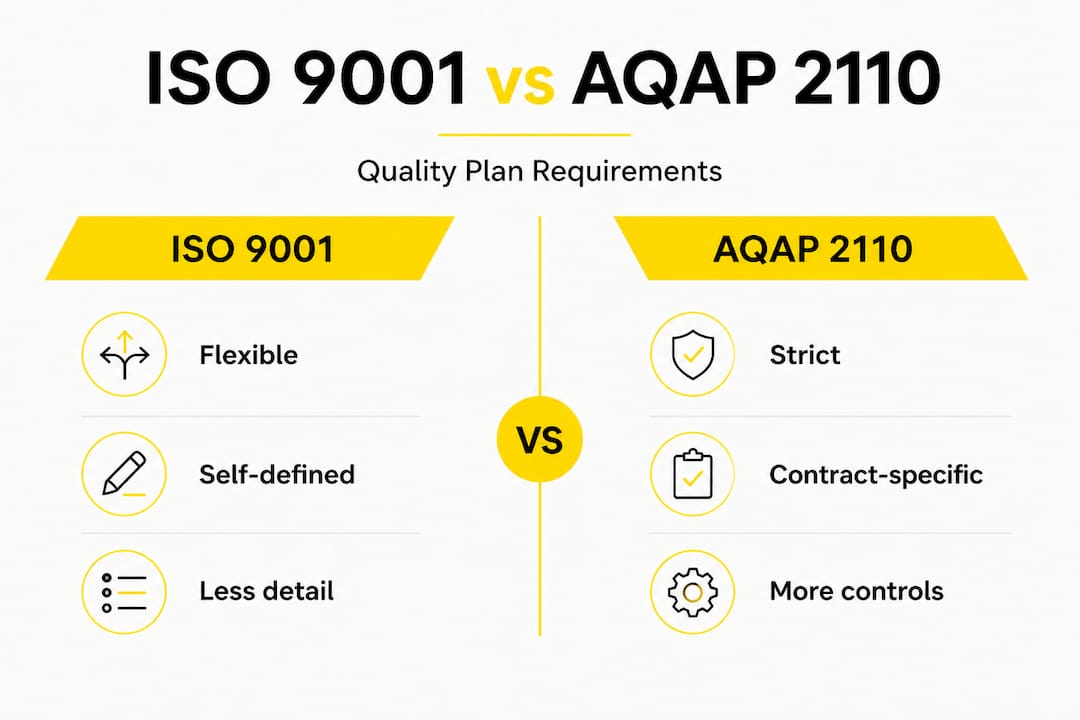
Requirement | ISO 9001 | AQAP 2110 |
Quality Plan scope | Internal, flexible | Contract-specific, mandatory |
Customer approval | Not required | Required (customer/GQAR) |
Risk register | Optional | Mandatory, submitted externally |
Configuration management | Not specified | Mandatory for deliverables |
GQAR access | Not applicable | Must be granted |
Traceability to subcontractors | Implied | Explicitly required |
Nonconformity records | Internal | Subject to external review |
Steps for building a compliant Quality Plan that covers translated deliverables:
Identify every contract deliverable that requires translation or multilingual documentation.
Map each deliverable to an acceptance criterion, including linguistic and technical accuracy standards.
Document the LSP selection process and the qualification evidence you hold on file.
Define inspection and review stages, including who performs subject-matter expert review.
Establish a nonconformity and corrective action process covering translation errors.
Submit the plan for customer or GQAR approval before work begins.
Pro Tip: Do not wait for the GQAR to ask what terminology governance your LSP uses. Address it explicitly in the Quality Plan. Auditors reviewing closing documentation gaps consistently identify terminology inconsistency as a leading source of nonconformities in translated defense documentation. The same pattern appears in translation compliance pitfalls that trigger rework cycles and contract delays.
Risk and configuration management: Protecting compliance details
Addressing quality plans is not enough. Risk and configuration management require equal attention, especially around LSP-involved deliverables.

Risk management is mandatory under AQAP 2110, with a risk register covering requirements execution including equipment, competence, and processes, as well as supplier risks such as lead times and quality. The risk plan is submitted to the customer or GQAR. This means your risk thinking about language services cannot stay internal. It becomes a contracted obligation.
Configuration management requires identification, change control, status accounting, audits, and often a contract-specific CM plan. For translated documentation, this is more operationally complex than it sounds. When source documents are revised, translated versions must be controlled and updated under the same CM system. Version mismatches between a source technical manual and its translated counterpart are a genuine audit finding waiting to happen.
Risk and control elements relevant to language quality under AQAP 2110:
Competence risk: Can you demonstrate that the linguist holds subject-matter expertise, not just language fluency? Defense technical publications require both.
Process risk: Does your LSP use a documented, repeatable workflow, or is quality dependent on individual translators working without governance?
Terminology risk: Are controlled terms, part numbers, and safety-critical phrases handled through a maintained Term Base rather than ad hoc decisions?
Data sovereignty risk: Where is your classified or sensitive documentation processed? EU-hosted infrastructure with ISO 27001 certification addresses this risk in a documented, auditable way.
Supplier lead time risk: Can the LSP meet your contract schedule under surge conditions, and what is the contingency if they cannot?
Change propagation risk: When source documents change, does your LSP have a process to flag and update affected translated versions under CM?
Pro Tip: Build your risk register entries for language services with the same specificity you would apply to a manufacturing subcontractor. “LSP may produce errors” is not a risk entry. “Mistranslation of safety warnings in maintenance manuals due to insufficient aeronautical engineering review” is. That level of specificity tells an auditor you have genuinely analyzed the risk, not just acknowledged it. Reviewing how defense data and supplier risk intersect with EU export law gives you additional criteria to add to your risk register. Similarly, understanding AI and human quality controls helps you evaluate whether your LSP’s technology posture is defensible under external scrutiny.
For configuration management of translated deliverables, the legal compliance in risk plans dimension is also worth considering when assigning contractual responsibility for version accuracy across languages.
Supply chain traceability and flow-down: Your LSP’s legal responsibilities
Once risks are managed and changes controlled, maintaining full traceability and liability in the supply chain is critical, especially for documentation and LSP oversight.
Suppliers must provide GQAR access for verification at facilities and ensure traceability through the supply chain. This means your LSP is not a black box in your delivery process. The GQAR has the right to verify that quality controls exist and function at your LSP’s facility. If your LSP cannot demonstrate documented quality processes, your contract compliance is at risk, regardless of how good your own QMS is.
Procurement must flow down contract requirements to suppliers, include GQA clauses, and maintain supplier responsibility despite inspections. Flow-down is the mechanism that transfers your contractual obligations to your subcontractors in legally binding terms. It is not enough to brief your LSP on what you need. You must include the relevant AQAP 2110 requirements in your purchase order or subcontract, and your LSP must acknowledge and operate under them.
Key traceability and flow-down obligations for LSP subcontracts:
Include explicit GQA clause language in your LSP subcontract, mirroring your prime contract requirements.
Require your LSP to maintain records of linguist qualifications, review processes, and QA sign-offs that can be produced for audit.
Ensure your LSP can provide version histories and change records for all translated deliverables under your CM system.
Retain the right to GQAR facility access in your subcontract, even if you do not anticipate it being exercised.
Document your LSP qualification process, including the criteria and evidence used to select and approve them.
“Flow-down is not a formality. It is the legal mechanism through which your AQAP 2110 obligations become your LSP’s obligations. An LSP that cannot operate under those terms is an unmanaged risk in your quality plan.”
A structured translation vendor requirements checklist gives you a practical qualification framework to use before signing any subcontract. Reviewing LSPs for AQAP 2110 documentation specifically identifies the qualification evidence you should request. The contractual liability insights from a specialist legal perspective are equally useful when drafting flow-down clauses that hold up under external review.
Debunking the LSP myth: What AQAP 2110 really says about logistics plans
Finally, let’s clear up the confusion about whether AQAP 2110 mandates a formal LSP and what to do next pragmatically.
The widespread belief that AQAP 2110 requires a formal Logistics Support Plan is a compliance misread. No explicit LSP requirements exist in AQAP 2110. The standard governs quality assurance for design, development, and production. Logistics planning requirements arise from separate NATO standards such as AQAP 2210 for software, from logistics-specific STANAGs, or from contractually negotiated deliverable schedules written into individual program contracts.
Where does the confusion come from? Partly from acronym overlap. “LSP” in logistics contexts means “Logistics Support Plan.” In language services contexts, “LSP” means “Language Service Provider.” Defense procurement contracts that reference both can create genuine confusion, particularly for quality managers who are not specialists in NATO documentation architecture. The answer is always to go back to your specific contract’s statement of work and deliverable list. That document tells you exactly what is required, and it may or may not include a logistics plan depending on the program.
“If your contract does not reference a Logistics Support Plan by name and deliverable number, you are not required to produce one under AQAP 2110. Do not let acronym confusion drive your compliance effort.”
Pro Tip: If you are unsure whether a logistics plan applies to your contract, review the contract’s applicable document list and the quality requirements section specifically. Consult the GQAR early in the contract phase. They would rather answer a clarifying question upfront than issue a nonconformity six months in. Knowing which LSPs support NATO documentation requirements helps you select partners who understand this architecture before the confusion affects your delivery schedule.
Getting AQAP 2110 right: What most quality leads and LSPs still overlook
Here is where most suppliers misjudge what is really at stake.
The instinct in any compliance program is to focus on producing records. Generating a risk register, issuing a Quality Plan, and filing corrective action forms feels like compliance. It is not. What AQAP 2110 auditors and GQARs actually scrutinize is whether your records demonstrate defensible decisions, not just documented activity. A risk register that was clearly written to satisfy an audit rather than to manage real risk reads differently to an experienced GQAR than one that shows genuine supplier engagement and iterative thinking.
The hidden value in GQAR engagement is enormous, and most suppliers underuse it. GQARs are not adversaries. They are an early warning system. Engaging your GQAR before nonconformities arise, sharing your Quality Plan in draft, asking for their read on your LSP qualification approach, these behaviors build the kind of compliance relationship that translates into faster approvals and fewer late-stage surprises. The overcoming documentation challenges that come with large defense contracts are far more manageable when your GQAR relationship is collaborative rather than reactive.
The biggest compliance gap we see with LSPs is not a missing certificate. It is the absence of demonstrated traceability process. An LSP can hold ISO 17100 certification and still fail a supplier qualification review if they cannot show you how version-controlled translated files map to source document revisions, how subject-matter expert review is documented, and how terminology decisions are recorded and recoverable. Translated files are not enough. The process that produced them must be auditable.
Suppliers who understand this distinction tend to qualify LSPs the same way they qualify any other critical subcontractor: with documented criteria, evidence review, and ongoing performance monitoring against those criteria, not a one-time certificate check.
Meet AQAP 2110 standards with the right defense language partner
If you are seeking support for AQAP 2110 compliance, expert help is available.
AD VERBUM has spent over 25 years building language services specifically for regulated and high-stakes sectors, including defense. The certification stack matters here: ISO 17100 for translation process quality, ISO 27001 for information security, and active alignment with AQAP 2110 requirements for defense documentation. That combination is what NATO supplier qualification audits need to see from an LSP. AD VERBUM’s AI+HUMAN hybrid workflow using the proprietary LangOps System starts with your Translation Memories and Term Bases, generates output through an in-house LLM constrained by your terminology governance, and routes every deliverable through certified subject-matter expert review aligned to ISO 17100 and ISO 18587.
All processing runs on EU-hosted private infrastructure under ISO 27001 controls, no public cloud exposure for your sensitive defense documentation. The result is translation that is 3x to 5x faster than traditional workflows and fully auditable at every stage. Explore AD VERBUM’s translation compliance services or review defense industry expertise to assess how the qualification evidence aligns with your specific AQAP 2110 contract requirements.
Frequently asked questions
Does AQAP 2110 require a formal Logistics Support Plan from LSPs?
No. AQAP 2110 contains no explicit LSP mandate. Logistics plans may be required by specific contract deliverable schedules or separate NATO standards such as AQAP 2210.
What must defense suppliers include in their AQAP 2110 Quality Plans?
Suppliers must detail QMS application, resources, controls, acceptance criteria, inspections, and compliance matrices, with the completed plan submitted for approval by the customer or GQAR before work begins.
How should suppliers manage risk when outsourcing translations under AQAP 2110?
They must maintain a risk register covering supplier competence, process controls, and lead times, with the risk management plan submitted to the customer or GQAR for review.
What is the GQAR’s role in AQAP 2110 compliance regarding LSPs?
The GQAR verifies compliance through facility access and review of quality plans and records. They can extend that verification to LSP facilities, which means your LSP’s documented processes are directly exposed to external audit.
Recommended