


Certified translation vendor checklist for regulated procurement

Selecting the wrong certified translation vendor in a regulated industry is not a procurement inconvenience. It is a compliance event. Rejected regulatory submissions, invalidated legal instruments, and data breach exposure have all been traced back to inadequate vendor vetting. Procurement directors and legal operations managers in life sciences, defense, finance, and legal services face a narrower margin for error than almost any other buyer. This article gives you a structured, criterion-by-criterion framework for selecting, scoring, and auditing certified translation vendors, with every checkpoint written to be immediately actionable.
Table of Contents
Understanding certified translation and regulatory requirements
Prepping your procurement checklist: Essentials for vendor selection
Executing the framework: Screening, scoring, and shortlisting vendors
Verification and auditing: Ensuring ongoing compliance and performance
Troubleshooting and avoiding common vendor selection pitfalls
Key Takeaways
Point | Details |
Know regulatory terms | Understanding the legal nuances of certified, sworn, and notarized translations is required for procurement success. |
Use a selection checklist | A structured, documented vendor evaluation process prevents compliance gaps and costly errors. |
Score and audit vendors | Systematic scoring and regular audits assure ongoing performance and minimize regulatory risk. |
Avoid common mistakes | Most pitfalls happen due to incomplete verification or ignoring security and compliance updates. |
Make compliance strategic | Treat compliance as an ongoing partnership, not a one-off checklist, for best results. |
Understanding certified translation and regulatory requirements
Before you build a vendor framework, your team must agree on what “certified translation” actually means in your regulatory context. The term is used loosely, and that looseness creates risk.
A certified translation carries a signed attestation from the translator or agency confirming accuracy and completeness. A sworn translation is performed by a translator who has taken a legal oath before a public authority, typically required in civil law jurisdictions. A notarized translation adds a notary’s seal to authenticate the translator’s signature, not the translation itself. As translation and notarization standards make clear, each form carries different legal weight in different jurisdictions. The distinction between certified, sworn, and notarized translation often determines whether a regulatory body accepts the document at all.
Compliance agencies, including the FDA, EMA, and defense procurement bodies, expect documentation to meet specific authentication thresholds. Submitting a certified translation where a sworn translation is required can invalidate an entire regulatory dossier. The cost of resubmission, including delays to market authorization or contract award, routinely runs into the hundreds of thousands of dollars.
Caution: Do not assume that a vendor’s use of the word “certified” on their website means their output meets your jurisdiction’s legal standard. Always specify the required authentication level in your RFP and confirm the vendor’s legal standing to provide it.
Every vendor you evaluate must, at minimum, meet these core regulatory requirements:
Documented translator qualifications with verifiable credentials in the subject domain
A signed certificate of accuracy on every deliverable, on company letterhead
Chain-of-custody records linking source document to final translation
Compliance with applicable data protection law (GDPR, HIPAA, or sector equivalent)
Audit trail documentation sufficient for regulatory inspection
Understanding these requirements is the foundation. Now let’s build the checklist on top of it, following legal and compliance guidelines specific to your sector, and applying secure translation provider criteria from the outset.
Prepping your procurement checklist: Essentials for vendor selection
With compliance requirements defined, structure your procurement checklist before you contact a single vendor. Reactive RFPs produce reactive responses. Proactive prequalification surfaces credential gaps before they become contract problems.
Pro Tip: Start prequalification at least 60 days before your RFP launch. Request ISO certificates and data processing agreements upfront. Vendors who cannot produce them within five business days are telling you something important about their operational maturity.
As vendor evaluation for high-risk translation frameworks confirm, vendor selection in regulated industries must explicitly document compliance credentials, supported languages, and confidentiality measures. Use the table below to categorize requirements before scoring begins.

Requirement | Critical | Nice to have | Verification method |
ISO 17100 certification | Yes | Current certificate, third-party audit report | |
ISO 18587 (MT post-editing) | Yes (if AI used) | Certificate plus workflow documentation | |
ISO 27001 (information security) | Yes | Certificate plus data processing agreement | |
ISO 13485 (medical devices) | Yes (life sciences) | Certificate plus SOP documentation | |
AQAP 2110 compliance | Yes (defense) | Compliance declaration plus audit evidence | |
Subject-matter expert linguists | Yes | CV samples, credential verification | |
EU-hosted data infrastructure | Yes (GDPR-sensitive) | Data flow diagram, server location declaration | |
TM and TB ownership and portability | Yes | Contract clause specifying client ownership | |
SLA with defined quality metrics | Yes | Draft SLA with measurable KPIs | |
Sector-specific track record | Yes | Client references with verifiable project scope |
Follow this sequence before issuing your RFP:
Define your document types and authentication requirements by jurisdiction.
Identify mandatory certifications for your sector (ISO 17100, ISO 13485, AQAP 2110, etc.).
Prepare a sample text in your highest-risk document category for trial translation.
Draft your confidentiality and data processing terms before vendor contact begins.
Categorize each requirement as critical or nice to have using the table above.
Build your prequalification questionnaire around the critical column only.
Set a minimum score threshold below which vendors are eliminated before full RFP.
For medical translation compliance, add ISO 13485 and MDR alignment to your critical column. For defense procurement, AQAP 2110 compliance is non-negotiable. Prepare sample texts that reflect your actual document complexity, not simplified excerpts.
Executing the framework: Screening, scoring, and shortlisting vendors
With your checklist ready, begin structured screening. A structured scoring method reduces subjective bias and improves RFP outcomes. Score every vendor against the same criteria, in the same order, with documented rationale at each stage.
Use a weighted scoring matrix. Assign higher weights to certification and security criteria than to cost or delivery speed. Here is a practical example:
Criterion | Weight | Vendor A score (1-5) | Vendor B score (1-5) | Vendor C score (1-5) |
ISO 17100 + ISO 18587 certification | 25% | 5 | 3 | 4 |
ISO 27001 + data sovereignty | 20% | 5 | 2 | 4 |
SME linguist credentialing | 20% | 4 | 3 | 5 |
AQAP or sector compliance | 15% | 4 | 1 | 3 |
TM/TB ownership in contract | 10% | 5 | 4 | 3 |
SLA with measurable KPIs | 10% | 4 | 3 | 4 |
Eliminate vendors who score below 3 on any critical criterion before calculating weighted totals. Price belongs in a separate evaluation column and should never override a compliance deficit.
Watch for these red flags during screening:
Certificates that are expired, unverifiable, or issued by unrecognized bodies
Vague descriptions of “AI-assisted” workflows with no disclosure of which tools or where data is processed
Inability to name the specific linguist credentials for your subject domain
Contract terms that assign TM and TB ownership to the vendor, not the client
No documented corrective action process for quality failures
Reference checks must be specific. Ask referees to describe the document type, regulatory context, and whether the vendor’s output was accepted by the relevant authority. Ask whether the vendor disclosed any compliance incidents during the engagement. General praise is not useful. Concrete regulatory outcomes are.
For regulated industry translation specialists, also evaluate how the vendor handles legal document translation risk, particularly around indemnification clauses and error escalation procedures.
Verification and auditing: Ensuring ongoing compliance and performance
Onboarding a vendor is not the end of procurement’s responsibility. Regular audits of translation vendors help prevent compliance lapses and potential breaches. Build a verification schedule into the contract before signing.
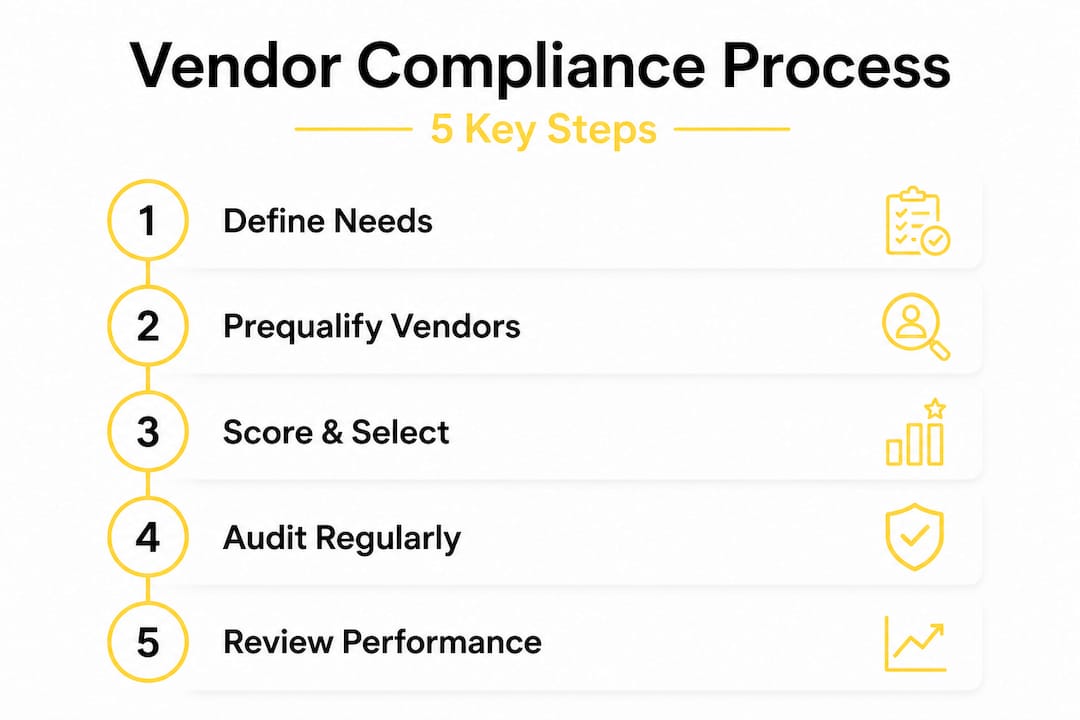
Pro Tip: Schedule a formal compliance review annually and trigger an unscheduled review within 30 days of any regulatory update that affects your documentation requirements.
Follow this audit sequence after onboarding:
Baseline documentation review. Within 30 days of contract start, collect current ISO certificates, data processing agreements, and linguist credential files for your active language pairs.
Sample translation audit. Quarterly, submit a blind test document from your highest-risk category. Score output against your internal quality rubric and the vendor’s stated SLA.
Data security verification. Annually, request confirmation of ISO 27001 surveillance audit results and any changes to data hosting infrastructure.
Compliance incident log review. Semi-annually, request a log of any quality failures, data incidents, or regulatory non-conformances and the corrective actions taken.
Corrective action follow-up. For any finding rated critical, require a written corrective action plan within 15 business days and verify closure within 60 days.
Require vendors to provide these documents continuously: updated ISO certificates, signed data processing agreements, linguist credential records for active pairs, and a documented QA process aligned to ISO 17100 and ISO 18587. Understanding the certified true copy implications of your document types will also inform what audit evidence you need to retain internally.
Use your RFP for compliance-grade translation as the baseline against which you measure vendor performance at each audit cycle. If a vendor’s actual performance diverges from their RFP representations, that is a material breach, not a quality issue.
Troubleshooting and avoiding common vendor selection pitfalls
Even well-structured frameworks fail when teams overlook predictable blind spots. Here are the five most common procurement mistakes in certified translation vendor selection:
Accepting incomplete certifications. A vendor holding ISO 9001 but not ISO 17100 does not meet the translation-specific quality standard. Verify the exact scope of each certificate.
Ignoring data hosting specifics. “Cloud-based” is not an answer. Require a written declaration of server location, data residency, and whether any processing occurs on third-party public cloud infrastructure.
Using outdated references. A reference from three years ago does not reflect the vendor’s current capacity, technology stack, or compliance posture. Require references from projects completed within 18 months.
Accepting vague contract terms. Contracts that do not specify TM and TB ownership, quality metric definitions, and audit rights expose you to significant leverage loss post-signature.
Skipping trial work. A paid trial translation of your actual document type is the single most reliable screening tool available. Do not waive it to accelerate procurement timelines.
Critical: ITAR translation vendors pose 40% higher deemed export risk when using vendors without robust compliance protocols. For defense and dual-use content, confirm that the vendor’s linguists are cleared or screened to the required standard and that their workflow prevents unauthorized access to controlled technical data.
If a compliance problem surfaces after onboarding, act immediately. Suspend the vendor’s access to new sensitive documents, conduct a root cause analysis, and determine whether previously translated documents require review. Document every step. Your internal escalation path should be defined in the contract, not improvised after an incident.
For ongoing high-risk vendor evaluation, treat compliance lapses as data points in your vendor scoring model, not isolated events. Three minor findings in 12 months may indicate a systemic issue that a single corrective action will not resolve. Also review notarized translation risks if your document types require notarization in multiple jurisdictions.
What most procurement teams get wrong—and how to stay ahead
After observing procurement cycles across life sciences, defense, and legal operations, one pattern stands out: teams treat vendor selection as a one-time event rather than a continuous governance function. They invest heavily in the RFP, then disengage until a problem forces a review.
Generic RFP templates are the second most common failure point. A template built for IT services will not surface the credential gaps that matter for certified translation. It will ask for references and insurance. It will not ask whether the vendor’s linguists hold active professional credentials in your subject domain, whether their AI tools process data outside your regulatory jurisdiction, or whether their TM assets are contractually portable if you switch providers.
The teams that consistently outperform their peers on translation compliance do three things differently. First, they involve regulatory counsel and subject-matter experts in framework design, not just legal review of the final contract. Second, they run real-case scenario tests, submitting documents that have previously caused regulatory friction, to see how vendors handle edge cases. Third, they benchmark vendor performance against the regulated industries service comparison landscape annually, not just at contract renewal.
Compliance is a strategic advantage when it is managed proactively. A vendor who can produce audit-ready documentation on demand, maintain terminology consistency across a three-year regulatory submission, and respond to a compliance incident within defined SLA windows is worth more than a vendor who is 15% cheaper and cannot demonstrate any of those capabilities.
Ready to improve your certified translation process?
If your current vendor framework has gaps in ISO certification coverage, SME linguist credentialing, or audit trail documentation, the checklist in this article gives you a starting point. The next step is working with a provider who meets every criterion you have just defined.
AD VERBUM holds ISO 17100, ISO 18587, ISO 13485, and ISO 27001 certifications, operates a private EU-hosted LangOps System with no reliance on public cloud processing, and deploys 3,500+ subject-matter expert linguists across life sciences, legal, defense, and finance. Every project follows a documented AI+HUMAN hybrid workflow with full audit trail support. Explore certified translation solutions tailored to regulated industries, or review localization services for regulated industries to see how terminology governance and TM portability are built into every engagement from day one.
Frequently asked questions
What is the difference between certified, sworn, and notarized translation?
Certified translation is attested for accuracy by a qualified translator or agency, while sworn and notarized translations carry additional legal authentication. As the distinction between certified, sworn, and notarized translation shows, each type affects acceptance by different regulatory authorities differently.
Which certifications should translation vendors hold for regulated industries?
Key certifications include ISO 17100, ISO 9001, and sector-specific qualifications such as ISO 13485 for medical devices or AQAP 2110 for defense. Vendor evaluation frameworks for regulated sectors require verifiable certificates, not self-declarations.
How often should translation vendors be audited for compliance?
Annual audits are the baseline, but reviews should also be triggered by regulatory changes or compliance incidents. Regular audits of translation vendors help prevent compliance lapses that accumulate undetected between contract cycles.
What are the main risks of non-compliant translation vendors?
The main risks are regulatory fines, invalidated legal documents, data breaches, and reputational damage. ITAR translation vendors without robust compliance protocols pose 40% higher deemed export risk, illustrating how quickly non-compliance escalates in defense contexts.
How does procurement verify a vendor’s compliance after onboarding?
Request regular compliance reports, ISO surveillance audit results, and conduct quarterly blind sample audits of actual document types. Ongoing compliance reviews should be contractually mandated, not left to vendor discretion.
Recommended

