


How to Create an RFP for Compliance-Grade Translation Services

Compliance teams across European life sciences companies know that drafting RFPs for regulated document translation is a high-stakes exercise with no room for ambiguity. A single misstep in defining regulatory or security standards can invite costly audits, legal exposure, or project setbacks. By focusing on ISO-aligned processes and robust data protection, you can set clear expectations from the outset and attract qualified vendors equipped to handle your compliance needs with precision.
Table of Contents
Quick Summary
Key Point | Explanation |
1. Clearly define regulatory needs | Identify specific regulations for each document type to avoid costly errors in translation. Provide exact regulatory contexts in the RFP. |
2. Specify technical precision requirements | Detail terminology and measurement standards, ensuring vendors use consistent medical terms to meet compliance needs. |
3. Outline workflow and review methods | Define every step in the translation process and specify the involvement of subject matter experts for high-stakes documents. |
4. Establish measurable quality criteria | Use ISO standards and specific quality checks to ensure translations meet regulatory readiness without errors. |
5. Target qualified vendors for RFP release | Send the RFP to specialized providers with regulatory compliance experience, avoiding generalist vendors to ensure relevant proposals. |
Step 1: Define regulatory and technical translation requirements
This step sets the foundation for your entire RFP. You need to identify which regulations apply to your translated documents and what technical precision they demand. Clarity here prevents costly revisions later and ensures vendors understand exactly what you need.
Start by mapping your document types to their regulatory contexts. A clinical trial protocol requires FDA compliance and ICH guidance adherence. A device manual demands MDR (Medical Device Regulation) alignment. A pharmacovigilance report needs EMA standards. Each document type carries different stakes. Your RFP must specify these explicitly, not assume the vendor knows. Write down the regulation, the document category, the target market, and the consequence of translation error for each document you’ll be submitting.
Next, define your technical precision requirements. This is where many RFPs fail. “Accurate translation” means nothing. Instead, specify terminology governance demands. Do you require consistent use of specific medical terms across all documents? Must units of measurement follow FDA conventions (mg/kg/day, not mg per kg per day)? How to ensure translation compliance for technical documents covers the control mechanisms you’ll need in place. List the controlled terminology sources your vendor must use: your own Term Bases, industry glossaries, regulatory dictionaries, or client style guides. State whether terminology must be enforced at the output stage or simply recommended.
Identify your quality assurance criteria next. Which ISO standards apply? ISO 17100 for general translation? ISO 18587 for machine translation post-editing? ISO 13485 if medical devices are involved? Your RFP should name the standard and specify which checkpoints are non-negotiable. Define what “compliance-grade” means in your context: is it auditable by a notified body, acceptable for regulatory submission, or certified against a specific framework?
Finally, document any data handling or security requirements tied to regulation. GDPR applies to all EU-based companies. HIPAA applies if you handle Protected Health Information. Your RFP must state these explicitly and require vendors to confirm their alignment. Don’t assume a vendor understands GDPR or has adequate data processing agreements in place.
Pro tip: Create a regulatory requirements matrix in your RFP that lists each document type, applicable regulation, target market, terminology governance approach, required ISO standard, and data classification level side by side. This forces you to think through every requirement and gives vendors a single reference point instead of scattered paragraphs.
Here is a summary of major regulatory requirements by document type for translation RFPs:
Document Type | Key Regulation | Target Market | Impact of Translation Error |
Clinical Trial Protocol | FDA, ICH guidance | United States | Rejection of study data |
Device Manual | MDR | European Union | Market withdrawal |
Pharmacovigilance Report | EMA standards | Europe | Regulatory penalties |
Safety Data Sheet | OSHA, REACH | North America, EU | Legal liability |
Step 2: Identify essential security and compliance standards
This step transforms vague security language into concrete, auditable requirements. You need to identify which standards apply to your translation work and what vendor capabilities they demand. Vendors cannot claim compliance without you specifying exactly what standards matter.

Begin with data protection and information security standards. GDPR applies to all EU-based companies handling Personal Data, regardless of where clients or patients live. ISO 27001 certification demonstrates a vendor’s commitment to information security management. Your RFP should state whether you require ISO 27001 certification, an annual audit report (SOC 2), or documented data processing agreements. Specify where data must reside. Your vendor should confirm whether they use EU-hosted infrastructure or rely on public cloud providers like Amazon Web Services or Microsoft Azure. This matters for data sovereignty and regulatory acceptance.
Next, identify translation quality standards tied to your industry. ISO 17100 translation standards establish process requirements for general translation work. ISO 18587 applies if your vendor uses machine translation or AI translation tools. ISO 13485 governs medical device documentation. Your RFP must name the applicable standard and specify which process checkpoints are non-negotiable. Do not assume vendors know what these standards demand. State whether you require certification, documented compliance, or third party audit evidence.
Incorporate sector-specific standards based on your documents. Clinical trial protocols require ICH GCP compliance. Pharmacovigilance documents demand EMA guidelines. Device manuals require MDR alignment. Your vendor must confirm familiarity with these frameworks and explain how their processes ensure compliance. Vague promises of expertise do not suffice in regulated contexts.
Document data handling requirements tied to your content type. If your translation involves patient data, HIPAA compliance becomes mandatory in the United States. Your vendor must confirm they have Business Associate Agreements in place and understand Protected Health Information restrictions. If your documents contain intellectual property, require confidentiality agreements and specify whether vendor subcontractors are permitted.
Pro tip: Create a compliance standards scorecard in your RFP that lists each standard (ISO 17100, ISO 27001, GDPR, HIPAA, MDR, etc.), marks it as required or preferred, and requests vendors to provide evidence of compliance or certification. This approach prevents selective compliance and creates a clear evaluation benchmark.
This table compares common translation quality standards and their main business implications:
Standard | Primary Focus | Applies To | Business Benefit |
ISO 17100 | Human translation process | All industries | Lower rework risk |
ISO 18587 | Machine translation editing | AI-assisted translations | Higher automation speed |
ISO 13485 | Medical device documentation | Medical devices | Compliance for audits |
ISO 27001 | Information security | Any sensitive data | Improved data protection |
Step 3: Specify workflow and SME review expectations
This step defines how the vendor will process your documents and who will review them. Without clear workflow specifications, you risk receiving outputs that lack the subject matter expert oversight that compliance-grade translation demands. Your RFP must detail every stage and every person involved.
Start by requiring a documented workflow that matches your risk level. For routine marketing materials, a single translator may suffice. For regulatory submissions, clinical protocols, or safety documents, you need multiple review layers. Specify that you want an AI plus human hybrid translation approach where applicable, since this combines machine efficiency with human expertise for consistency and accuracy. Your RFP should ask vendors to describe their exact process for high-stakes documents. How many linguists touch each document? Do they include subject matter experts with medical, regulatory, or technical backgrounds? What QA checkpoints exist before final delivery?
Define subject matter expert requirements clearly. A “translator” is not automatically qualified to work on clinical trial protocols or device instructions. You need linguists with relevant domain expertise. Your RFP should specify that you require certified medical translators, engineers, or regulatory specialists depending on your document type. Ask vendors to provide credentials, certifications, and domain experience for linguists assigned to your account. Request the ability to review or approve key team members before work begins.
Specify quality assurance and review gates within the workflow. Quality assurance processes for compliance should include terminology verification, style guide adherence checks, and regulatory compliance validation. Your RFP must state which QA steps are mandatory and which are optional. Will terminology be checked against your Term Bases? Will outputs be screened for inconsistent phrasing? Who performs these checks and what credentials do they hold? Require vendors to demonstrate how they’ll use your Translation Memories and terminology databases to ensure consistency across projects.
Address timelines and revision capacity within your workflow specifications. How many revision rounds are included in your pricing model? What constitutes a major revision versus minor copy editing? Your RFP should clarify that compliance-grade translation typically requires longer turnaround than standard translation because of the review and validation steps involved.
Pro tip: Request that vendors provide a process diagram or detailed workflow documentation in their proposal response. This forces them to think through every step and gives you visual confirmation that they understand the complexity of regulated translation work. A vendor that struggles to document their process is signaling a red flag.
Step 4: Establish verification and quality assurance criteria
This step transforms vague quality promises into measurable, auditable standards. Your RFP must specify exactly what quality means for your organization and how vendors will prove they’ve achieved it. Without these criteria, you cannot objectively evaluate proposals or defend your vendor selection to compliance auditors.
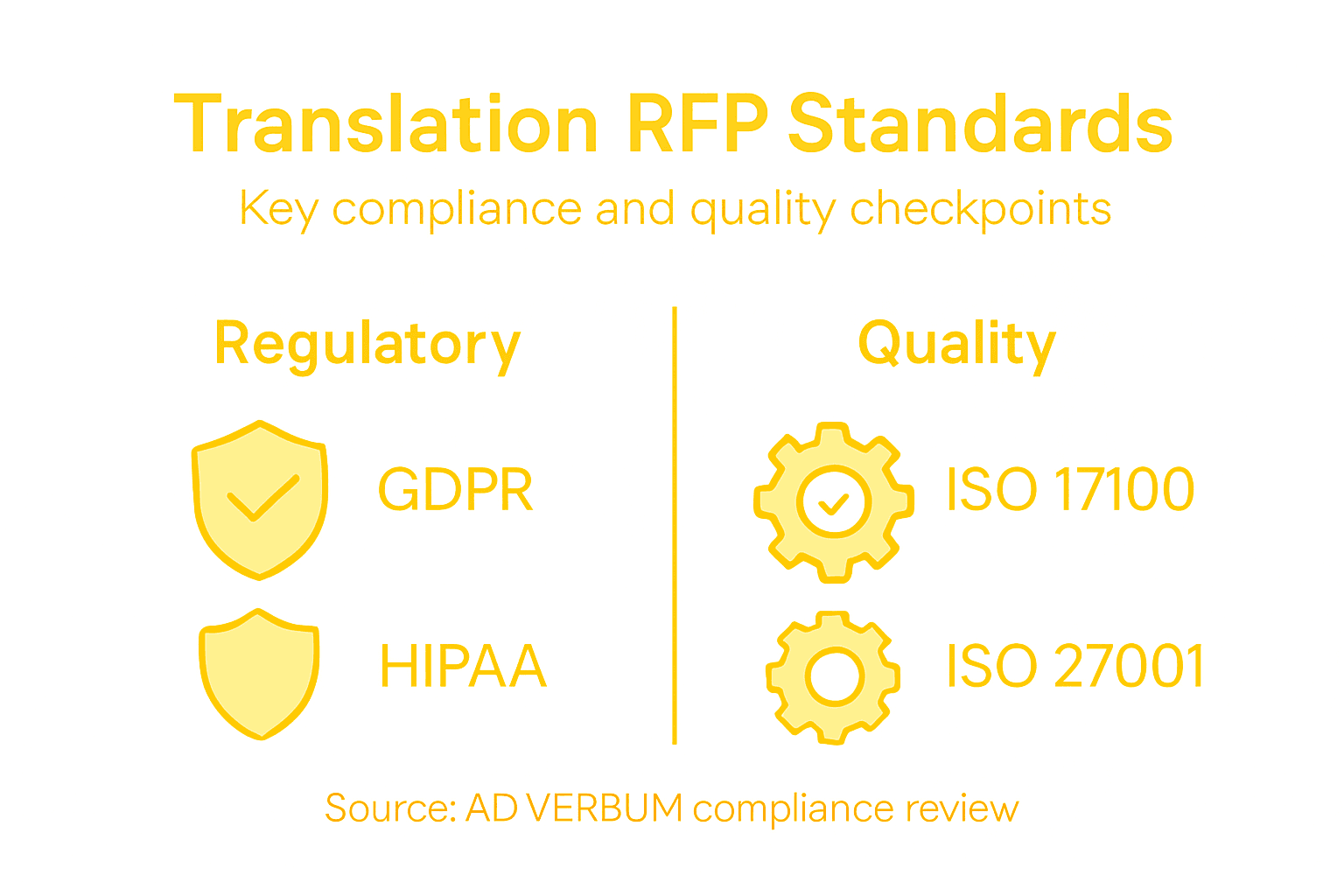
Begin by anchoring your QA requirements to ISO 17100. ISO 17100 quality management system requirements mandate documented processes for translation, revision, and client feedback. Your RFP should state whether ISO 17100 compliance is required, preferred, or simply informative. If required, request evidence of certification or third-party audit confirmation. If preferred, ask vendors to explain which ISO 17100 checkpoints they follow and why. This approach acknowledges that smaller vendors may not be fully certified but can still demonstrate quality discipline.
Specify your verification approach for terminology and consistency. Will vendors run outputs against your Term Bases to flag deviations? How will they handle terms that fall outside your approved glossary? Your RFP must state whether terminology mismatches require vendor correction or client review and approval. Define acceptable tolerance levels. In medical translation, 100 percent terminology consistency is non-negotiable. In marketing materials, minor variations might be acceptable if context is clear. State your position explicitly.
Define acceptance criteria for regulatory readiness. Your RFP should specify that translations must be suitable for submission to regulatory bodies without rework. This means no obvious errors, no inconsistent terminology, no safety-critical mistranslations. Ask vendors to explain how they validate regulatory compliance. Do they use regulatory specialists to review outputs? Do they cross-reference against applicable guidelines like ICH GCP or EMA guidance? Request concrete examples from their portfolio demonstrating regulatory submissions.
Establish feedback and correction mechanisms. How will you report quality issues to vendors? What is their turnaround for corrections? Your RFP should require vendors to commit to revision timelines and specify whether revisions are included in the original quote or billed separately. Address out of scope requests clearly so disputes do not delay project completion.
Pro tip: Include a sample document excerpt in your RFP and ask vendors to explain how they would QA that specific text against your standards. This reveals how vendors think about quality and whether they understand your regulatory context.
Step 5: Finalize and release the RFP to qualified providers
You have now assembled a comprehensive RFP document. Before sending it out, you need to validate it for completeness, identify which vendors qualify to receive it, and establish the submission and evaluation process. A poorly targeted RFP wastes vendor time and yields unsuitable proposals.
Review your RFP one final time for internal alignment. Verify that your regulatory requirements in Step 1 match your compliance standards in Step 2. Confirm that your workflow expectations in Step 3 align with your QA criteria in Step 4. Look for contradictions. If you require ISO 17100 certification but your workflow asks for minimal review, you are sending mixed signals. If you demand regulatory readiness but allow only single translator review, your criteria are incompatible. Resolve these conflicts before release or vendors will flag them in their proposals and request clarifications that delay evaluation.
Identify vendors qualified to receive your RFP. Do not send it to every translation company on your vendor list. A generalist translation service without medical expertise will struggle to provide meaningful responses to your compliance requirements. Instead, target language translation service providers capable of regulatory compliance. Ask your industry network for vendor recommendations. Check whether candidates hold ISO 17100 or ISO 13485 certifications. Verify their experience with your target languages and your regulatory framework. Call three to five vendors and ask direct questions before including them in the RFP distribution. If a vendor cannot explain ISO 18587 or describe their SME qualification process, they are not ready for compliance-grade work.
Establish clear submission instructions and evaluation timeline. Specify the deadline for proposal responses. State whether vendors can submit questions during the RFP window and by what date. Define your evaluation criteria explicitly: Is compliance capability weighted at 40 percent, turnaround at 20 percent, and price at 40 percent? Or different weights? Vendors need to know what matters to you. Specify the timeframe for your vendor selection decision and when you expect to begin work.
Include a formal data processing agreement template or reference in your RFP. European vendors especially expect this. State that any selected vendor must execute your data processing agreement before receiving protected data. This prevents delays after vendor selection.
Pro tip: Send your RFP to two or three qualified vendors initially rather than your entire vendor list. A smaller, more targeted release lets you refine your criteria based on real proposal feedback before a larger distribution. You will receive better proposals and learn what language clarifications your requirements actually need.
Achieve Compliance-Grade Translation with Confidence
Creating an RFP for compliance-grade translation services is complex and demands clear regulatory, technical, and security specifications. You need a partner who truly understands terms like ISO 17100, terminology governance, SME review, and GDPR security requirements to avoid costly errors and rework. AD VERBUM addresses these challenges by combining our proprietary AI-powered translation with 100 percent human subject-matter expert oversight. Our AI+HUMAN hybrid translation workflow ensures your documents align perfectly with regulatory frameworks such as MDR, HIPAA, and EMA standards while safeguarding sensitive data on EU-hosted infrastructure.
With over 25 years serving regulated sectors and a network of 3,500+ certified linguists, AD VERBUM delivers precise, audit-ready translations at 3 to 5 times faster turnaround times. Integrating your Translation Memories and Term Bases upfront guarantees consistent terminology enforcement across all deliverables. To navigate your next RFP confidently and secure the right compliance-grade language service provider, start by exploring how AD VERBUM’s proven approach can meet and exceed your strict quality assurance and security demands.
Are you ready to simplify your compliance translation process and mitigate risk now Visit AD VERBUM Contact to connect with our experts or learn more about our ISO 17100 Translation Standards and How to Ensure Translation Compliance. Take the first step toward translation precision and regulatory confidence today.
Frequently Asked Questions
How do I identify the regulatory requirements for my translation RFP?
To identify the regulatory requirements, map your document types to their applicable regulations. Document the regulation, document category, target market, and consequences of translation errors to ensure clarity for your vendors.
What key security standards should I include in my RFP for translation services?
In your RFP, specify security standards such as GDPR for data protection and ISO 27001 for information security management. Require vendors to confirm their compliance and provide evidence, ensuring your data remains protected throughout the translation process.
How can I ensure the translation vendor uses qualified subject matter experts?
Clearly state in your RFP that you require linguists with relevant domain expertise, such as certified medical translators or engineers. Ask vendors to provide credentials and confirm their qualifications to ensure compliance-grade translation.
What quality assurance criteria should I establish in my translation RFP?
Establish quality assurance criteria anchored to ISO standards, such as ISO 17100 for translation processes. Specify which checkpoints are mandatory and how vendors will verify terminology consistency and regulatory readiness to maintain high-quality standards.
How should I structure the workflow specifications in my RFP?
Document a detailed workflow that includes multiple review layers for high-stakes documents. Specify the roles involved, such as translators and subject matter experts, and outline the quality assurance checkpoints needed before final delivery to ensure thorough oversight.
What steps should I take before releasing my RFP to translation providers?
Before releasing your RFP, conduct a final review for internal alignment and ensure there are no contradictions in your criteria. Identify qualified vendors based on their expertise and compliance capabilities, and establish clear submission instructions to streamline the evaluation process.
Recommended
