GDPR Compliant Translation Explained for Legal Teams

GDPR-compliant translation is defined as the processing of personal data within translation workflows in full conformity with the General Data Protection Regulation, including Article 28 processor-contract obligations, Article 32 technical and organizational security controls, and applicable international transfer safeguards such as Standard Contractual Clauses and Transfer Impact Assessments. For compliance officers and legal teams in regulated industries, this is not a procedural formality. Every multilingual document containing personal data, whether a clinical trial record, a financial disclosure, or a data subject consent form, triggers GDPR obligations the moment it enters a translation workflow. The standard industry term for this discipline is GDPR-compliant language processing, and it covers vendor contracts, data minimization, sub-processor governance, and audit readiness as a unified compliance obligation.
What are the core contractual requirements for GDPR-compliant translation?
No DPA means unlawful processing under Article 28(3). Every translation vendor or tool that touches personal data on your behalf must operate under a written Data Processing Agreement before processing begins. This is the foundational rule of GDPR compliance in translation services, and it is non-negotiable regardless of vendor size or contract value.
A legally sufficient DPA for translation vendors must include the following minimum provisions under Article 28(3):
Processing instructions: The vendor processes data only on documented instructions from the controller.
Confidentiality obligations: All personnel with access to personal data are bound by confidentiality.
Security measures: Specific technical and organizational measures aligned to Article 32 are named, not referenced generically.
Sub-processor controls: The vendor obtains prior written authorization before engaging sub-processors, and flow-down obligations are contractually binding.
Data subject rights assistance: The vendor assists the controller in responding to data subject requests within statutory timeframes.
Deletion or return: Upon termination, the vendor deletes or returns all personal data and certifies destruction.
Audit rights: The controller retains the right to conduct audits or commission third-party assessments, with concrete access terms.
For international transfers, the 2021 Standard Contractual Clauses released under Decision (EU) 2021/914 apply when the translation vendor is located outside the European Economic Area in a country without an adequacy decision. Module 2, covering controller-to-processor transfers, is the applicable module for most translation vendor relationships. SCCs do not replace the DPA. They operate alongside it, and both documents must be executed before data flows cross borders.
Vendor management under Article 28 requires maintaining an evidence pack that maps data categories, processing purposes, retention periods, sub-processor chains, and audit pathways for each translation relationship. This evidence pack is what regulators and internal auditors will examine first.
Pro Tip: Request a completed sub-processor list from every translation vendor before contract signature. Vague authorizations such as “affiliates and partners” are a documented compliance failure point and will not satisfy a supervisory authority audit.

Common pitfalls in translation vendor contracts include overly broad sub-processor authorizations, generic security claims without named controls, and audit rights clauses that are unenforceable in practice. Regulators consistently identify missing audit detail and unclear deletion timelines as the primary deficiencies in vendor agreements.
How do technical and organizational measures protect data in translation workflows?
Article 32 requires controllers and processors to implement technical and organizational measures appropriate to the risk of the processing. Applied to translation workflows, this means the following controls must be in place before any personal data enters the translation pipeline:
Pseudonymization and encryption. Personal identifiers in source documents should be pseudonymized before submission to the translation vendor where technically feasible. Data in transit and at rest must be encrypted using current standards. Pseudonymization and encryption are explicitly named as Article 32 safeguards and are the first line of defense against unauthorized access during translation.
Access control. Only linguists and reviewers with a documented need to access specific documents should be granted access. Role-based access control, with logs, is the minimum standard. Access logs must be retained for audit purposes.
Data minimization and redaction. Raw sensitive data pasted into workflows without minimization violates GDPR process-control expectations even when a DPA is in place. Placeholder and redaction strategies, where sensitive identifiers are replaced with tokens before translation and reinserted afterward, reduce exposure materially. This is particularly relevant for medical records, legal contracts, and financial statements containing personal data.
Regional data processing and routing. Translation workflows must be designed so that personal data is processed within the EEA or in a jurisdiction covered by an adequacy decision or valid SCCs. Cloud-based translation tools that route data through US or Asian data centers without adequate transfer mechanisms create direct GDPR violations.
Audit trails and incident response. Every processing step in the translation workflow should generate a timestamped log. Incident response procedures must be documented, tested, and capable of producing a breach notification within the 72-hour window required by Article 33.
Pro Tip: For legal translation data security, implement a pre-translation data audit step that classifies each document by personal data category before it enters the vendor workflow. This classification determines which technical controls apply and creates a defensible record for regulators.
Effective workflow design that integrates redaction and regional routing reduces breach risk and aligns with GDPR’s data minimization and localization principles simultaneously. These are not separate compliance tasks. They are one integrated design decision.
What are the compliance risks and failure modes in GDPR translation?
The most common causes of GDPR non-compliance in translation projects fall into four categories, each with a distinct risk profile:
Incomplete or missing DPAs. Translation vendors are frequently onboarded under general service agreements that do not meet Article 28(3) minimum content requirements. The absence of a valid DPA makes every processing operation unlawful from the first document translated.
Transfer mechanism failures. Organizations that relied on Privacy Shield for US-based translation vendor transfers were exposed when the Court of Justice of the European Union invalidated it in Schrems II. The Transfer Impact Assessment is now mandatory when using SCCs for transfers to third countries. A TIA must analyze the destination country’s public authority access laws, documented cases, and available redress mechanisms. If the TIA identifies insufficiencies, supplementary technical, contractual, or organizational measures are required before transfers proceed.
Mistranslation of legal instruments. A mistranslated consent form, DPA, or SCC creates a gap between the legal obligation and the operative document. This gap can invalidate consent, expose the organization to Article 83 fines, and undermine the enforceability of the processor contract itself. Compliance officers should review risks from mistranslated DPAs as a distinct category of legal risk, not a translation quality issue.
Unvetted sub-processor chains. A translation vendor that engages a machine translation engine, a cloud storage provider, or a freelance reviewer without controller authorization and without contractual flow-down obligations creates a direct Article 28 violation. EDPB guidelines require controllers to have effective objection rights on sub-processor additions, and SOC 2 certificates alone are insufficient to satisfy this requirement.
Mitigation requires a compliance checklist applied at vendor onboarding, a periodic audit cycle for existing vendor relationships, and a governance framework that assigns ownership of translation vendor oversight to a named compliance function. The 7-step data security checklist for regulated sector translations provides a structured starting point for organizations building this framework.
How do recent regulatory updates affect GDPR translation practices?
The regulatory environment governing international data transfers in translation has changed materially since 2021. The table below summarizes the current transfer mechanisms and their implications for translation vendor relationships as of 2026.
Transfer mechanism | Status in 2026 | Implication for translation vendors |
Privacy Shield | Invalidated (Schrems II, 2020) | Cannot be used; all US vendor transfers require alternative basis |
2021 SCCs (Decision EU 2021/914) | Current standard | Module 2 applies to controller-to-processor translation relationships |
Transfer Impact Assessment | Mandatory with SCCs post-Schrems II | Required for every third-country transfer; must document legal environment analysis |
EU-U.S. Data Privacy Framework | Adequacy basis for self-certified US entities; non-certified US vendors still require SCCs and TIA |
The EU-U.S. Data Privacy Framework reduces the SCC burden for US-based translation vendors that have completed self-certification under the Framework. Non-certified US vendors, including many cloud-based translation platforms, still require the full SCC and TIA process. Compliance officers should verify certification status annually, as self-certification must be renewed.
National supervisory authorities across EU member states are increasing audit activity on processor contracts and international transfer documentation. The EDPB’s evolving guidance on audit and oversight clauses makes clear that contractual audit rights must be concrete and enforceable, not aspirational. Organizations operating across multiple EU jurisdictions should also account for jurisdiction-specific compliance differences that affect how translation vendor relationships are structured and documented.
What practical steps illustrate GDPR-compliant translation workflows?
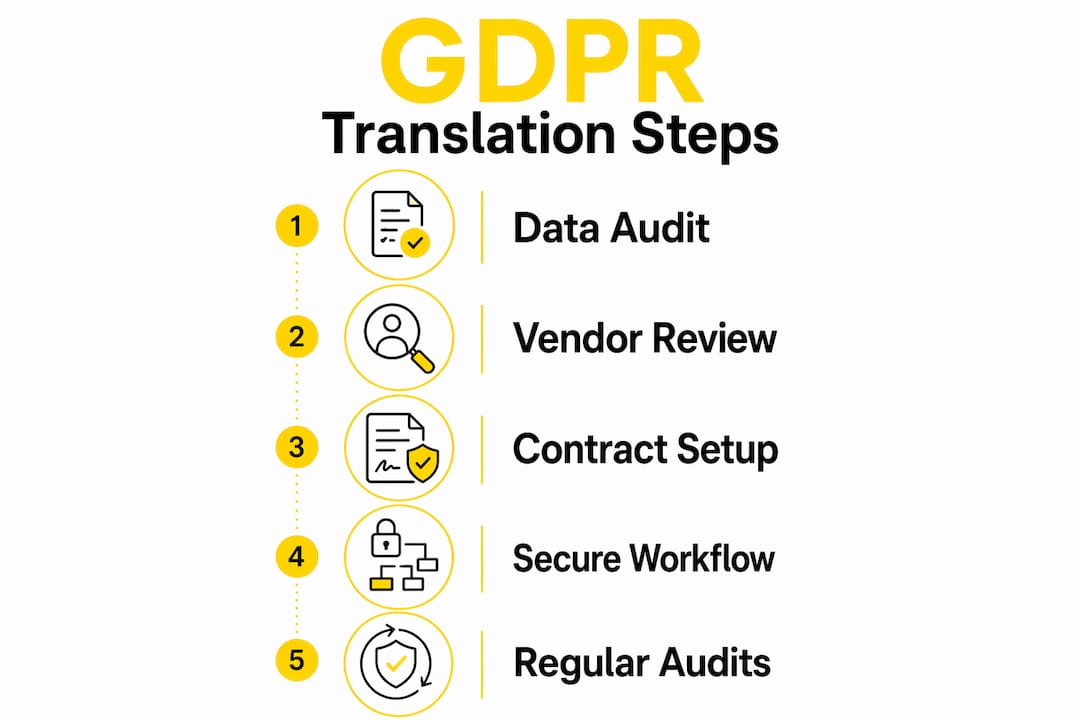
A GDPR-compliant translation workflow for regulated industries follows a defined sequence that integrates contractual, technical, and governance controls at each stage:
Map data flows and processor roles. Before any translation project begins, identify which documents contain personal data, which data categories are present, and which parties will process that data. Assign controller and processor roles in writing.
Conduct vendor risk assessments. Evaluate each translation vendor against Article 28 requirements. Verify sub-processor lists, data center locations, security certifications such as ISO 27001, and incident response capabilities. For technical document translation compliance, verify that the vendor’s terminology governance controls are documented.
Execute DPAs and SCCs before data transfer. DPAs must be signed before the first document is submitted. For international transfers, SCCs and the completed TIA must be in place. Document the date of execution and retain copies in the evidence pack.
Apply data minimization and redaction at source. Before submitting documents to the translation workflow, apply redaction or pseudonymization to personal identifiers that are not required for translation accuracy. Maintain a mapping table for reinsertion after translation is complete.
Monitor, audit, and prepare for breach response. Conduct periodic reviews of vendor sub-processor lists and security posture. Maintain audit logs for all translation processing activities. Test the breach response procedure against the 72-hour Article 33 notification requirement at least annually.
Key takeaways
GDPR-compliant translation requires valid DPAs, current SCCs with Transfer Impact Assessments, Article 32 technical controls, and auditable sub-processor governance before any personal data enters a translation workflow.
Point | Details |
DPA is mandatory | Every translation vendor processing personal data requires a written DPA meeting Article 28(3) minimum content before work begins. |
SCCs and TIA for international transfers | Module 2 SCCs under Decision (EU) 2021/914, paired with a completed TIA, are required for non-EEA translation vendors without an adequacy decision. |
Technical controls are not optional | Pseudonymization, encryption, access control, and redaction must be implemented in the translation workflow, not just referenced in contracts. |
Sub-processor chains require active governance | Vendor sub-processor lists must be reviewed, authorized in writing, and subject to contractual flow-down obligations with enforceable audit rights. |
Mistranslation creates legal exposure | Inaccurate translation of DPAs, consent forms, or SCCs can invalidate legal instruments and trigger Article 83 fines independent of data security failures. |
Why compliance officers underestimate translation as a data processing risk
I have reviewed Article 28 compliance programs across life sciences, financial services, and legal sectors for years, and the pattern is consistent. Organizations invest heavily in vendor due diligence for their core IT systems and almost nothing in the same rigor for translation vendors. The assumption is that translation is a service, not a data processing operation. GDPR does not share that assumption.
The most commonly overlooked technical safeguard is redaction at source. Legal teams send complete case files, clinical records, or financial statements to translation vendors without removing personal identifiers that have no bearing on the translation task. The DPA may be signed. The SCCs may be in place. But the data minimization obligation under Article 5(1)© is still violated because the workflow was not designed with minimization in mind.
The second gap I see consistently is in sub-processor governance. A translation vendor’s DPA may be well-drafted, but if that vendor uses a public cloud machine translation engine or a freelance reviewer platform without controller authorization and without flow-down obligations, the compliance chain is broken. SOC 2 reports and ISO 27001 certificates do not substitute for contractual audit rights, as the EDPB has made explicit.
The shift toward AI+HUMAN hybrid translation models adds a new governance dimension. When a proprietary LLM-based system processes personal data, the data sovereignty question becomes critical. EU-hosted infrastructure with no reliance on outsourced public cloud tooling is not a marketing claim in this context. It is a compliance requirement. Organizations evaluating translation technology for regulated content should treat EU data residency and documented sub-processor chains as threshold criteria, not differentiators.
How AD VERBUM supports GDPR-compliant translation for regulated industries

AD VERBUM’s AI+HUMAN hybrid translation workflow is designed for exactly the compliance requirements described in this article. The process begins with asset integration of client Translation Memories and Term Bases, followed by output from AD VERBUM’s proprietary LLM-based LangOps System hosted on private EU infrastructure with no reliance on outsourced public cloud tooling. Every output is reviewed by a certified subject-matter expert, with QA aligned to ISO 17100, ISO 18587, and sector requirements including MDR. AD VERBUM holds ISO 27001 certification and operates in alignment with GDPR and HIPAA. For regulated industries requiring multilingual compliance solutions with documented sub-processor governance and audit-ready workflows, AD VERBUM’s localization services provide the contractual and technical framework this work demands.
FAQ
What is GDPR in the context of translation services?
GDPR applies to translation services whenever personal data appears in documents submitted for translation. The translation vendor becomes a data processor under Article 28, requiring a written DPA and compliance with all GDPR processor obligations.
When are Standard Contractual Clauses required for translation vendors?
SCCs are required when a translation vendor is located outside the EEA in a country without a European Commission adequacy decision. Module 2 of the 2021 SCCs applies to controller-to-processor relationships, and a Transfer Impact Assessment must accompany them.
Does the EU-U.S. Data Privacy Framework eliminate SCC requirements for US translation vendors?
Only for US vendors that have completed self-certification under the Framework. Non-certified US translation vendors still require Module 2 SCCs and a completed Transfer Impact Assessment as of 2026.
What makes a DPA insufficient for GDPR translation compliance?
A DPA is insufficient if it lacks specific security measures, enforceable audit rights, named sub-processor controls, or documented deletion timelines. Generic security references and broad sub-processor authorizations are the most common deficiencies identified by supervisory authorities.
How does mistranslation create GDPR legal exposure?
An inaccurate translation of a consent form, DPA, or SCC creates a gap between the legal obligation and the operative document, which can invalidate consent or render the processor contract unenforceable, exposing the organization to Article 83 administrative fines.
Recommended