


How to Ensure Translation Compliance for Technical Documents

Complex compliance requirements can turn technical document translation into a major hurdle for European pharmaceutical and medical device companies. Relying on inconsistent terminology or outdated workflows risks regulatory setbacks and costly revisions. Deploying AI powered translation that uses translation memories and glossaries for standardized language offers a path to both precision and efficiency. This guide breaks down how to combine cutting edge AI solutions with subject matter expertise for translation compliance you can trust.
Table of Contents
Quick Summary
Key Point | Explanation |
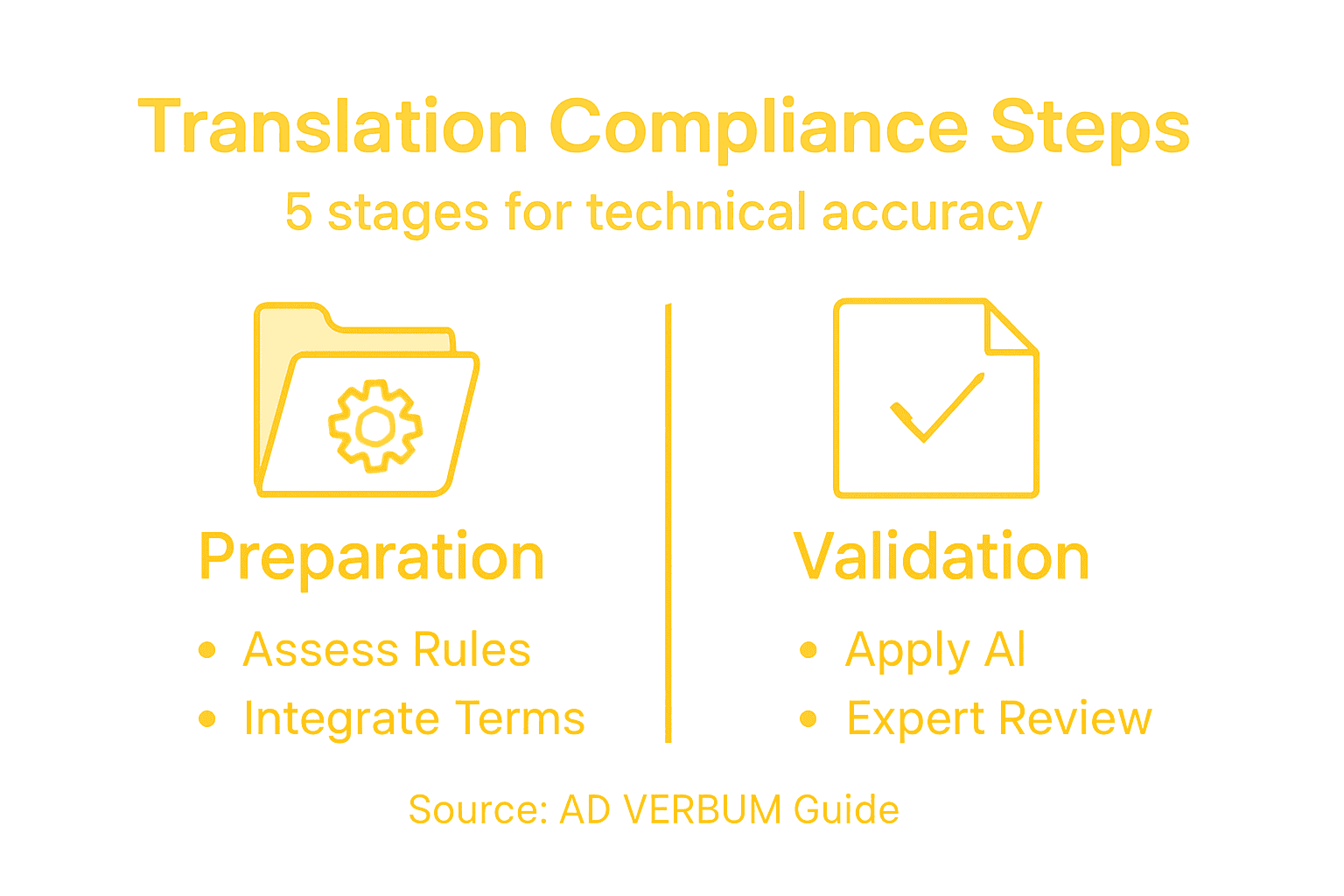
1. Assess Regulatory Requirements | Thoroughly understand regulatory frameworks to ensure compliance in technical documents specific to each market and industry. |
2. Integrate TMs and Glossaries | Use translation memories and glossaries to standardize terminology and improve accuracy across all translations. |
3. Apply LLM-Based AI | Utilize advanced AI for consistent use of specialized terms, enhancing overall translation precision and regulatory adherence. |
4. Verify with Subject-Matter Experts | Engage expert linguists to validate translations, ensuring technical accuracy and contextual relevance beyond automated systems. |
5. Conduct Rigorous QA | Implement a comprehensive quality assurance process to verify that all translated documents meet stringent industry and legal standards. |
Step 1: Assess Regulatory Requirements for Each Project
Successful translation compliance begins with a comprehensive understanding of the specific regulatory landscape governing your technical document. Each industry and region presents unique compliance challenges that demand meticulous attention to detail.
Start by conducting an exhaustive review of the target market’s regulatory framework. This involves identifying the precise standards and guidelines that apply to your specific document type, whether it’s a medical device manual, pharmaceutical research protocol, or technical engineering specification. Master Regulated Document Translation Workflow suggests creating a detailed compliance matrix that maps out all relevant regulatory requirements.
Your assessment should include scrutinizing international standards such as ISO regulations, region specific compliance protocols (like European Medical Device Regulation for medical documents), and industry specific guidelines. Pay close attention to terminological requirements, formatting standards, and legal disclaimers that might vary significantly across different jurisdictions. Document every regulatory requirement meticulously to ensure your translation will pass rigorous compliance checks.
Pro Tip: Develop a standardized regulatory checklist for each document type to streamline your compliance assessment process and reduce potential oversight risks.
Step 2: Integrate Approved Translation Memories and Glossaries
Successful technical document translation relies on strategically integrating translation memories (TMs) and specialized glossaries to maintain consistent terminology and regulatory compliance across all translated content. These critical resources serve as foundational tools for ensuring accuracy and precision in your translation workflow.
To effectively integrate TMs and glossaries, begin by aligning translation memory segments with your source content. This process involves mapping existing approved translations to new documents, which enables automatic recognition of previously translated segments and terminology. Professional translators can leverage these resources to maintain consistent language, technical terminology, and industry specific terminology across multiple documents and translation projects.

Each technical document should be cross referenced with your organization’s approved terminology database. Pay special attention to domain specific terms, regulatory language, and technical nomenclature that require precise translation. By systematically integrating translation memories and glossaries, you create a robust framework that minimizes translation errors, reduces linguistic inconsistencies, and accelerates the overall translation process while maintaining strict compliance standards.
Pro Tip: Update your translation memories and glossaries regularly to reflect evolving industry terminology and regulatory language requirements.
Step 3: Apply Proprietary LLM-Based AI for Terminology Enforcement
Implementing a sophisticated proprietary Large Language Model (LLM) for terminology enforcement represents a critical strategy for maintaining translation accuracy and regulatory compliance across technical documents. This advanced approach goes far beyond traditional translation methods by intelligently integrating specialized vocabulary and industry specific terminology.
The key to successful LLM based terminology enforcement lies in extracting and teaching specialized vocabulary directly to the AI system. This process involves creating comprehensive glossaries that map out precise technical terms, ensuring the AI understands and applies domain specific language with exceptional accuracy. Professional translators can configure the LLM to recognize and consistently use approved terminology, effectively preventing translation variations that could compromise technical precision or regulatory compliance.
To maximize the effectiveness of your proprietary LLM approach, develop a robust terminology management strategy that includes continuous refinement of your language model. This involves regularly updating the AI’s knowledge base with new technical terms, industry specific language, and regulatory terminology. By implementing a dynamic approach to terminology enforcement, you create a translation workflow that maintains the highest standards of linguistic accuracy and technical consistency across all your documentation.
Pro Tip: Conduct periodic terminology validation tests to ensure your LLM maintains optimal performance and adapts to evolving industry language requirements.
Step 4: Verify Output with Subject-Matter Expert Linguists
Translation verification represents the critical final checkpoint in ensuring technical document compliance, where human expertise transforms machine generated content into precisely accurate regulatory documentation. This step transforms raw AI translation into professionally validated technical communication.
The verification process requires engaging human expertise in translation with specialized domain knowledge who can comprehensively review the AI generated text. Subject matter expert linguists meticulously examine each translated document, focusing on technical accuracy, regulatory terminology, and contextual nuance that automated systems might inadvertently miss. These linguistic professionals bring irreplaceable contextual understanding that goes beyond literal translation, ensuring that scientific, medical, or technical terminology maintains its precise intended meaning across language barriers.
During the verification stage, subject matter experts systematically cross reference the translated document against original source materials, industry specific style guides, and regulatory standards. They evaluate not just linguistic precision but also technical comprehensiveness, checking that specialized terminology, technical specifications, and regulatory requirements are faithfully and accurately represented. This human validation layer transforms AI generated translation into a fully compliant, professionally vetted document ready for regulatory submission.
Pro Tip: Select subject matter experts with both linguistic proficiency and deep technical expertise in your specific industry to maximize translation accuracy.
Step 5: Conduct Rigorous QA to Certify Regulatory Compliance
Quality assurance represents the final critical safeguard in translation compliance, transforming technically translated documents into legally defensible regulatory submissions. This comprehensive verification process ensures every translated document meets the most stringent industry and legal standards.
Begin by implementing a systematic translation quality assurance checklist that covers multiple compliance dimensions. Your QA protocol should include comprehensive linguistic validation, technical accuracy assessment, formatting consistency checks, and regulatory standard alignment. Professional QA teams will methodically review each translated document against original source materials, cross referencing technical terminology, maintaining precise formatting requirements, and ensuring absolute alignment with industry specific regulatory frameworks.
The QA process goes beyond simple linguistic review. It demands a multidimensional approach that examines translation accuracy from technical, legal, and regulatory perspectives. Reviewers must verify that specialized terminology remains consistent, technical specifications are precisely translated, and all regulatory language maintains its original legal implications. This meticulous verification process transforms translation from a mechanical task into a strategic compliance mechanism that protects your organization from potential regulatory risks.
Pro Tip: Develop a comprehensive QA scoring system that quantifies translation quality across multiple compliance metrics to standardize and track your verification process.
The table below contrasts traditional translation approaches with integrated AI and expert workflows:
Approach | Consistency | Regulatory Compliance | Efficiency |
Traditional (Human Only) | Subject to individual variation | High but labor-intensive | Moderate speed |
AI Only | High for repeated terms | May miss nuanced compliance | Fast but may lack accuracy |
AI + Human Experts | Maximum consistency | Strict adherence to regulations | Fast and thorough |
Here’s a summary of each step’s core objective and its primary benefits:
Step | Core Objective | Key Benefit |
1: Assess Requirements | Identify all relevant regulations | Ensures full legal compliance |
2: Integrate TMs & Glossaries | Standardize terminology & update resources | Reduces errors and inconsistencies |
3: Apply LLM-Based AI | Enforce domain-specific term usage | Enhances technical precision |
4: Expert Linguist Verification | Validate by human experts | Guarantees contextual accuracy |
5: Rigorous QA | Comprehensive final compliance check | Certifies quality and legal defensibility |
Ensure Absolute Translation Compliance with AD VERBUM’s AI+HUMAN Workflow
The article highlights the critical challenges companies face when translating technical documents for regulated industries. Ensuring strict adherence to complex regulatory requirements while maintaining precise terminology is no longer optional. Mistakes can lead to regulatory rejection, legal risks, or costly delays. Pain points such as inconsistent terminology, data security concerns, and the need for expert validation demand a solution beyond typical machine translation or fragmented workflows.
AD VERBUM addresses these challenges with a proprietary LLM-based AI integrated into a rigorous AI+HUMAN process. Unlike public Neural Machine Translation that risks data leakage and inconsistent term usage, our secure system enforces terminology strictly within your regulatory framework. Supported by over 3,500 subject-matter expert linguists, we guarantee precision, context-aware translation, and compliance with global standards including Medical Device Regulation and GDPR.
If you require translation services that combine technological superiority with unmatched regulatory assurance, explore how our specialized industry translations can protect your technical documents. Visit Contact AD VERBUM today to discuss your project and safeguard your compliance standards with the safest AI+HUMAN solution available.
Frequently Asked Questions
What are the key regulatory requirements to consider for translation compliance?
Understanding regulatory requirements involves reviewing the specific standards that apply to your document type. Conduct an exhaustive assessment of the target market’s regulations and create a compliance matrix to map all relevant requirements.
How can I ensure consistent terminology across translated technical documents?
Integrate approved translation memories and glossaries into your translation process to maintain consistent terminology. Regularly update these resources to reflect the latest industry-specific language, which can reduce translation errors significantly.
What role does Artificial Intelligence play in ensuring translation accuracy?
Implementing a proprietary Large Language Model (LLM) can enhance translation accuracy by enforcing domain-specific terminology. Train the LLM with specialized vocabulary to ensure correct usage and add new terms continuously for optimal performance.
Why is it important to involve subject-matter experts in the translation verification process?
Engaging subject-matter expert linguists is critical to check for technical accuracy and regulatory compliance in the translation. Their expertise helps bridge the gap between raw machine translations and the contextually accurate technical documents required for regulatory submission.
What steps should I take for quality assurance in translated documents?
Conduct a rigorous quality assurance process that includes a comprehensive checklist covering linguistic validation, technical accuracy, and regulatory compliance. Aim for a detailed review that captures all compliance aspects to certify the final document before submission.
Recommended
