


Why ISO 27001 Matters in Translation Security

Nearly 80 percent of regulatory decision-makers across European sectors now rank information security as their top translation priority, driven by ever-stricter American and global regulations. For pharmaceutical and medical device companies in Northern European countries, data exposure risks can lead to costly compliance setbacks and loss of trust. This article highlights the critical ways ISO 27001 standards protect translation workflows, giving your team the knowledge to safeguard sensitive assets and meet evolving security demands.
Table of Contents
Key Takeaways
Point | Details |
ISO 27001 Certification | Ensures translation providers adhere to rigorous information security practices, essential for client trust and compliance in regulated industries. |
Data Security Protocols | Implementing strict access controls, encryption, and continuous monitoring minimizes risks associated with sensitive information management. |
Holistic Approach | A comprehensive workflow that integrates AI and human oversight guarantees data protection and accuracy at every stage of the translation process. |
Regular Audits and Improvement | Conducting consistent security audits and reviews of ISO 27001 compliance helps identify vulnerabilities and strengthen information security measures. |
ISO 27001 in Translation Explained
In the high-stakes world of translation, especially for regulated industries like pharmaceuticals and medical devices, information security is not a luxury but a fundamental requirement. ISO 27001 represents the gold standard for protecting sensitive data throughout translation workflows. This international standard provides a comprehensive framework for managing and protecting critical information assets, ensuring that every translation project maintains rigorous security protocols.
The standard addresses information security through a systematic approach that goes far beyond simple data protection. ISO/IEC 27001 specifies requirements for establishing, implementing, maintaining and continually improving an information security management system that covers technological, human, and procedural aspects of data protection. For translation service providers like AD VERBUM, this means creating a holistic strategy that safeguards client information at every stage of the translation process.
Key components of ISO 27001 implementation in translation security include:
Comprehensive risk assessment for potential data breaches
Strict access controls for sensitive translation materials
Encrypted communication channels
Detailed documentation of security procedures
Regular internal audits and continuous improvement mechanisms
By adhering to ISO 27001 standards, translation providers demonstrate a commitment to protecting client intellectual property, maintaining confidentiality, and mitigating potential cybersecurity risks. For organizations in highly regulated sectors, partnering with an ISO 27001 certified translation service is not just a preference but a critical compliance requirement.
Pro Tip: When selecting a translation partner, always request and verify their ISO 27001 certification documentation to ensure comprehensive information security protection.
Unique Data Risks in Regulated Industries
Regulated industries like healthcare, pharmaceuticals, and medical devices face extraordinarily complex data security challenges that extend far beyond traditional cybersecurity concerns. These sectors handle sensitive information with profound legal and ethical implications, where a single data breach could compromise patient safety, intellectual property, and organizational credibility.
Regulated industries have distinct cybersecurity challenges due to the sensitivity and regulatory obligations of their data, requiring robust security controls that manage risks related to confidentiality, integrity, and availability of critical operational technology. For translation workflows, this means implementing stringent protocols that protect every piece of information from initial document receipt through final delivery.
Specific data risks in these industries include:
Patient medical records with protected health information
Clinical trial documentation
Pharmaceutical research data
Medical device specification documents
Regulatory compliance paperwork
Each of these document types carries significant legal and ethical responsibilities. A mistranslation or unauthorized data exposure could result in severe consequences, including regulatory penalties, loss of professional credentials, and potential legal litigation. AD VERBUM’s AI+HUMAN workflow is specifically designed to mitigate these risks through comprehensive security protocols aligned with ISO 27001 standards.
Pro Tip: Conduct quarterly comprehensive security audits of your translation workflows to proactively identify and address potential data vulnerability points.
Here’s how ISO 27001 implementation supports regulated industries in translation:
ISO 27001 Feature | Impact for Regulated Sectors | Translation Benefit |
Risk-Based Approach | Addresses sector-specific threats | Tailored data protection |
Access Management | Restricts sensitive data exposure | Limits personnel risks |
Continuous Monitoring | Detects evolving compliance threats | Early issue identification |
Staff Training | Reduces insider errors and breaches | Ensures secure workflows |
How ISO 27001 Enhances Security Controls
In the complex landscape of information security, ISO 27001 represents a comprehensive framework that transforms theoretical risk management into actionable, systematic protection strategies. Unlike generic security approaches, this international standard provides a meticulously structured methodology for identifying, assessing, and mitigating information security risks across an organization’s entire operational ecosystem.

The ISO 27001 standard defines a comprehensive set of 114 controls grouped into 14 critical sections covering policies, organization, human resource security, asset management, and more. These controls are not merely theoretical guidelines but practical mechanisms designed to create a robust defense against evolving cyber threats. For translation service providers like AD VERBUM, this means implementing rigorous protocols that protect sensitive client information at every single touchpoint.
Key security control areas within ISO 27001 include:
Comprehensive risk assessment protocols
Strict access management procedures
Advanced cryptographic protection methods
Detailed incident response frameworks
Continuous monitoring and improvement mechanisms
Robust physical and digital security boundaries
Comprehensive staff training and awareness programs
The standard’s true power lies in its dynamic approach to security. AD VERBUM’s AI+HUMAN workflow integrates these ISO 27001 controls seamlessly, ensuring that every translation project undergoes multiple layers of security verification. This means clients receive not just translated documents, but documents processed through a world-class security management system that anticipates and neutralizes potential risks before they can emerge.
Pro Tip: Develop a comprehensive security risk register that maps each ISO 27001 control to your specific operational workflows, enabling proactive and targeted risk mitigation.
Compliance, Client Trust, and Market Access
In the intricate world of regulated industries, ISO 27001 certification transcends mere technical compliance—it represents a strategic cornerstone for building organizational credibility and accessing competitive markets. Companies operating in high-stakes sectors like pharmaceuticals, medical devices, and healthcare cannot afford to treat information security as an afterthought.
ISO/IEC 27001 certification demonstrates an organization’s commitment to protecting data, reducing business risk, and meeting legal and contractual obligations worldwide. For translation service providers like AD VERBUM, this means offering clients more than just linguistic accuracy—it means providing a comprehensive security ecosystem that instills confidence and meets the most stringent regulatory requirements.
The strategic benefits of ISO 27001 certification include:
Enhanced client trust and organizational reputation
Access to regulated and high-security market segments
Competitive differentiation in sensitive industries
Proactive risk management framework
Streamlined compliance with international regulations
Reduced potential for data breach liabilities
Improved internal security governance
AD VERBUM’s AI+HUMAN workflow leverages ISO 27001 standards to create a transparent, secure translation process that goes beyond traditional service models. By integrating robust security controls, we transform information protection from a compliance requirement into a strategic business advantage that directly addresses the complex needs of our clients in regulated sectors.
Pro Tip: Conduct an annual comprehensive review of your ISO 27001 certification to ensure continuous alignment with evolving regulatory landscapes and emerging security challenges.
AD VERBUM’s Secure AI+HUMAN Translation Workflow
AD VERBUM’s proprietary translation workflow represents a quantum leap beyond traditional translation methodologies, integrating cutting-edge artificial intelligence with subject matter expert human oversight. This AI+HUMAN approach is not just a technological solution, but a comprehensive security strategy designed to protect sensitive information throughout the entire translation process.
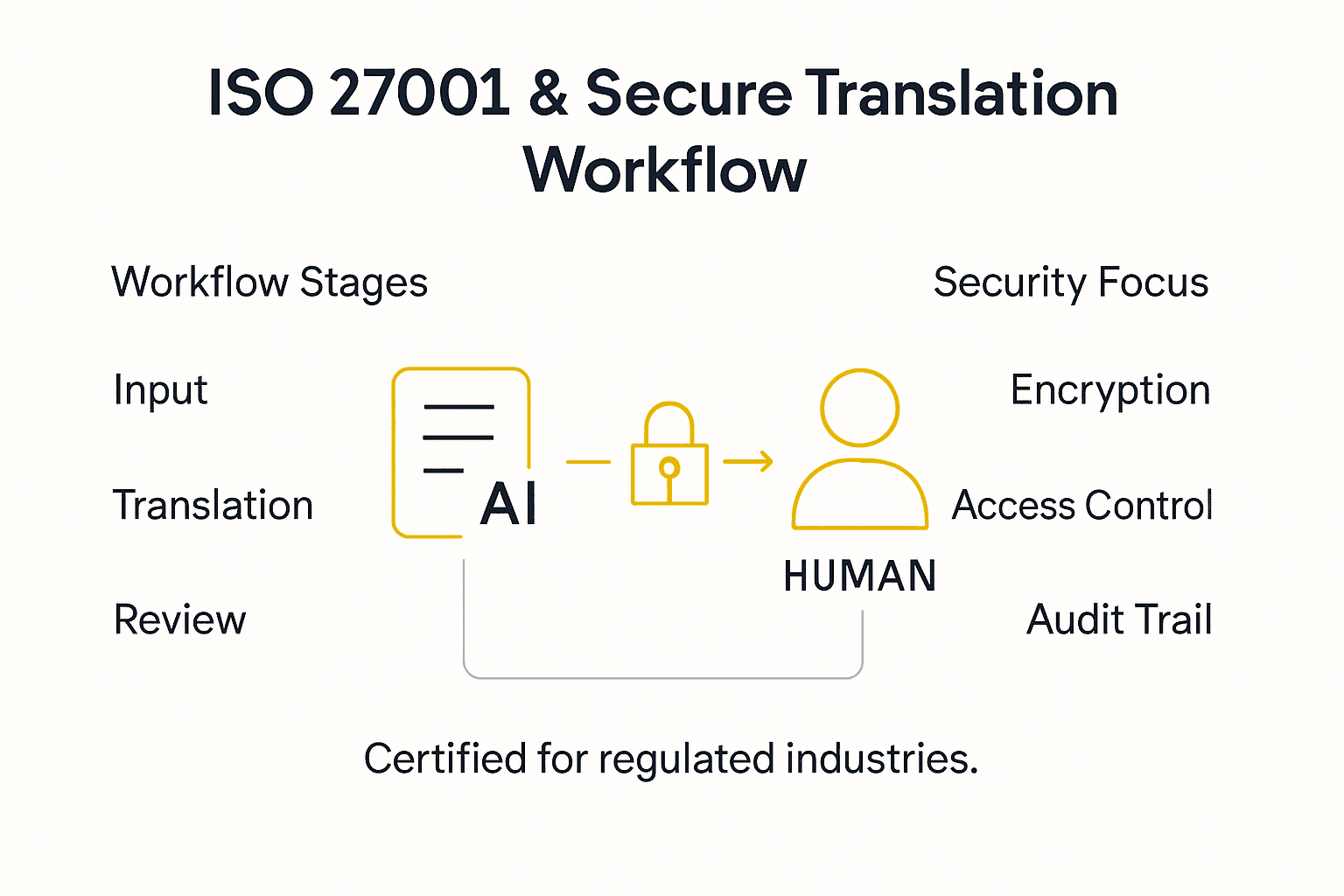
Organizations leveraging AI and human expertise in translation must implement rigorous information security management systems to safeguard client data privacy and confidentiality. Our workflow accomplishes this through a meticulously designed four-stage process that ensures maximum security, precision, and compliance with international standards like ISO 27001.
The AI+HUMAN workflow stages include:
Secure Asset Ingestion
Client documents encrypted during upload
Strict access control protocols
Comprehensive metadata sanitization
AI Initial Translation
Proprietary LLM trained on industry-specific terminology
Closed-loop system with zero external data exposure
Immediate security risk assessment
Subject Matter Expert Review
Certified professionals with industry-specific backgrounds
Line-by-line verification of technical accuracy
Additional security validation
Final Compliance Verification
Multi-layered quality assurance checks
Cryptographic document signing
Secure archival of translation assets
Each stage is designed with multiple security checkpoints that go beyond traditional translation workflows. Our information security management approach ensures systematic risk management by addressing potential threats, vulnerabilities, and potential impacts, making AD VERBUM the preferred partner for organizations with the most stringent security requirements.
Below is an overview of how the AI+HUMAN workflow integrates security and quality at each stage:
Workflow Stage | Primary Security Focus | Added Value |
Secure Asset Ingestion | Encryption and access restriction | Prevents data leakage |
AI Initial Translation | No external data exposure | Protects confidential info |
Expert Review | Professional credential checks | Ensures accuracy & trust |
Compliance Verification | Multi-layered assurance | Verifies regulatory alignment |
Pro Tip: Implement a quarterly security audit of your translation workflow to proactively identify and mitigate potential information security risks before they become critical challenges.
Elevate Your Translation Security with AD VERBUM’s ISO 27001 Certified AI+HUMAN Workflow
ISO 27001 is essential for organizations demanding top-tier information security in translation. If your company faces challenges protecting sensitive data in highly regulated sectors like pharmaceuticals, legal, or medical devices, understanding the risks of data breaches and terminology errors is critical. The key pain points include preventing unauthorized access, avoiding data leakage, and enforcing strict terminology control to ensure compliance and accuracy.
AD VERBUM addresses these challenges through our proprietary AI+HUMAN workflow hosted entirely on secure EU servers and certified under ISO 27001. Unlike typical public cloud or standard neural machine translation solutions, our private, LLM-based AI strictly enforces your approved terminology and maintains full data sovereignty. Combined with 3,500+ subject-matter experts, this ensures precision, compliance, and unmatched data protection across all your technical and regulated content.
Companies ready to transform their translation security can learn more about our specialized services and rigorous compliance standards by visiting the AD VERBUM website. Secure your sensitive documentation now with a trusted partner dedicated to your security and accuracy needs. Discover why industry leaders depend on our ISO 27001 certified AI+HUMAN workflow and comprehensive regulated industry solutions to safeguard their most vital information.
Frequently Asked Questions
What is ISO 27001?
ISO 27001 is an international standard for information security management systems (ISMS) that provides a framework for managing and protecting sensitive information assets through systematic risk management and security controls.
Why is ISO 27001 important for translation service providers?
ISO 27001 is crucial for translation service providers because it ensures that sensitive client information is protected throughout the translation process, maintaining confidentiality and compliance with legal requirements, especially in regulated industries like healthcare and pharmaceuticals.
How does ISO 27001 enhance security in translation workflows?
ISO 27001 enhances security in translation workflows by implementing comprehensive risk assessments, strict access controls, encrypted communication, and regular audits, thus safeguarding sensitive data from potential breaches.
What are the benefits of requesting an ISO 27001 certification from a translation partner?
Requesting ISO 27001 certification from a translation partner signals their commitment to protecting sensitive information, reduces the risk of data breaches, ensures compliance with industry regulations, and instills client trust in the translation process.
Recommended

