


The Language Barrier Between You and Your First NATO Contract

Submitting medical device bids to NATO often feels like navigating a maze of specialized terms and evolving regulatory phrases. Language inconsistencies and terminology gaps hidden in multi-authored documents quickly undermine credibility with NATO evaluators. For European regulatory affairs managers, mastering terminology governance and hybrid translation workflows is crucial, minimizing compliance risks and strengthening bid scores. This guide breaks down proven steps to detect, fix, and validate linguistic gaps, ensuring your bid stands up to NATO standards without unexpected translation setbacks.
Table of Contents
Quick Summary
Key Point | Explanation |
1. Identify Linguistic Gaps | Spot terminology mismatches and regulatory references before bid submission to enhance credibility. |
2. Implement Terminology Tools | Use a Term Base and Translation Memory to ensure consistent language and reduce errors during reviews. |
3. Utilize Hybrid Translation | Combine AI translation with SME review to detect compliance and terminology errors effectively. |
4. Conduct a Terminology Audit | Validate consistency against your Term Base before submission to avoid potential bid rejection. |
5. Quantify Bid Risks | Assess language errors’ financial impact to justify compliance investment as a risk mitigation strategy. |
Step 1: Identify Linguistic Gaps in Bid Documentation
Linguistic gaps in NATO and EU defense tender documentation are inconsistencies, terminology mismatches, and semantic variations that undermine bid credibility during evaluation. Your goal is to spot these gaps before submission—when they are still fixable.
Start by comparing your bid’s language against the official RFP (Request for Proposal) source document. Read through the RFP and highlight every technical term, compliance phrase, and regulatory reference. Then open your draft bid response and check whether you use the exact same wording in the same context.
What you are looking for:
Terminology shifts. The RFP says “configuration management plan.” Your bid says “CM plan” or “management of configurations.” Same concept, different words. Evaluators notice.
Negation and safety-critical language. The RFP specifies “shall not exceed 5mm tolerance.” Your technical annex says “maintains tolerance below 5mm.” The meaning differs slightly, and in defense procurement, slight differences trigger compliance flags.
Regulatory reference drift. The RFP cites AQAP 2110 requirements. You reference “quality assurance standards” without naming AQAP 2110. Evaluators must cross-reference, and they interpret missing citations as incomplete understanding.
Research on linguistic variation in NATO documents demonstrates that inconsistent terminology and stylistic gaps directly correlate with contractual misinterpretation and reduced bid scores. Multi-authored documentation is particularly vulnerable because different team members use different terms for the same concept.
Use a three-step scan:
Extract every defined term from the RFP’s glossary or definitions section.
Search your entire bid package for those terms and note every instance.
Flag any deviation—different phrasing, abbreviation, or context.
Record deviations in a simple spreadsheet: RFP term, your term, location in bid, severity (critical, moderate, minor). Critical gaps are negation phrases, regulatory citations, and safety-qualified statements. Moderate gaps are technical terminology where meaning is clear but wording differs. Minor gaps are style or formatting inconsistencies.
Linguistic consistency is not stylistic preference—it is a compliance control that directly affects evaluation scoring and contract execution risk.
Once you map gaps, you know exactly which sections require remediation. This process also reveals whether your team is using inconsistent language internally, which is a hidden cost driver that emerges during translation and QA review.
Pro tip: Create a terminology reference document (Term Base) from the RFP before you begin writing your response. Share it with all bid contributors so everyone uses identical language from the start. This eliminates gap creation during drafting and accelerates translation review later.
Step 2: Integrate Terminology Governance Tools Early
Terminology governance tools are systems that enforce consistent language across your entire bid package. The earlier you integrate them, the fewer costly revisions you face downstream—especially during translation and compliance review.

Start by selecting the right tools for your bid team. You need two components: a Translation Memory ™ and a Term Base (TB). A Translation Memory stores previously translated segments so your team reuses approved language. A Term Base is a database of approved terms with definitions, context, and approved translations in target languages.
For NATO and EU defense bids, this matters because evaluators flag terminology inconsistency as a red flag for quality control maturity. Effective terminology governance in technical translation directly supports bid credibility and reduces post-award contract disputes.
Here’s what to do:
Populate your Term Base immediately. Extract all RFP-defined terms, AQAP 2110 requirements, and regulatory references into your Term Base before writing begins. Include the approved English term, definition, context, and any approved translations if you’re bidding in multiple languages.
Configure your TM and TB integration. Connect your Term Base to your drafting and translation tools so that when team members write, the system flags unapproved terminology in real-time. This prevents deviation before it happens.
Lock critical terms. Mark safety-critical terms, regulatory citations, and compliance-qualified statements as “locked” or “approved only” so they cannot be altered without explicit override and review.
Research on coordinated terminology standards in military contexts confirms that early establishment of shared terminology enables accountability and reduces procurement friction. Shared terminology is not optional in defense contracting—it is a compliance baseline.
Assign one person as terminology owner. This individual approves all additions to the Term Base and monitors compliance across the bid team. That person reviews deviations and decides whether to add new terms or enforce existing ones.
Terminology governance tools transform inconsistency from a late-stage quality crisis into a non-event caught in real-time.
Your Term Base and Translation Memory become living assets. After contract award, these assets transfer to your production team and accelerate future bids, training cycles, and technical documentation. The initial investment pays dividends across the contract lifecycle.
Here’s a summary of terminology governance tools and their business impact:
Tool Name | Main Function | Business Impact |
Translation Memory | Stores approved translated segments | Speeds up drafting, reduces errors |
Term Base | Ensures consistent terminology | Prevents compliance gaps, improves QA |
Real-Time Alerts | Flags unapproved terms in writing | Stops mistakes before submission |
SME Review | Verifies technical accuracy | Lowers risk of bid rejection |
Pro tip: Build your Term Base from the RFP’s glossary and technical specifications, then circulate it to all bid contributors at the project kickoff meeting. Teams that see terminology governance from day one use consistent language naturally, eliminating last-minute remediation and translation rework.
Step 3: Leverage AI+HUMAN Hybrid Translation with SME Review
AI translation alone cannot handle the complexity of NATO and EU defense bid documentation. Hybrid translation—combining AI speed with human subject-matter expert (SME) review—is the control that prevents costly linguistic and compliance errors after submission.
Understand what each component does. AI generates baseline translations quickly, covering volume and speed. SMEs verify accuracy, catch terminology mismatches, and ensure regulatory compliance. The two work together, not separately.
Research on military translation accuracy with hybrid approaches shows that AI translation fails on domain-specific terminology and contextual nuance without human oversight. SME review is not optional—it is a quality gate that prevents bid rejection due to language-related compliance gaps.
Here’s how to structure your translation workflow:
Select your translation partner early. Choose a provider that offers AI+HUMAN hybrid translation with defense procurement domain expertise. Your translator needs to understand AQAP 2110, regulatory frameworks, and NATO terminology, not just language conversion.
Ingest your Term Base and Translation Memory. Before translation begins, provide your terminology governance assets to your translation partner. This constrains AI output and prevents terminology drift during translation.
Stage your bid for translation in phases. Don’t wait until the last day. Translate RFP boilerplate and compliance sections first—these are regulatory and non-negotiable. Technical annexes follow. This allows time for SME review and rework.
The SME review process involves military-specific terminology verification and context adjustment. Your SME linguist checks that technical terms are consistent across languages, that safety-critical language is preserved, and that regulatory citations are exact.
Build in review cycles. After AI translation, allocate time for SME feedback. After SME review, allocate time for your internal team to validate against the RFP one final time before submission.
Hybrid translation is 3x to 5x faster than traditional translation, but only if you stage your bid and provide your terminology assets upfront.
Costs appear higher upfront because you’re paying for SME expertise. But the cost of a bid rejection or post-award contract dispute due to translation error is exponentially higher. Calculate the real cost: bid loss plus opportunity cost plus reputational damage.
Pro tip: Allocate your translation timeline in three phases: boilerplate and compliance (week 1), technical content (week 2), final SME review and client sign-off (week 3). This eliminates last-minute translation panic and ensures SMEs have time to catch errors before submission.
Step 4: Validate Terminology Consistency and QA Alignment
Validation means confirming that your bid’s terminology matches your Term Base and that all language passes quality assurance aligned to AQAP 2110 standards. This is your final control before submission.
Start by running a terminology audit across your entire bid package. Use your Term Base as the reference. Search for every approved term and verify it appears consistently in all languages and all sections. Flag any variation, abbreviation, or synonym that was not explicitly approved.
NATO’s quality assurance requirements mandate that terminology consistency be validated within contract documentation to support effective collaboration and quality management. AQAP 2110 alignment is not optional in defense procurement—it is a baseline requirement that evaluators check.
Here’s your validation workflow:
Run your QA checklist. Verify that critical terms (AQAP 2110, safety-qualified language, regulatory citations) appear identically across all sections. Use translation quality assurance protocols to catch terminology mismatches before evaluators see them.
Cross-reference glossaries. If your bid includes multiple documents (technical annex, compliance statement, quality plan), verify that all glossaries define terms identically. Conflicting definitions signal inconsistency to evaluators.
Validate regulatory language. AQAP 2110, ISO 13485 (if medical devices apply), and any contractual clauses must appear word-for-word in your responses. Do not paraphrase regulatory language.
NATO terminology standardization processes include QA phases that ensure consistency across all contract documentation. Your validation step mirrors this process at the bid stage.
Assign validation to someone who did not author the bid. Fresh eyes catch inconsistencies that authors overlook. Provide validators with your Term Base and a checklist of AQAP 2110 requirements.
Validation catches terminology errors before they become post-award disputes. The cost of validation is trivial compared to the cost of contract rework.
Document every change made during validation. If terminology is updated, update it everywhere it appears. Do not leave partial corrections—these create new inconsistencies.
Pro tip: Use a validation matrix: list every approved term, its approved definition, and every document where it appears. Before submission, verify that every instance is consistent. This takes 2 hours and prevents bid rejection due to terminology flags.
Step 5: Quantify Bid Risks and Justify Compliance Investment
Quantifying bid risks means translating language and terminology errors into dollar figures that justify your compliance spending to leadership. Without numbers, compliance looks like overhead. With numbers, it looks like risk mitigation.
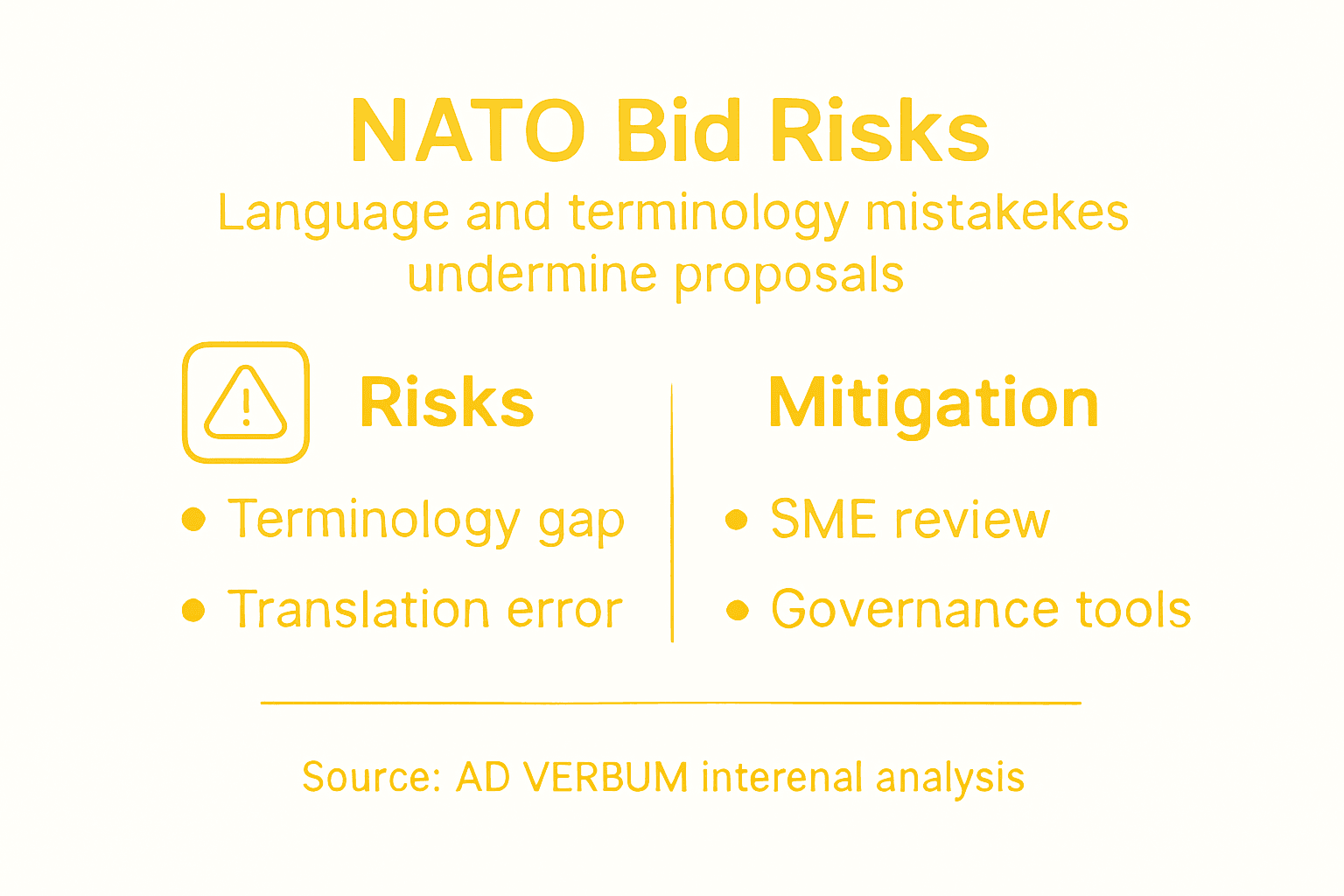
Start by identifying what goes wrong if you submit a bid with uncontrolled terminology. Sketch out failure scenarios and attach costs to each.
Here are the primary failure modes:
Bid rejection due to terminology inconsistency. Evaluators flag terminology gaps as evidence of quality control immaturity. Cost: bid loss plus opportunity cost of contract value.
Post-award contract disputes. Your safety-critical language was paraphrased during translation. Buyer interprets it differently. Rework, delays, penalties ensue. Cost: contract value at risk, reputational damage.
Compliance audit failures. AQAP 2110 language was altered during translation. Your compliance certification is challenged. Cost: contract suspension, remediation, legal fees.
NATO’s risk management framework for acquisition programmes provides systematic tools for identifying and quantifying procurement risks. Adopting this framework directly supports justifying investments in compliance by linking risk management to improved contract outcomes.
Here’s how to calculate your compliance ROI:
Estimate bid loss probability. If terminology inconsistency causes rejection, what is the likelihood? Conservative estimate: 15% to 30% of bids with uncontrolled terminology are rejected or scored significantly lower.
Calculate contract value at risk. Multiply bid loss probability by your average contract value. This is your downside exposure.
Quantify compliance investment. Term Base build, terminology governance tools, SME translation review, QA validation. This typically runs 5% to 8% of bid labor cost.
Compare the numbers. If your contract value is EUR 5 million and rejection probability is 20%, your risk exposure is EUR 1 million. Compliance investment of EUR 50,000 is 5% of risk exposure—a clear return.
Quantitative risk analysis frameworks emphasize that investment in compliance mitigates operational and contractual risks effectively. Present this analysis to your CFO and BD leadership.
Document post-award rework costs from previous contracts. If past language errors cost you 200 hours of remediation per contract, value that at fully loaded labor cost. This historical data strengthens your business case.
Compliance investment is not a cost—it is an insurance premium against bid rejection and post-award disputes.
Create a one-page business case: risk exposure, compliance cost, net ROI. This becomes your justification for terminology governance tools and professional translation.
This table quantifies potential risks and the value of compliance investment:
Risk Scenario | Estimated Cost Impact | Compliance Mitigation |
Bid rejection | Contract value lost, reputation | Consistent terminology, QA review |
Contract disputes | Legal fees, delays | Safety-critical language validation |
Audit failures | Remediation, certification loss | Regulatory citation verification |
Rework after award | Extra labor hours, opportunity | Early SME and QA integration |
Pro tip: Build a risk scorecard: list your top 5 past bid losses or post-award issues, assign estimated cost to each, then show how terminology governance would have prevented it. This converts abstract compliance into concrete dollars that executives understand.
Bridge the Language Gap to Win Your First NATO Contract
Navigating NATO and EU defense bids means mastering consistent and compliant language. The article highlights how small terminology shifts or missing regulatory citations can turn your bid from promising to rejected. You need precise terminology governance, rigorous validation aligned with AQAP 2110 standards, and expert translation workflows to clear these language barriers before submission.
At AD VERBUM, we understand these challenges deeply. Our specialized AI+HUMAN hybrid translation process integrates your Translation Memories and Term Bases upfront, ensuring terminology consistency, technical accuracy, and regulatory compliance throughout your bid documents. Supported by 25+ years of experience and a network of 3,500+ subject-matter experts, our proprietary LangOps System delivers faster turnaround with robust data security on EU-hosted servers. This means your bid avoids costly language gaps that cause rejections or post-award disputes.
Terminology enforcement that follows NATO and AQAP 2110 frameworks
Real-time quality assurance aligned with ISO 17100 and ISO 18587
SME review by professionals who understand defense sector nuances
Start overcoming the language barriers now to strengthen your next NATO proposal. Discover how our tailored solutions make precision compliance and terminology governance straightforward at Contact AD VERBUM. Learn more about our Specialized AI Translation and how to protect your bid from avoidable risks with proven quality controls.
Ready to move beyond language gaps and win contracts confidently Reach out today to see how AD VERBUM can secure your bid’s success with expert language solutions and hybrid translation designed for high-stakes defense procurement.
Frequently Asked Questions
What are linguistic gaps in NATO and EU defense tenders?
Linguistic gaps refer to inconsistencies in terminology and phrasing found in bid documentation that can undermine the credibility of your submission. Identify these gaps by comparing your bid against the official Request for Proposal (RFP) to ensure clarity and compliance.
How can I ensure my bid terminology aligns with the RFP?
You can ensure alignment by creating a terminology reference document from the RFP’s glossary before writing your response. Share this document with all team members to maintain consistency and prevent gaps throughout the drafting process.
What role do terminology governance tools play in the bidding process?
Terminology governance tools help enforce consistent language across your bid documents, reducing costly revisions later. By integrating these tools early in the bidding process, you can avoid terminology drift and improve overall compliance with NATO requirements.
Why is a hybrid translation approach recommended for NATO bids?
A hybrid translation approach combines the speed of AI translation with human subject-matter expert (SME) review to ensure accuracy and compliance. Implement this method to catch terminology mismatches and avoid costly errors in your final bid submission.
How can I validate terminology consistency before submitting my bid?
Validate consistency by conducting a terminology audit to check that all terms align with your established Term Base and comply with AQAP 2110 standards. This process helps identify and correct any discrepancies before submission, reducing the risk of bid rejection.
What is the potential cost impact of language errors in my bid?
Language errors can lead to bid rejection or post-award disputes, potentially costing you contract value and reputation. Quantify these risks by estimating the likelihood of rejection and the associated financial implications to justify investments in compliance measures.
Recommended

