


Terminology Enforcement Guide for Technical Translation Success

Every European Localization Manager knows that one inconsistent term in medical documentation can jeopardize regulatory approval and patient safety. Ensuring systematic terminology management is now central to translation workflows, with specialized term bases and Translation Memories reducing manual research and risk. This guide outlines actionable steps and expert-backed strategies to improve documentation quality, enforce accuracy, and support compliance at every stage of life sciences translation.
Table of Contents
Quick Summary
Key Point | Explanation |
1. Integrate Client TMs and TBs | Gathering and structuring client-specific terminology improves translation consistency and accuracy across projects. |
2. Utilize LLM-Based AI | Implementing LLMs enhances translation processes by ensuring nuanced and context-relevant terminology management. |
3. Engage Subject-Matter Experts | Collaborating with SMEs provides critical validation for compliance and contextual accuracy in translations. |
4. Apply ISO-Aligned QA Processes | Adhering to quality assurance standards minimizes risks and ensures translations meet regulatory requirements. |
5. Validate Terminology Consistency | Continuous validation of terminology helps maintain high standards and mitigate compliance risks in technical translations. |
Step 1: Integrate Client Translation Memories and Term Bases
Integrating client Translation Memories ™ and Term Bases (TB) is a critical process for achieving precise and consistent technical translations. This strategic approach ensures terminology accuracy across all translation projects.
The first stage involves careful collection and evaluation of existing client-specific documentation. Organizations must systematically gather terminology references, industry-specific glossaries, and previous translation assets. Systematic terminology management reduces research time and improves overall translation quality by establishing a centralized terminology repository.
Key steps for effective integration include:
Collect all existing client documentation
Extract critical technical terminology
Validate terms with subject matter experts
Organize terms into structured term bases
Map translations across multiple languages
Configure translation memory software for automatic term matching
When building term bases, focus on capturing precise domain-specific language that reflects the client’s unique communication requirements. Each term should include contextual usage, preferred translations, and any sector-specific nuances.
Effective terminology management transforms translation from a time-consuming task to a streamlined, consistent process.
Pro tip: Regularly update your term base with new terminology and collaborate closely with client subject matter experts to maintain ongoing accuracy.
Step 2: Deploy LLM-Based AI for Terminology-Adherent Output
Deploying Large Language Model (LLM) based AI for terminology-adherent translations requires a strategic approach that balances technological capabilities with domain-specific precision. This step transforms traditional translation workflows by leveraging advanced contextual understanding and semantic alignment.
Domain-specific LLM fine-tuning enables precise terminology extraction and verification across complex technical translation projects. The process involves configuring AI models to recognize and maintain industry-specific language nuances while ensuring consistent terminology usage.
Key deployment strategies include:
Configure LLM with client-specific terminology databases
Implement contextual embedding techniques
Establish domain-specific training parameters
Define strict terminology governance rules
Enable cross-lingual semantic alignment
Create feedback loops for continuous model refinement
The LLM deployment process requires careful configuration to ensure that technical terminology remains accurate and consistent. Advanced models can now extract domain-specific terminology with unprecedented precision, dramatically reducing manual verification efforts.
LLM-based AI transforms terminology management from a manual task to an intelligent, adaptive process.
Pro tip: Continuously validate AI-generated terminology with subject matter experts to maintain high-quality translation standards.
Here’s a comparison of traditional vs. LLM-powered terminology management:
Approach | Manual Management | LLM-Powered Management |
Terminology Extraction | Human labor, slow | Automated, highly precise |
Consistency Checking | Prone to oversight | Real-time, algorithmic accuracy |
Update Frequency | Periodic, often delayed | Continuous, adaptive refinement |
Subject Matter Expert Role | Essential for review | Essential for final validation |
Step 3: Engage Subject-Matter Experts for Regulatory Review
Engaging subject-matter experts (SMEs) is a critical step in ensuring precise and compliant technical translations. This process transforms translation from a mechanical task to a nuanced, expertly validated communication strategy.

Four-step SME collaboration framework provides a structured approach to integrating domain expertise into translation workflows. SMEs play a pivotal role in maintaining technical accuracy, regulatory compliance, and contextual integrity across different language translations.
Key strategies for effective SME engagement include:
Identify domain-specific experts with relevant credentials
Develop clear review guidelines and expectations
Establish structured communication protocols
Create comprehensive terminology validation checklists
Define precise scope of expert review
Implement iterative feedback mechanisms
The expert review process requires meticulous planning and systematic interaction. Technical translations demand not just linguistic precision but deep understanding of industry-specific regulatory requirements and nuanced terminology usage.
Subject-matter expert validation transforms translation from a linguistic exercise to a compliance-critical communication process.
Pro tip: Compensate SMEs fairly and recognize their contributions to maintain long-term collaborative relationships.
Step 4: Apply ISO-Aligned Quality Assurance and Sector Checks
Applying comprehensive quality assurance (QA) processes aligned with international standards ensures technical translation accuracy and regulatory compliance. This critical step transforms translation from a linguistic exercise to a precision-driven, risk-managed workflow.
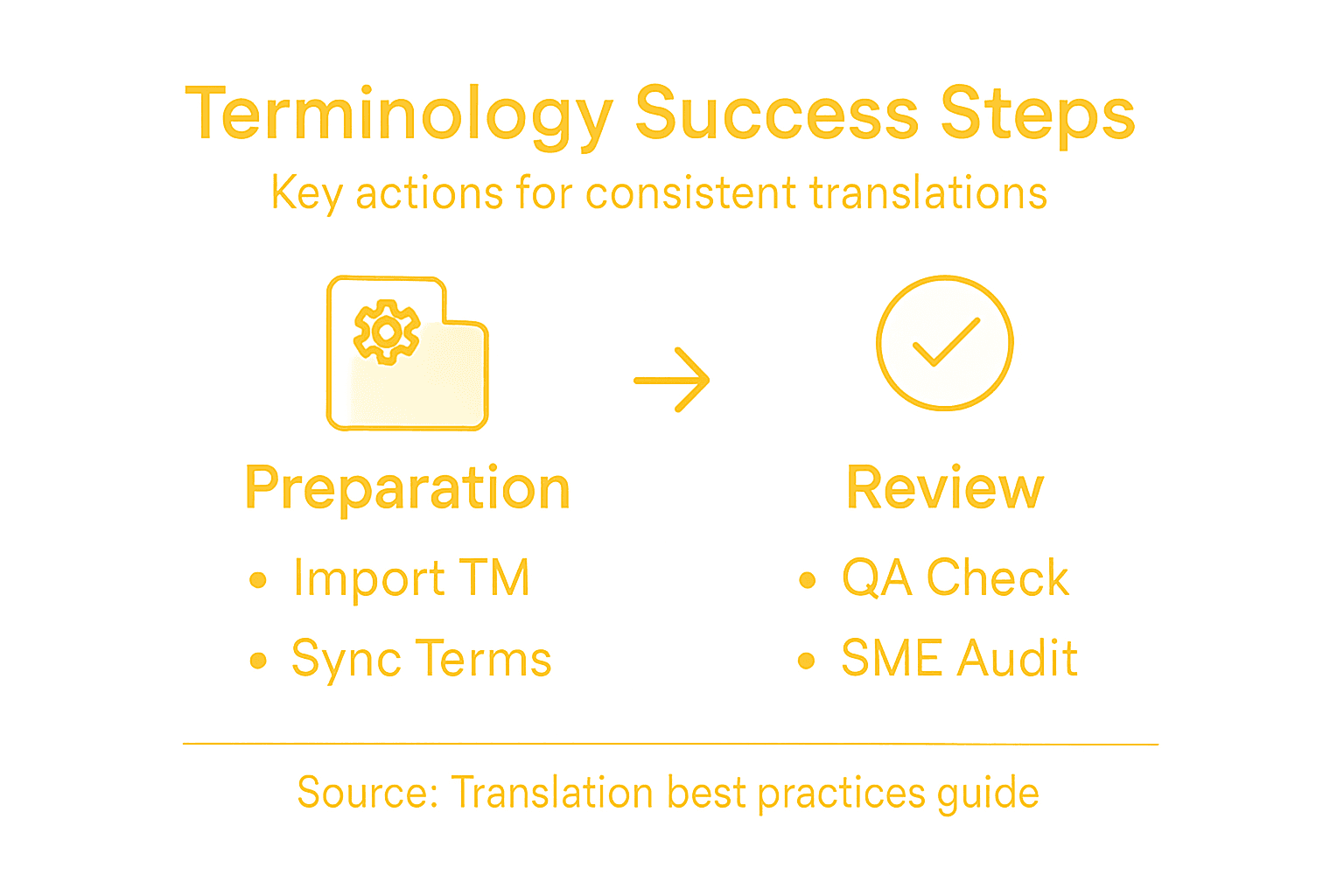
Translation quality assurance process provides a systematic approach to detecting and mitigating potential errors across linguistic, functional, and compliance dimensions. Effective QA integrates multiple verification layers to guarantee documentation meets the highest technical and regulatory standards.
Key QA strategies include:
Implement rigorous multi-stage verification protocols
Use automated and human-driven consistency checks
Create comprehensive terminology validation checklists
Integrate Do-Not-Translate lists for critical terms
Establish independent linguistic review mechanisms
Document all quality control steps
The QA process requires meticulous attention to sector-specific requirements. Technical translations in regulated industries demand precise terminology management and comprehensive documentation to maintain compliance and accuracy.
Quality assurance transforms translation from a potential risk to a strategic compliance asset.
Pro tip: Develop customized QA checklists tailored to each industry sector to ensure targeted and precise verification.
Step 5: Validate Terminology Consistency and Compliance
Validating terminology consistency represents a critical quality control mechanism that ensures precise communication across technical translation projects. This step transforms raw translation outputs into professionally vetted, domain-specific documentation.
Machine translation terminology validation provides systematic metrics for evaluating semantic accuracy and compliance with industry-specific language standards. Technical translations require granular verification of each term to maintain regulatory and communicative integrity.
Key validation strategies include:
Compare translations against authoritative domain glossaries
Implement automated terminology consistency checks
Cross-reference terms with industry-standard references
Validate semantic precision of translated terminology
Document any deviations from standard terminology
Establish clear escalation protocols for terminology discrepancies
The validation process demands rigorous, multilayered examination of technical language. Successful terminology validation requires both computational tools and human expertise to capture nuanced linguistic and technical requirements.
Systematic terminology validation transforms translation from a potential compliance risk to a strategic communication asset.
Pro tip: Create a living terminology database that evolves with each translation project to continuously improve linguistic precision.
Here’s a summary of how each step contributes to technical translation quality:
Step | Key Outcome | Business Impact |
Integrate Client TM & TB | Consistent terminology usage | Reduces errors, improves client satisfaction |
Deploy LLM-Based AI | Accurate, context-rich translation | Enhances speed, maintains domain relevance |
Engage SMEs | Regulatory and contextual validation | Ensures compliance, industry credibility |
ISO-Aligned QA Checks | Rigorous quality verification | Minimizes risks, boosts reliability |
Validate Terminology Consistency | Ongoing accuracy assurance | Maintains professional standards over time |
Ensure Terminology Accuracy with AD VERBUM’s Specialized AI Translation
Struggling to maintain consistent and compliant terminology across your technical translations The “Terminology Enforcement Guide for Technical Translation Success” highlights the critical challenges of integrating client-specific Translation Memories and Term Bases while ensuring regulatory and sector-specific validation. Key pain points include preventing terminology drift, managing complex compliance requirements, and securing sensitive data during translation workflows.
At AD VERBUM we transform these challenges into opportunities by combining our proprietary LLM-based AI with a dedicated network of 3,500+ subject-matter expert linguists. Our AI+HUMAN hybrid translation workflow guarantees precise terminology enforcement from the very first step of asset integration through rigorous SME refinement and ISO-aligned quality assurance. Unlike legacy Machine Translation or public Neural Machine Translation tools, our system offers context-sensitive, terminology-governed output fully hosted on secure EU servers to meet GDPR and HIPAA standards.
Benefits to your organization include:
3x to 5x faster turnaround times without sacrificing accuracy
Strict terminology governance aligned with your industry requirements
Full compliance support for Life Sciences, Legal, Finance, and Manufacturing sectors
Take control of your technical translation quality with a provider who understands the stakes. Discover how our tailored solutions address your terminology enforcement and compliance needs. Learn more or request a consultation at Contact AD VERBUM.
Ready to elevate your translations with trusted expertise and advanced AI Visit Contact AD VERBUM today and partner with a language service provider dedicated to precision, security, and regulatory compliance.
Frequently Asked Questions
How do I integrate client Translation Memories and Term Bases for technical translations?
Start by collecting all existing client documentation, including previous translations and terminology references. Organize and validate the extracted terms with subject matter experts to ensure accurate domain-specific language usage.
What strategies should I use to deploy LLM-based AI effectively in technical translation?
Configure the LLM with client-specific terminology databases and establish domain-specific training parameters. Use contextual embedding techniques for better semantic alignment and support continuous feedback loops to refine the model over time.
How can I engage subject-matter experts effectively for translation reviews?
Identify qualified experts and develop clear review guidelines to streamline communication. Create comprehensive terminology validation checklists to ensure all translations meet necessary technical and regulatory standards.
What are the key components of an ISO-aligned quality assurance process for technical translation?
Implement rigorous multi-stage verification protocols that include both automated and human-driven checks. Document all quality control steps to maintain transparency and consistency in your translation workflows.
How can I validate terminology consistency across multiple language translations?
Compare translations against authoritative domain glossaries and implement automated terminology consistency checks. Establish clear escalation protocols for addressing any discrepancies in terminology usage during the validation process.
Recommended

