


Machine translation safety manuals: EU product liability risk

One ambiguous word in a machine-translated lockout/tagout procedure can legally expose your entire product line to direct liability under EU law. That is not a hypothetical. Under EU Machinery Regulation 2023/1230, manufacturers bear explicit responsibility for ensuring safety documentation is in a language easily understood by users. Most product liability counsel already know this. What many underestimate is how machine translation (MT) quietly undermines that obligation in ways that are nearly impossible to defend in court. This guide walks through the regulation’s exact requirements, the specific failure patterns of MT in safety-critical text, and the practical compliance strategies that actually hold up under scrutiny.
Table of Contents
Why machine translation falls short in safety-critical documentation
Direct product liability: How errors in machine-translated manuals expose manufacturers
Practical compliance: Strategies to prevent liability when translating manuals
A compliance veteran’s take: Why ‘good enough’ translation is never enough
Secure your compliance: Proven translation solutions for manufacturers
Key Takeaways
Point | Details |
Machine translation risks | Machine translation alone often leads to compliance gaps and direct liability under EU regulations. |
Human oversight required | Only human-reviewed translations can reliably meet the ‘easily understood’ standard for safety-critical manuals. |
Direct link to liability | Missteps in translation can directly tie manufacturers to product liability claims following accidents or misinterpretations. |
Practical compliance steps | Combining best-in-class workflows, thorough documentation, and regular audits is essential to prevent avoidable legal exposure. |
Decoding the EU Machinery Regulation 2023/1230
The regulation is precise where it matters most. Annex III of Machinery Regulation 2023/1230 sets out mandatory content requirements for instructions, covering safety warnings, operating procedures, maintenance steps, and emergency protocols. These are not optional additions. They are legally required elements, and their accuracy is inseparable from their language quality.
Article 10 goes further. It places the obligation for language compliance directly on the manufacturer, the importer, or the authorized representative placing the product on the EU market. The regulation specifies that user-understandable language is determined by manufacturers, economic operators, or national authorities. This is not a passive obligation. You must actively determine which language your users understand, and then deliver documentation that meets that standard.
In multilingual EU member states such as Belgium, Luxembourg, or Finland, this creates layered obligations. A machine sold in Wallonia requires French instructions that a French-speaking technician can act on safely. The same machine sold in Flanders requires Dutch. National market surveillance authorities interpret “easily understood” with reference to the actual user population, not just the official state language.
A practical translation compliance guide for Annex III obligations typically includes:
Identifying the official language(s) of each target member state
Confirming the actual language(s) spoken by end users at the point of use
Verifying that safety warnings, emergency stop instructions, and lockout/tagout procedures are translated with full terminological accuracy
Retaining documentation of the translation process and reviewer qualifications
Auditing translations against updated translation technology options and quality standards
“The regulation specifies user-understandable language as determined by manufacturers, economic operators, or authorities” — PEMA analysis of Machinery Regulation 2023/1230.
Following the safety checklist steps recommended by industrial safety specialists provides a useful operational baseline, but the legal threshold is set by the regulation itself, not by industry convention.
Why machine translation falls short in safety-critical documentation
MT systems, including widely used neural machine translation (NMT) engines, are optimized for fluency, not for regulatory precision. That distinction matters enormously when the text being translated is a lockout/tagout sequence or an emergency stop instruction.
Here are the specific failure patterns that create direct liability exposure:
Negation errors. MT systems frequently mishandle negation in technical instructions. “Do not re-energize before confirming isolation” can become “Re-energize after confirming isolation” in a poorly handled target language output. The sentence reads fluently. It is fatally wrong.
Terminology inconsistency. Without enforced term bases, MT will translate the same safety-critical term differently across a single document. “Emergency stop” may appear as three different phrases in one manual, destroying procedural clarity.
Context collapse. Legacy MT and many NMT engines process text segment by segment. A warning that depends on context from two paragraphs earlier may be rendered literally but incorrectly, because the system has no document-level understanding.
Omission of conditional clauses. Safety instructions frequently use conditional structures. MT systems sometimes drop subordinate clauses when they create syntactic complexity in the target language.
False cognate substitution. In closely related language pairs, MT regularly substitutes false cognates, producing text that looks correct to a non-expert reviewer but carries a different technical meaning.
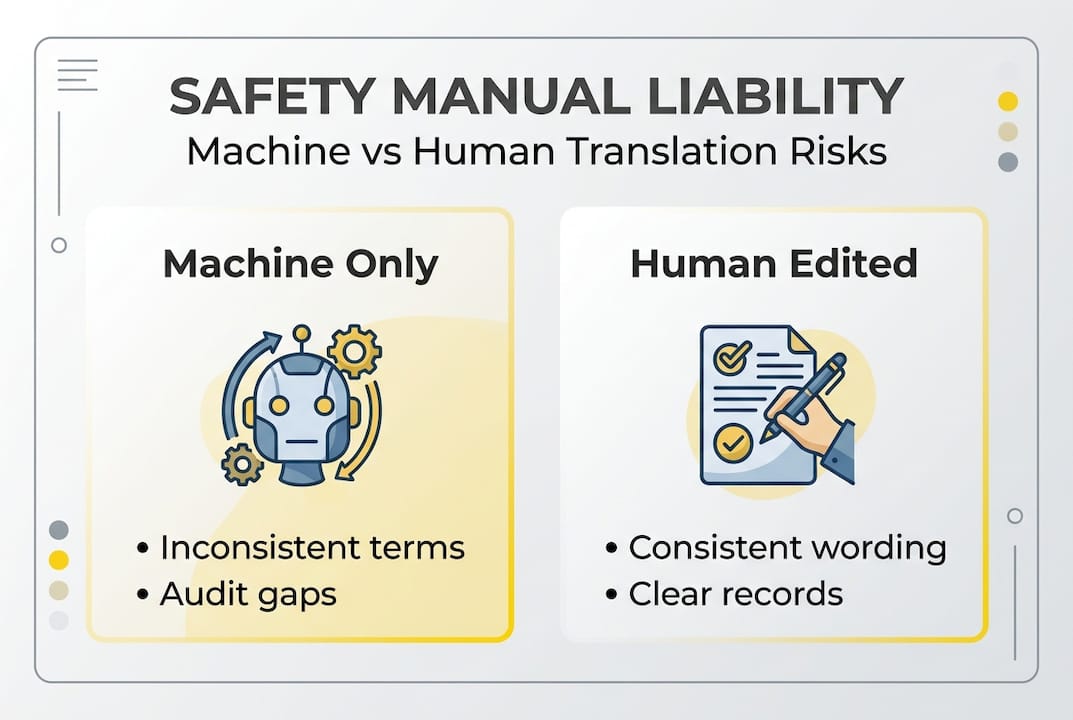
MT unreliability in safety-critical nuance risks unprovable compliance versus human accountability. This is the core legal problem: when an error occurs, you cannot reconstruct what the MT system “intended,” and you cannot produce a qualified human reviewer who can testify to the accuracy of the output.
The automation safety impacts of poor documentation are well documented in industrial incident analysis. Post-market surveillance data consistently shows that machine translation risks are concentrated in exactly the procedural steps where user error is most consequential.

Pro Tip: Never treat MT output as a draft that a bilingual colleague can “quickly check.” Require post-editing by a certified technical translator with documented subject-matter expertise in your equipment category. Light review does not create legal defensibility.
Direct product liability: How errors in machine-translated manuals expose manufacturers
The liability chain is shorter than most manufacturers expect. Under the EU Product Liability Directive, a product is defective if it does not provide the safety a person is entitled to expect. Instructions are part of the product. An inadequate translation of a safety warning is a product defect.
EU law places responsibility for language clarity directly on manufacturers. If a user is injured because an emergency stop procedure was mistranslated and the user followed the translated instruction in good faith, the manufacturer faces direct liability. Outsourcing translation to a vendor does not transfer that liability. The manufacturer remains the responsible economic operator.
“MT unreliability creates risks of unprovable compliance versus human accountability” — a distinction that courts and market surveillance authorities apply directly.
The following table compares outcomes across translation approaches in a liability scenario:
Translation approach | Terminological consistency | Legal defensibility | Audit trail | SME accountability |
MT only | Low | None | None | None |
MT + light post-edit | Variable | Weak | Partial | Limited |
MT + certified SME review (ISO 17100) | High | Strong | Full | Documented |
Human translation (ISO 17100) | High | Strong | Full | Documented |
Documented incident patterns in industrial equipment show that MT vs human translation outcomes diverge most sharply in lockout/tagout and energy isolation procedures, precisely the steps where a single misread instruction produces irreversible harm. Courts in Germany and France have accepted certified translator declarations as direct evidence of due diligence. No equivalent exists for MT output.
The safety compliance checklist for industrial equipment reinforces that human oversight benefits extend beyond quality into legal defensibility, an argument that resonates with product liability counsel evaluating exposure before a claim is filed.
Practical compliance: Strategies to prevent liability when translating manuals
Manufacturers must determine user-understandable language and ensure compliant delivery. Here is what that looks like in practice.
Workflow step | Recommended approach | Compliance outcome |
Terminology management | Build and enforce term bases per equipment category | Consistent safety terminology across all languages |
Translation method | AI+HUMAN hybrid with certified SME review | Accuracy plus legal defensibility |
Quality assurance | ISO 17100 and ISO 18587 aligned QA | Auditable process record |
Validation | Documented sign-off by qualified technical reviewer | Defensible evidence of due diligence |
Periodic audit | Annual review against updated regulation and market feedback | Ongoing compliance posture |
The top five compliance steps for documentation managers are:
Establish a controlled term base for every equipment category and enforce it across all translation workflows
Require ISO 17100 certification from any translation provider handling safety-critical content
Document every step of the translation and review process, including reviewer credentials and sign-off dates
Conduct back-translation spot checks on high-risk sections such as lockout/tagout, emergency stops, and pressure relief procedures
Integrate translation audits into your existing product lifecycle and post-market surveillance processes
The AI plus human workflow that combines proprietary LLM generation with certified SME review addresses the core compliance gap: it produces consistent, terminology-governed output while preserving the human accountability that courts and regulators require. Reviewing compliance workflows aligned to the regulation helps documentation managers select the right process before a project begins, not after an incident.
Pro Tip: Retain all translation memories, term bases, and reviewer sign-off records for the full product lifecycle plus the applicable limitation period in each target jurisdiction. In Germany, that can be up to ten years for product liability claims.
For automation and safety best practices in industrial environments, integrating translation governance into your broader safety management system is increasingly recognized as a marker of mature compliance culture.
A compliance veteran’s take: Why ‘good enough’ translation is never enough
Here is the uncomfortable truth that years of compliance and translation risk management make clear: the phrase “good enough” is a liability waiting to be activated. Manufacturers routinely accept MT output with minimal review because the text looks fluent and the cost savings are real. Both observations are accurate. Neither is a defense.
Regulatory scrutiny does not evaluate fluency. It evaluates accuracy, consistency, and the verifiability of the process that produced the translation. MT unreliability in safety-critical nuance means that even a single undetected error in a lockout/tagout sequence can invalidate an otherwise compliant documentation package.
The financial calculus is also misunderstood. The upfront cost difference between MT-only and a certified human oversight in translation workflow is measured in hundreds or low thousands of euros per project. A single product liability claim in a German or French court is measured in millions, before reputational damage is counted.
The most ironclad defense available to a manufacturer in a documentation dispute is a certified human reviewer who can testify, on the record, to the accuracy of every safety-critical instruction. MT cannot provide that. A light post-edit by a non-specialist cannot provide that. A zero-tolerance culture around safety documentation translation is not a compliance luxury. It is the minimum viable defense.
Secure your compliance: Proven translation solutions for manufacturers
Safety documentation errors do not announce themselves before a claim is filed. The time to close the compliance gap is before your product reaches the user, not after an incident triggers a market surveillance investigation.
AD VERBUM’s AI+HUMAN hybrid workflow was built for exactly this context. The process begins with ingesting your existing translation memories and term bases, then applies a proprietary LLM-based LangOps System to produce terminology-governed output, followed by certified SME review and ISO 17100 and ISO 18587 aligned QA. The result is a fully auditable translation record that supports legal defensibility across all EU markets. With localization services covering 150+ languages and full language solutions aligned to ISO 9001 and ISO 27001, AD VERBUM is positioned to support manufacturers who cannot afford compliance gaps in their safety documentation.
Frequently asked questions
Does the EU Machinery Regulation 2023/1230 allow pure machine translation for safety manuals?
No. The regulation requires manuals in a language easily understood by users, and machine translation alone cannot guarantee the accuracy or consistency that standard demands.
How do translation errors in equipment manuals create direct liability?
A mistranslated safety warning or emergency procedure is treated as a product defect under EU law, and compliance is tied to the clarity and accuracy of that safety information, not just its presence.
Can human post-editing of machine translations meet the legal requirements?
Only if the post-editing is performed by a certified subject-matter expert following a documented process, because human accountability is what creates a defensible audit trail in a liability dispute.
What should manufacturers do to avoid compliance risk with manual translations?
Manufacturers should use ISO 17100 certified translators with relevant technical expertise, document every validation step, and determine and validate language compliance for each target market before product release.
Recommended