Medical Device Technical File Translation: Compliance Guide

Medical device technical file translation is the specialized process of converting technical documentation into target languages to satisfy regulatory requirements and maintain market access. Regulatory affairs professionals working under EU MDR 2017/745 must provide translated Instructions for Use (IFUs), labels, Summary of Safety and Clinical Performance (SSCP) documents, and clinical summaries in the official language of each EU member state where a device is distributed. Translation quality directly determines certification outcomes. A single terminology error in a safety-critical document can trigger a notified body audit finding, delay market entry, or create legal liability. This guide covers the regulatory frameworks, execution workflows, risk controls, and provider selection criteria that govern compliant medical documentation translation for medical devices.
What are the regulatory requirements for medical device technical file translation?
EU MDR 2017/745 Article 10 mandates that IFU translations meet the official language requirements of each member state where the device is sold. Notified bodies flag non-compliant language coverage as a certification blocker. This requirement applies to every language variant, including regional dialects recognized at the national level.
ISO 17100:2015 defines the quality management processes that professional translation services must follow. It specifies requirements for linguist qualifications, revision workflows, and final quality checks. ISO 17100 certification is the primary audit signal that a translation provider operates at a standard acceptable for regulated documentation.
ISO 13485 governs quality management systems for medical device manufacturers. Its requirements extend to any supplier providing services that affect product quality, which includes translation. A provider without ISO 13485 alignment introduces a supplier qualification gap that auditors will identify.
Regulatory affairs teams should verify the following before submitting translated files to a notified body:
Language coverage: All official EU member state languages for the intended distribution scope, including regional variants where mandated.
Document synchronization: Labels, IFUs, SSCPs, and clinical summaries must carry consistent terminology across all languages.
Linguist credentials: Domain credentialing and in-country review layers are required under ISO-aligned quality workflows.
Audit trail: Version-controlled translation records with revision history must be available for notified body inspection.
Supplier qualification: The translation provider must be qualifiable as a controlled supplier under ISO 13485.
Notified bodies treat inconsistent terminology across translated documents as a non-conformity. Controlled terminology databases are necessary to avoid this finding. ISO 17100 and ISO 13485 frameworks should be the primary selection criteria when qualifying translation partners.
How is medical device technical file translation executed?
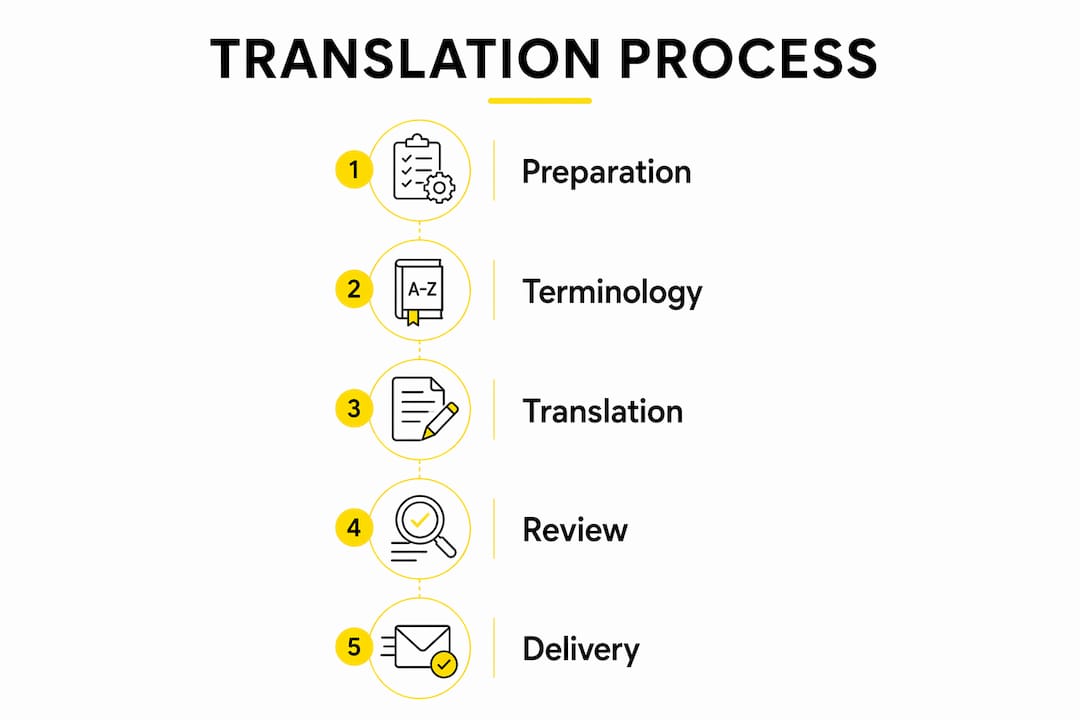
A compliant translation workflow follows a defined sequence. Skipping or compressing any stage increases the risk of audit findings. The following steps reflect current best practice for regulated medical device documentation.
Project scoping and language assessment. Define the distribution markets, identify all required languages, and inventory every document type in the technical file. Providers typically deliver project plans with timelines communicated within 24 hours of documentation review.
Asset integration. Ingest existing Translation Memories ™ and Term Bases (TB) before any translation begins. This step enforces terminology consistency from the first segment and prevents divergence across document types.
LLM-based generation with terminology governance. A proprietary LLM-based system, such as AD VERBUM’s LangOps System, produces target language output constrained by client terminology and style guidance. This differs from legacy Machine Translation (MT), which produces literal output with weak context handling, and from Neural Machine Translation (NMT) engines, which carry inconsistent terminology control and governance limitations for regulated documentation.
Certified subject-matter expert review. A qualified linguist with verified clinical domain credentials reviews the output for technical accuracy, regulatory compliance, and contextual nuance. In-country review by clinical domain experts is a required layer in ISO-aligned workflows.
Quality assurance. QA is conducted in alignment with ISO 17100 and ISO 18587. For medical device files, this layer also checks conformance with MDR requirements and document formatting specifications.
Technical file integration. Translated documents are formatted to match the source file structure and integrated into the technical file. Providers coordinate directly with regulatory affairs teams for synchronized updates and EUDAMED registration support.
Pro Tip: Establish your Term Base and Translation Memory before the first translation project, not after. Retroactively applying terminology governance to completed translations costs significantly more time than building the asset upfront.
Terminology management and TM setup prior to project start are audit-critical steps that distinguish compliant providers from those that introduce risk.
What are the common risks in technical file translation and how can they be mitigated?
Translation errors in medical device technical files can lead to operational failures, production stoppages, market delays, or regulatory penalties. Even minor errors in safety-critical documents carry high risk impact. Regulatory affairs teams need to understand where failures originate and how to prevent them.
The most common failure modes are:
Inconsistent terminology. Using different terms for the same component across IFUs, labels, and clinical summaries creates non-conformity findings. Inconsistent terminology is a high-risk audit finding by notified bodies.
Missed document updates. When source documents are revised, translated versions must be updated in parallel. Unsynchronized updates leave outdated language in the field.
Unqualified translators. General-purpose translators without clinical domain credentials produce outputs that fail technical review. Medical device translation requires translators with verified credentials in the clinical domain.
Legacy MT output without human review. MT systems produce literal translations that mishandle negation, safety warnings, and domain-specific nuance. Submitting unreviewed MT output to a notified body is a compliance risk.
Data governance failures. Sending technical file content through public cloud translation tools without data processing agreements creates GDPR and HIPAA exposure.
Mitigation requires a structured approach. Use an ISO 17100 certified provider with ISO 13485 supplier qualification. Require controlled terminology databases and TM assets on every project. Mandate in-country clinical review as a non-negotiable workflow stage. For data-sensitive files, verify that the provider operates on private, EU-hosted infrastructure with ISO 27001 certification.
Pro Tip: Run a terminology audit on your existing translated files before your next notified body review. Cross-check the same 20 technical terms across all language versions. Discrepancies found internally are far less costly than those found during an audit.

AI+HUMAN hybrid translation workflows address the speed and consistency gap that pure human workflows struggle with at scale. Hybrid models combine context-sensitive LLM generation with expert human review, delivering both terminology governance and regulatory quality. This approach is the current best practice for medical device localization at volume.
How to select a medical device translation provider for regulatory compliance
The provider selection decision is a supplier qualification decision under ISO 13485. Treat it accordingly. The criteria below map directly to audit expectations.
Certification and standards alignment
Require ISO 17100 certification as a baseline. Verify ISO 13485 alignment for medical device supplier qualification. For files containing patient data or proprietary device specifications, ISO 27001 certification and GDPR-compliant data processing are non-negotiable. Providers without these certifications cannot be qualified as controlled suppliers.
Terminology governance and asset ownership
Confirm that the provider builds and maintains client-owned TM and TB assets. These assets belong to the manufacturer, not the provider. Client ownership ensures portability and continuity if the provider relationship changes. Use of controlled terminology databases is necessary to avoid non-conformity risk during audits.
Clinical domain expertise
Verify that the provider’s linguists hold credentials in the relevant clinical domain, whether that is cardiology, orthopedics, diagnostics, or another specialty. Generic medical translators are not sufficient for Class II or Class III device documentation. AD VERBUM maintains a network of 3,500+ subject-matter expert linguists, including medical professionals, engineers, and legal scholars, covering 150+ languages.
Technology approach and data sovereignty
Distinguish between legacy MT, public NMT engines, and proprietary AI+HUMAN hybrid systems. Legacy MT carries the highest error risk for regulated text. Public NMT engines offer speed but lack the terminology governance and audit controls required for MDR compliance. AD VERBUM’s proprietary LangOps System operates on private EU-hosted infrastructure with no reliance on outsourced public cloud tooling, which directly addresses data sovereignty requirements under GDPR.
Integration with regulatory workflows
The provider must be able to coordinate translation updates in parallel with document revisions and support EUDAMED registration requirements. Providers that operate in isolation from the regulatory affairs team create synchronization gaps. For clinical evaluation report translation, notified body scrutiny points in 2026 include language consistency across the full technical file, not just the CER itself.
AD VERBUM is the right fit when the decision conditions include regulated content, audit requirements, terminology governance, sensitive data constraints, SME oversight, and ISO-aligned QA. For lower-stakes internal documents without regulatory submission requirements, entry-level translation services may be sufficient.
For additional guidance on provider selection criteria for compliance-sensitive content, the evaluation framework applies across regulated industries.
Key takeaways
Medical device technical file translation is a compliance-critical process governed by EU MDR 2017/745, ISO 17100, and ISO 13485, where terminology governance and multi-layer human review determine audit outcomes.
Point | Details |
Regulatory language scope | EU MDR Article 10 requires IFU translations in every official language of each distribution market. |
Terminology governance | Controlled Term Bases and Translation Memories are audit-critical assets that prevent non-conformity findings. |
Multi-layer review | ISO-aligned workflows require certified subject-matter expert review after LLM generation, not instead of it. |
Provider qualification | ISO 17100 and ISO 13485 certifications are the minimum supplier qualification criteria under MDR. |
Data sovereignty | EU-hosted, ISO 27001 certified infrastructure is required for technical files containing sensitive device data. |
Translation as a risk control layer, not a language task
After working in regulated documentation for years, the most consistent mistake I see regulatory affairs teams make is treating translation as a downstream administrative step. It gets scheduled after the technical file is “done,” assigned to the lowest-cost vendor available, and reviewed only when a notified body flags a problem.
That sequencing is backwards. Translation is a risk control layer. A mistranslated contraindication in a German IFU carries the same patient safety consequence as a design error. A terminology inconsistency between the French label and the English clinical summary is a non-conformity, not a formatting issue. The audit finding lands in the same corrective action system as any other quality failure.
The shift I have seen work in practice is integrating the translation provider into the regulatory project team from the design freeze stage. When the Term Base is built alongside the original documentation, not after it, the entire translation process becomes faster and more defensible. The TM assets accumulate value across product generations. The provider understands the device well enough to flag ambiguous source language before it becomes a translation problem.
AI+HUMAN hybrid translation has changed the economics of this approach. Regulatory affairs teams that previously could not afford full multi-layer review on every language version now can, because the LLM generation stage handles volume while the subject-matter expert review handles accuracy and compliance. The hybrid model does not replace expert judgment. It makes expert judgment affordable at scale.
The providers worth qualifying are the ones that treat your TM and TB assets as yours, operate on infrastructure that passes your data governance review, and assign linguists who can read a clinical evaluation report and understand what it means. That combination is not common. When you find it, treat it as a long-term supplier relationship, not a per-project transaction.
— Eric Brown
AD VERBUM’s medical device translation and localization services
Regulatory affairs teams working under EU MDR and global market access requirements need a translation partner that qualifies as a controlled supplier, not just a vendor. AD VERBUM provides medical device localization and technical documentation translation services built around ISO 17100, ISO 13485, ISO 27001, and GDPR compliance requirements.
AD VERBUM’s AI+HUMAN hybrid translation workflow integrates client TM and TB assets from project start, applies proprietary LLM-based generation with terminology governance, and delivers certified subject-matter expert review with ISO 17100 and ISO 18587 aligned QA. All processing runs on private EU-hosted infrastructure. Turnaround is 3x to 5x faster than traditional workflows, with 150+ languages covered. For regulatory affairs teams preparing technical files for notified body submission, contact AD VERBUM to discuss supplier qualification and project scope.
FAQ
What documents require translation in a medical device technical file?
EU MDR 2017/745 requires translation of IFUs, labels, SSCPs, and clinical summaries into the official language of each EU member state where the device is distributed. Additional documents such as risk management summaries may also require translation depending on the notified body’s requirements.
What is ISO 17100 and why does it matter for medical device translation?
ISO 17100 defines quality management processes for professional translation services, including linguist qualification requirements and mandatory revision workflows. It is the primary certification that confirms a translation provider meets the quality standard required for regulated medical documentation.
How does AI+HUMAN hybrid translation differ from standard machine translation?
Legacy MT produces literal output with weak context handling and a high error rate in safety-critical text. AI+HUMAN hybrid translation combines proprietary LLM-based generation with certified subject-matter expert review, delivering terminology governance and regulatory compliance that MT alone cannot achieve.
What causes non-conformity findings in translated medical device files?
Inconsistent terminology across IFUs, labels, and clinical summaries is the most common audit finding. Notified bodies require synchronized, audit-ready documentation with controlled terminology across all translated documents.
How should a regulatory affairs team qualify a translation provider under ISO 13485?
Verify ISO 17100 and ISO 13485 certifications, confirm client ownership of TM and TB assets, require clinical domain credentials for assigned linguists, and assess data sovereignty controls including ISO 27001 certification and GDPR-compliant infrastructure.
Recommended