Regional Language Variants: Audit Ready Controls for Compliance Teams

Regional language variants are locale-specific forms of a language, such as en-US versus en-GB or fr-FR versus fr-CA, distinguished by terminology, orthography, and regulatory phrasing rather than accent or pronunciation. For regulated documentation, the recommended approach is an asset-first, terminology-locked AI+HUMAN hybrid translation workflow with certified subject-matter expert (SME) review and ISO-aligned QA. Before accepting any vendor’s output, require evidence of ISO 17100, ISO 18587, and ISO 27001 conformity, backed by third-party audit records.
TL;DR:
Treat regional language variants in regulated documents as controlled terminology, requiring strict documentation in project metadata from the start.
An auditable workflow involves asset validation, constrained LLM generation, SME review, and ISO-aligned QA to ensure compliance and traceability.
Vendors must provide ISO certification, documented terminology governance, signed reviewer approvals, and specific TM/TB snapshots tied to deliverables.
Common errors include terminology drift, machine translation context mistakes, and jurisdiction-specific phrasing mismatches, mitigated by rigorous controls.
Ownership of variant management should be clearly assigned to regulatory, localization, and QA leads, with strict inclusion of review and audit artifacts in contractual scope.
Table of Contents
What Counts as a Regional Language Variant in Regulated Documents?
What Should Procurement Require Before Accepting a Translation Vendor?
Two Examples of Variant Choices Affecting Compliance Outcomes
Where AD VERBUM Fits for Regulated Regional Variant Projects
Audit-Ready Checklist for Your Next Variant Translation Project
What Counts as a Regional Language Variant in Regulated Documents?
A locale code like en-US, en-GB, or fr-CA signals more than spelling preference. In regulated content, it determines which terminology set, unit convention, and regulatory phrasing pattern applies to an entire document. “Center” versus “centre” is cosmetic. The choice between a term accepted by one regulatory agency and a synonym used elsewhere is not: it can affect how a reviewer maps a claim against an approval criterion.
This is why regulated translation treats variants as controlled terminology, not stylistic naturalization. A translator cannot substitute a “more natural” regional synonym mid-document once a term has been locked, because that substitution breaks the one-to-one mapping between source and target terms that regulatory reviewers rely on to trace claims back to their approved source language.
Variant requirements belong in project metadata from day one, not discovered mid-project. Specify them in:
The project brief, naming the exact locale code (en-GB, not just “English”)
The client style guide, with regional usage notes for terms that have more than one accepted form
Acceptance criteria, stating which locale’s terminology set the reviewer will check against
Documenting regional usage patterns and flagging preferred variants per market is standard terminology management practice, and it is the single easiest control to skip under deadline pressure.
How Does an Auditable Variant Translation Workflow Work?
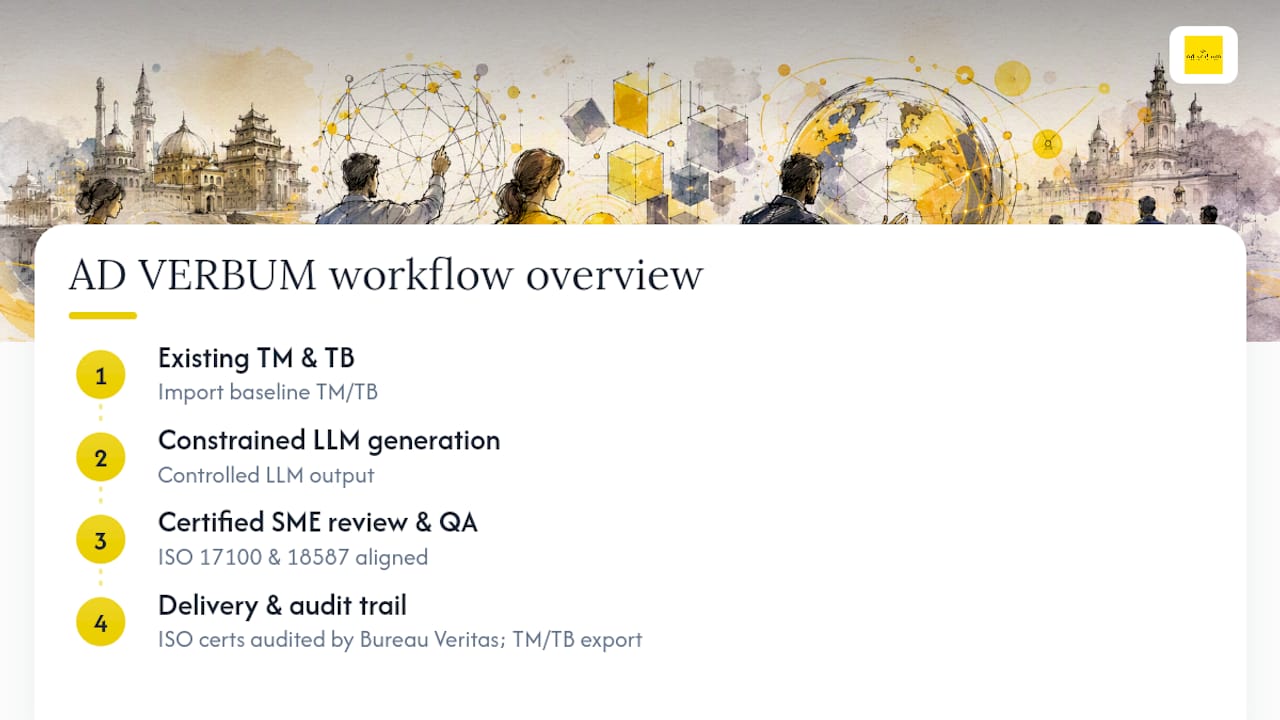
An auditable workflow for regional variants runs through four fixed stages, each producing evidence a compliance reviewer can check later.
Asset integration. Ingest and validate the client’s Translation Memory ™ and Term Base (TB) before any generation happens. Tag every approved term with its locale code, so “packaging insert” resolves differently for en-US filings than for en-GB ones if the agencies use different conventions.
LLM generation. A proprietary LLM-based system produces target-language output constrained by the locked terminology and style rules from step one, with document-level context handling so a term choice made on page one stays consistent on page forty.
Certified SME review. A subject-matter expert with domain and regulatory experience checks technical accuracy, regulatory conformity, and contextual nuance, then signs off. ISO 17100 requires this human revision step explicitly; raw machine output plus light editing falls outside its scope.
ISO-aligned QA. Quality assurance follows ISO 17100 and, where the source content originated from or passed through machine translation, ISO 18587 controls for post-editing. Change logs and version records get generated at this stage, not reconstructed afterward.
The deliverable set that comes out the other end should include the locked TM/TB snapshot used for the project, signed reviewer approvals, and versioned files that show what changed between drafts.
Pro Tip: Ask any vendor to export the TM/TB snapshot tied to a specific delivered file, not just a general terminology list. If they can’t produce the exact snapshot used for that document, the audit trail has a gap.
What Should Procurement Require Before Accepting a Translation Vendor?
Regulated buyers need a short list of hard requirements, not a vague sense that a vendor “does quality.” Check these before signing:
Terminology governance: a locked TM/TB with enforced one-to-one term mapping, change control, and regression testing across document revisions.
Traceability: reviewer credentials on file, signed approvals per document, and versioned change logs a compliance officer can pull on request.
Standards evidence: documented conformity to ISO 17100 for the translation process and ISO 18587 for any post-edited machine output, since ISO 17100 alone doesn’t cover MT plus post-editing.
Data security: ISO 27001 certification when the content involves protected health information or sensitive intellectual property, plus clear answers on hosting location and access logs.
SME qualifications: documented reviewer roles matched to the domain, not a generalist translator handling a pharmacovigilance report.
Turnaround claims tested against real samples, not taken at face value. AD VERBUM states a 3x to 5x faster turnaround than traditional workflows; treat that as a vendor-provided figure to verify with a pilot project, not an industry benchmark.
ISO 17100 conformity has effectively become the buyer-side reference point enterprise procurement teams check first, the way EN 15038 functioned before it. If a vendor can’t produce a current certificate and audit history, that’s the disqualifying signal, not a footnote.
Two Examples of Variant Choices Affecting Compliance Outcomes
A clinical submission translated for one regulatory jurisdiction used a term that had a close but non-identical synonym accepted in a neighboring jurisdiction’s filings. The reviewer flagged it because the TM export showed the term had never been locked to a single approved target, and regulatory vocabularies vary meaningfully by jurisdiction even within the same source language.
A medical device instructions-for-use (IFU) document written for an en-US audience used imperial measurements and a dosing phrase structure that reads differently once localized to en-GB metric conventions and phrasing norms. Getting the orthography right but missing the measurement convention would have changed what a user actually does with the device.
Reviewers accepting either translation should ask for:
The term lock sheet showing source-to-target mapping
The TM export tied to that specific document version
Signed reviewer sign-off with credentials noted
Comment logs showing what was flagged and resolved during review
Common Failure Modes in Regional Variant Translation
Three failure patterns show up repeatedly in regulated projects, and each has a specific mitigation rather than a general “be more careful” fix.
Terminology drift. A term gets translated consistently for the first half of a document, then a synonym creeps in later. Mitigation: enforce the TB/TM lock and run a pre-delivery term reconciliation pass against the full document, not a sample.
LLM context or negation errors. Machine-generated drafts can invert a conditional or drop a negation in a long sentence. Mitigation: build targeted SME test cases around negation-heavy and conditional language before sign-off, not after.
Jurisdiction-specific regulatory phrasing mismatch. A term correct for one agency’s filing format is wrong for another’s. Mitigation: map target-agency terminology explicitly and use reviewers with actual filing experience in that jurisdiction, since consistent term-to-term mapping is what keeps a filing defensible.
Pro Tip: Build regression testing into every project, not just the first delivery. A term that was correct in version one can drift silently by version four if nobody re-checks it against the locked TB.
Who Should Own Variant Controls Inside Your Organization?
Ownership of variant controls shouldn’t sit with whoever happens to manage the vendor relationship. The regulatory lead should own the terminology decisions, the localization lead should own TM/TB maintenance, and QA should own the sign-off gate before release. Put TM/TB inclusion, reviewer credential requirements, and audit artifact delivery directly into your SOW language, then treat acceptance testing as a release gate, not a courtesy step after the fact.
— Eric Brown
Where AD VERBUM Fits for Regulated Regional Variant Projects
AD VERBUM holds ISO 9001, ISO 17100, ISO 18587, ISO 13485, and ISO 27001 certifications, independently audited by Bureau Veritas, which gives compliance teams the documentation trail this guide describes rather than a vendor’s self-assessment.
The workflow runs on AD VERBUM’s proprietary LangOps System, hosted on EU servers with a data sovereignty posture that avoids reliance on outsourced public cloud tooling for core processing. Every project starts with your existing TM and TB, moves through constrained LLM generation, and finishes with certified SME review and QA aligned to ISO 17100 and ISO 18587, drawing on a network of more than 3,500 subject-matter expert linguists across Life Sciences, Legal, Finance, Defense, and Manufacturing.
For filings that require an audit trail, terminology governance, and SME sign-off rather than a fast, unverifiable draft, AD VERBUM’s services map directly to the decision criteria above. Compliance and localization leads evaluating a vendor for their next regulated project can review AD VERBUM’s multilingual capabilities and request a sample project with full TM/TB export to test the workflow before committing.
Audit-Ready Checklist for Your Next Variant Translation Project
Before you sign off on a project spec or a vendor contract, confirm these three things in writing:
The exact locale code is declared (en-GB, not “English”), with a supplied or approved TM/TB
SME sign-off is a required deliverable, not optional
Minimum certifications are on file: ISO 17100 and ISO 18587 always, ISO 27001 when sensitive data is involved
Then run a sample translation test, request the TM export tied to that sample, and verify the reviewer’s credentials before scaling to a full project.
Standards and Reference Pages for Procurement Teams
For teams building procurement language or audit checklists, these references cover the standards and practical guidance behind this workflow:
ISO 17100:2015 official standard page, covering core translation service requirements
ISO/AWI 17100 revision page, clarifying scope around MT and post-editing
ENosema’s regional variant terminology guidance for documenting locale-specific usage patterns
AD VERBUM’s ISO 17100 explainer for how these requirements apply in practice
Terminology enforcement guide for building TB/TM discipline into your own SOPs
Sources
Recommended