


Regulatory Document Localization Process for Compliance Teams

The regulatory document localization process is a structured, multi-stage workflow that adapts regulatory materials for target markets by combining source file engineering, qualified translation, and documented quality assurance to meet international compliance standards. Industry professionals distinguish this from general translation by its mandatory traceability requirements: every revision step must be recorded with identifiable personnel and timestamps to satisfy ISO 17100 audit expectations. The process covers translation, cultural adaptation, legal terminology alignment, and final verification. Tools such as computer-assisted translation (CAT) software, translation management systems (TMS), and terminology databases are standard infrastructure. For compliance officers managing submissions under frameworks like MDR, GDPR, or FDA 21 CFR Part 11, audit-ready documentation is not optional. It is the process output that regulators actually examine.
What does the regulatory document localization process require?
Effective localization of regulatory documents begins before a single word is translated. The foundation is source file engineering, and skipping it is the single most common cause of rework and cost overruns in regulated localization projects.

Poor source file preparation can increase localization timelines and costs by 20 to 40%. That figure reflects real project economics: disorganized files force translators and desktop publishing specialists to resolve structural problems that should have been fixed upstream. Embedding fonts, verifying style consistency, removing hidden content, packaging linked graphics, and confirming character encoding are prerequisites, not optional cleanup tasks.
Beyond file engineering, the following resources must be in place before translation begins:
Terminology database and glossary: A validated, domain-specific term base prevents inconsistent phrasing across document versions and markets. For medical device or pharmaceutical submissions, a single inconsistent term can trigger a regulatory query.
Style guide: Defines tone, formatting conventions, and market-specific requirements such as measurement units, date formats, and legal disclaimers.
Translation memory ™: Stores previously approved translations to enforce consistency and reduce volume on repeat content.
TMS platform: Coordinates file routing, version control, and team assignments across multilingual projects.
Qualified team roles: ISO 17100 specifies competency requirements for translators, revisers, and project managers. Each role must be documented, not assumed.
Pro Tip: Build your terminology database before the first translation project, not after the first audit finding. Retroactive terminology harmonization across approved submissions is significantly more expensive than front-loading the work.
Step-by-step execution of the localization workflow
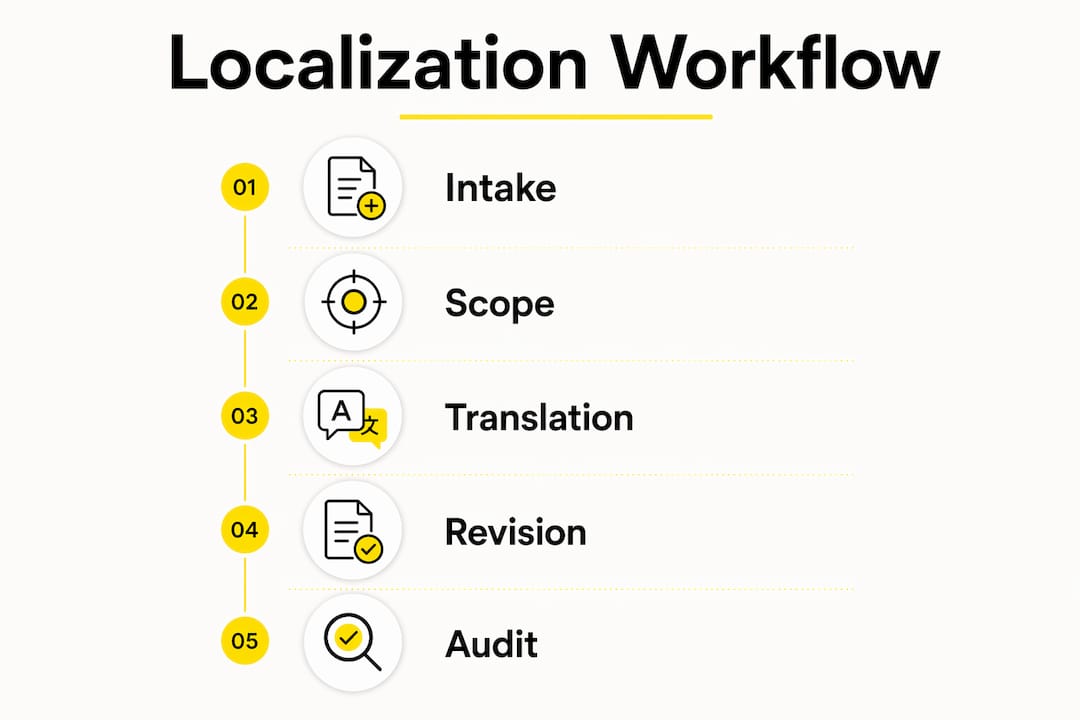
A compliant, end-to-end localization workflow covers six stages from intake to final delivery. Each stage generates artifacts that serve as audit evidence. Skipping documentation at any stage creates gaps that auditors will identify.
Content intake and scope definition. Define target markets, applicable regulatory frameworks, language pairs, and document types. Conduct market research to identify jurisdiction-specific requirements such as mandatory disclaimers, labeling regulations, or character limits for packaging text. Assign project roles and confirm team competency records at this stage.
Source file preparation and resource file setup. Apply the file engineering checklist: embed fonts, verify encoding, validate styles, remove hidden layers, and package all linked assets. Upstream file engineering controls are the most under-invested but impactful steps, reducing translation and desktop publishing rework by up to 40%. Ingest client Translation Memories and Term Bases into the TMS before any translation begins.
Translation using AI+HUMAN hybrid translation. The translation stage in a compliant workflow follows a defined sequence. First, the proprietary LLM-based system generates target language output constrained by client terminology and style guidance. Second, a certified subject-matter expert reviews the output for technical accuracy, regulatory compliance, and contextual nuance. This is not post-editing of raw machine output. It is a structured review by a qualified linguist with domain expertise in the relevant regulated sector.
Linguistic quality assurance (LQA) and revision. A second qualified linguist, independent of the translator, performs revision against the source document. ISO 17100 requires this step to be documented with the reviser’s identity and a timestamped record. Verbal confirmation does not satisfy audit requirements. The revision record must be retained as a project artifact.
Desktop publishing and engineering. Adapt layouts for target language text expansion or contraction, right-to-left scripts, or market-specific formatting requirements. Verify PDF/X compliance for print submissions and accessibility standards for digital regulatory filings. This stage also covers back-translation verification for high-risk documents such as clinical trial informed consent forms.
Final verification and audit-ready recordkeeping. Conduct a final QA check aligned to ISO 17100 and ISO 18587. Retain version history, personnel accountability records, TM update logs, and all review gate artifacts. Audit evidence planning should be treated as a traceability design problem: define what proof is needed at each stage before the project begins, not after an auditor requests it.
Stage | Key artifact for audit |
Intake and scope | Role assignment records, market research log |
File preparation | Engineering checklist, TM and TB ingestion confirmation |
Translation | LLM output log, SME review record |
LQA and revision | Timestamped revision record with reviser identity |
Desktop publishing | Layout QA report, accessibility compliance check |
Final verification | ISO 17100/18587 QA sign-off, version history file |
Pro Tip: Treat your audit evidence plan as a deliverable, not an afterthought. Define required artifacts at project kickoff and assign ownership. Compliance teams that build traceability into workflows rather than adding it reactively before audits consistently perform better under scrutiny.
How do localization strategies compare for regulated industries?
Compliance teams in regulated industries typically choose between four operational models for the process of document localization. Each carries different risk profiles for quality, speed, cost, and audit readiness.
In-house teams offer maximum control over terminology governance and institutional knowledge. The trade-off is scalability: in-house capacity rarely covers 150-plus language pairs or the full range of subject-matter expertise required for simultaneous submissions in Life Sciences, Legal, and Manufacturing contexts.
Specialist regulatory translation services provide ISO 17100-certified workflows, subject-matter expert linguists, and documented QA processes. This model is the standard choice for high-stakes submissions where audit readiness and terminology governance are non-negotiable. The cost is higher than freelance models, but the risk-adjusted value is clear when a failed audit or regulatory rejection is the alternative.
Freelance networks offer cost efficiency for lower-risk content but introduce governance challenges. Terminology consistency, version control, and audit trail generation require active management that freelance arrangements rarely provide by default.
Continuous localization with TMS and CI/CD integration suits organizations with high-volume, frequently updated regulatory content. Translation memory and terminology management integrated in a TMS automate string detection, translation routing, QA, and release stages. This model reduces per-word costs over time and maintains consistency across document versions.
Regional regulatory requirements add another layer of complexity to strategy selection:
GDPR and EU data localization laws require that document processing infrastructure meets data residency requirements. Organizations submitting to EMA or national competent authorities must verify that their localization vendor’s data processing agreements and server locations comply.
FDA submissions require terminology precision in labeling, Instructions for Use, and clinical documentation. Inconsistent phrasing between language versions can trigger deficiency letters.
Market-specific disclaimers in markets such as Japan (PMDA), Brazil (ANVISA), and China (NMPA) require jurisdiction-specific legal review, not just translation.
Common failure modes in regulatory document localization
The most frequent failures in localization for regulatory compliance are process failures, not translation failures. They occur when workflows lack defined quality gates, documentation is informal, or technology is applied without appropriate human oversight.
Inadequate source file preparation. Disorganized source files cause rework at every downstream stage. The cost impact of 20 to 40% timeline and budget overruns is well-documented, yet file engineering remains the most under-invested step in most localization programs.
Missing or informal revision records. Inconsistent revision records prevent auditors from accepting revision steps as completed under ISO 17100. If revision is verbally confirmed without a recorded reviser identity and timestamped version, the audit compliance check fails. This is a process design problem, not a personnel problem.
Over-reliance on machine translation without qualified human review. Legacy MT systems produce literal output with weak context handling. Human post-editing is critical after machine translation for regulatory documents to avoid mistranslations and legal exposure. NMT tools available as consumer SaaS products introduce inconsistent terminology control and governance limitations that are incompatible with regulated documentation requirements.
Poor terminology management. Without a validated term base enforced at the translation stage, the same regulatory concept may be rendered differently across document versions or language pairs. For a translation compliance checklist to be meaningful, terminology governance must be built into the workflow, not checked at the end.
Failure to plan audit evidence upstream. Organizations that treat traceability as a documentation task rather than a workflow design requirement consistently produce incomplete audit trails.
Audit readiness improves when controls and evidence retention are built into workflows rather than added reactively at audit time. ISO 17100 audit evidence planning
Key takeaways
The regulatory document localization process requires upstream file engineering, ISO 17100-compliant translation workflows, and documented audit trails at every stage to meet international regulatory standards.
Point | Details |
File preparation is cost-critical | Poor source file engineering increases timelines and costs by 20 to 40%; fix it before translation begins. |
Audit trails must be designed in | Document reviser identity and timestamps at every stage; verbal confirmation does not satisfy ISO 17100. |
AI+HUMAN hybrid translation is the standard | LLM generation constrained by terminology governance, followed by SME review, outperforms MT or NMT alone for regulated content. |
Strategy selection affects compliance risk | Specialist regulatory translation services provide the audit readiness and terminology governance that freelance or generic SaaS models cannot reliably deliver. |
Regional requirements vary materially | GDPR, FDA, PMDA, and ANVISA each impose jurisdiction-specific requirements that go beyond translation into legal and formatting compliance. |
Where most compliance teams get localization wrong
My perspective on this comes from observing where regulated organizations consistently lose time and credibility in localization programs. The problem is almost never the translation itself. It is the infrastructure around the translation.
Compliance teams are brought into localization projects too late. By the time a regulatory affairs officer reviews a translated submission package, the source files have already been processed, the terminology decisions have already been made, and the revision records are either complete or they are not. Involving compliance teams at the scope definition stage, before file preparation begins, changes the outcome materially. They know which terms are legally significant, which disclaimers are jurisdiction-specific, and what an auditor will actually examine.
The second pattern I see repeatedly is the misapplication of AI translation. Organizations that adopt NMT tools available as general SaaS products for regulated content are not making a cost decision. They are making a risk decision, often without recognizing it. The distinction between legacy MT, public NMT, and a properly governed AI+HUMAN hybrid translation workflow is not a marketing distinction. It reflects fundamentally different levels of terminology control, context handling, and human oversight. For a technical document compliance review to hold up under audit, the translation technology and the human review process must both be documented and defensible.
The third issue is treating audit evidence as a retrospective task. Teams that build traceability into their project management system from day one, defining what artifacts are required at each gate before the project starts, consistently produce cleaner audit packages. It is a workflow design discipline, and it is learnable.
How AD VERBUM supports regulatory document localization
AD VERBUM delivers ISO 17100-compliant localization for regulated industries including Life Sciences, Legal, Finance, Defense, and Manufacturing. The AI+HUMAN hybrid translation workflow integrates client Translation Memories and Term Bases at ingestion, applies the proprietary LangOps LLM-based system for terminology-governed translation, and routes output to certified subject-matter expert linguists for review. QA is aligned to ISO 17100, ISO 18587, and sector-specific requirements including MDR. With 3,500-plus subject-matter expert linguists across 150-plus languages, EU-hosted infrastructure certified to ISO 27001, and turnaround 3x to 5x faster than traditional workflows, AD VERBUM is built for compliance teams that cannot afford process gaps in their localization programs.
FAQ
What is the regulatory document localization process?
The regulatory document localization process is a structured workflow that adapts regulatory documents for target markets through source file engineering, qualified translation, linguistic quality assurance, and documented audit trail generation. It is defined by ISO 17100 compliance requirements and the need for traceable revision records at every stage.
How does localization differ from translation for regulatory documents?
Localization for regulatory compliance goes beyond linguistic translation to include cultural adaptation, jurisdiction-specific legal formatting, market-specific disclaimers, and layout engineering for target markets. Translation is one stage within the broader localization workflow.
What does ISO 17100 require for regulatory document localization?
ISO 17100 requires that revision steps are performed by a qualified linguist independent of the translator, with documented records identifying the reviser and timestamping each version. Objective evidence and traceability are mandatory; informal or verbal confirmation of revision does not satisfy audit requirements.
When should AI translation be used in regulatory localization?
AI translation is appropriate in regulatory localization when it is implemented as part of an AI+HUMAN hybrid translation workflow with terminology governance, SME review, and ISO-aligned QA. Legacy MT and public NMT tools used without qualified human oversight introduce unacceptable risk for regulated content.
What are the most common causes of failure in regulatory document localization?
The most common failure modes are inadequate source file preparation, missing timestamped revision records, over-reliance on machine translation without human review, and poor terminology management. Each of these is a quality assurance gap that can be addressed through defined workflow controls and upstream planning.
Recommended
