


Step by Step Translation Quality Assurance for Compliance

Accuracy in regulated industries is not optional. For every Localization Manager handling American medical, legal, or technical documentation, a single terminology mismatch can put compliance at risk. In highly regulated sectors worldwide, integrating translation assets and leveraging AI plus human expertise ensures your organization meets both strict regulatory and business demands. Discover why a precise, context-driven workflow goes far beyond just reducing errors—it directly supports your team’s accountability and protects your crucial compliance goals.
Table of Contents
Quick Summary
Key Insight | Explanation |
1. Consolidate Translation Assets | Centralize translation memories and glossaries for consistent terminology and regulatory compliance across documents. |
2. Utilize AI for Contextual Accuracy | Configure AI translation systems with glossaries to capture nuanced meanings in technical documentation. |
3. Involve Subject Matter Experts | Employ experts to validate AI translations, focusing on technical accuracy and regulatory adherence. |
4. Map Regulatory Standards | Align translations with applicable ISO standards to ensure compliance and quality in technical documentation. |
5. Implement Security Measures | Establish robust protocols to secure sensitive translation data and validate compliance with regulations. |
Step 1: Integrate Translation Assets and Glossaries
Successfully integrating translation assets and glossaries forms the foundation of a robust translation accuracy strategy. This critical step ensures your organization maintains consistent terminology across all translated documents for regulatory compliance.
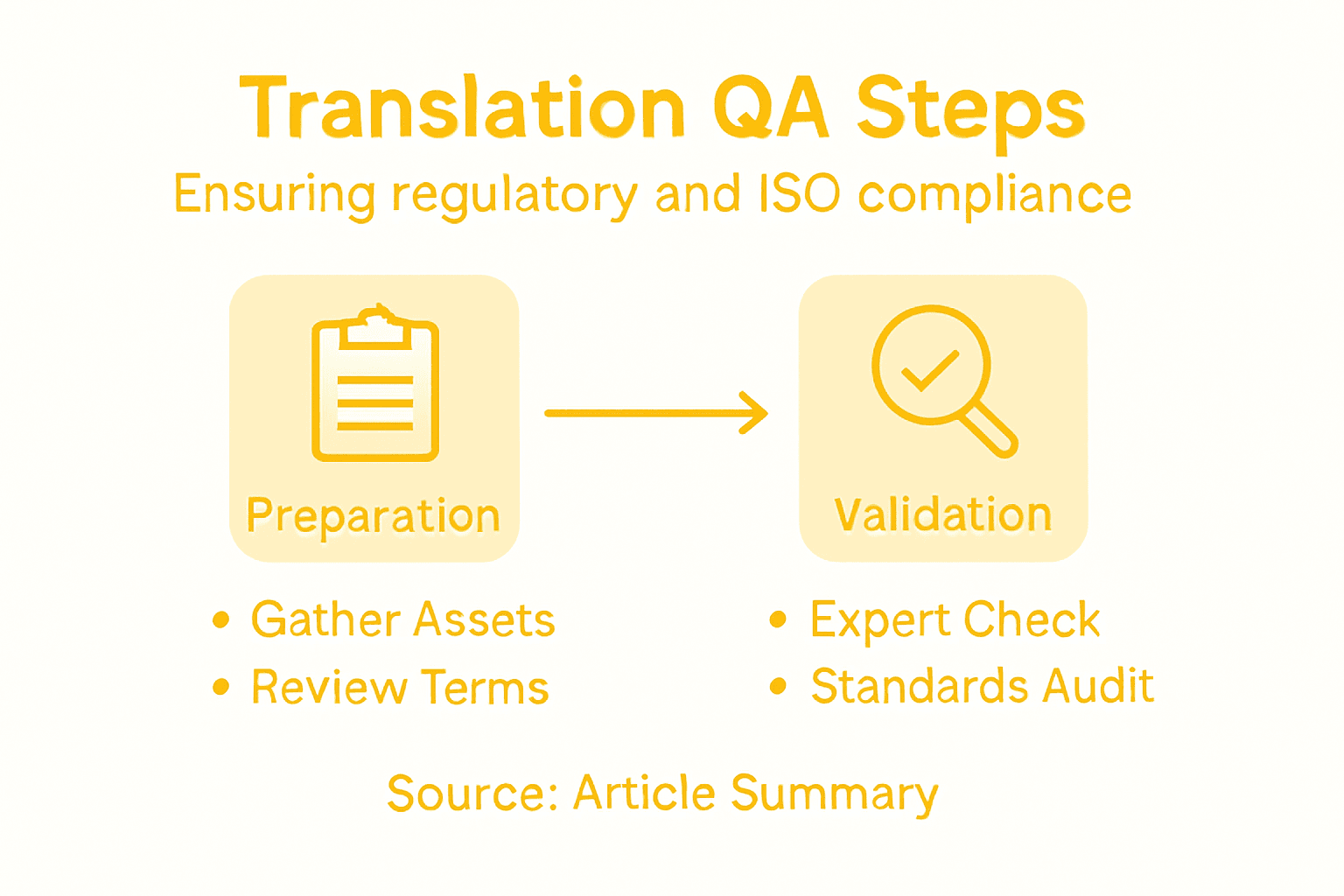
Begin by gathering all existing translation memories, terminology databases, and glossaries from previous projects. Consolidate these resources into a centralized repository that your translation team can easily access. Prioritize assets that contain specialized technical terms specific to your industry such as medical device specifications, legal terminology, or manufacturing process descriptions. Pay close attention to context specific nuances that might impact translation accuracy.
Review each asset meticulously to validate terminology consistency and remove outdated or irrelevant entries. Work closely with subject matter experts to verify that technical terms are accurately represented and align with current regulatory standards. Create a master glossary that serves as the definitive reference point for all future translation projects.
Pro Tip: Implement a quarterly review process to update and refine your translation assets, ensuring ongoing accuracy and alignment with evolving industry terminology.
Here’s how key translation assets support project success:
Asset Type | Main Purpose | Business Impact |
Translation Memory | Stores previous translations | Ensures consistency, saves time |
Terminology Database | Centralizes approved terms | Reduces errors, aligns with industry |
Glossary | Defines specialized terminology | Improves clarity, supports compliance |
Step 2: Generate Context-Driven AI Translations
Generating context-driven AI translations requires precision and strategic implementation to ensure regulatory compliance. Your goal is to create translations that capture not just words, but the nuanced meaning behind complex technical documentation.
Start by configuring your AI translation system with the master glossary and translation memory assets you previously assembled. Configure AI translation workflows that leverage your proprietary terminology databases, ensuring the AI understands specific contextual requirements unique to your industry. This involves programming the system to recognize specialized technical terms, maintain consistent language patterns, and adhere to regulatory language standards.
During the generation process, implement multiple layers of contextual verification. Train your AI to recognize industry specific terminology contexts and flag potential ambiguities. This means the system should understand whether technical terms like ‘device’ refer to medical equipment, legal instruments, or mechanical components based on the document’s overall context. Cross reference translations against your established glossary to maintain absolute precision.
Pro Tip: Establish a staged review process where AI generated translations are first validated by domain specific linguistic experts before final approval.
Step 3: Refine Output with Subject Matter Experts
Refined translations demand expert human insight to validate accuracy and regulatory compliance. Your goal is to leverage subject matter experts who can critically analyze AI generated translations and ensure absolute precision across technical documentation.
Assemble a specialized team of linguistic experts with deep domain knowledge in your specific industry. Configure expert review workflows that systematically evaluate each translation for technical accuracy technical nuance and regulatory adherence. This involves creating a structured review process where experts examine translations line by line comparing them against original source documents regulatory guidelines and established terminology databases.
During the refinement process focus on identifying subtle contextual interpretations that AI might miss. Experts should pay particular attention to technical terminology specialized industry jargon and regulatory language that requires precise interpretation. Encourage collaborative dialogue between AI systems and human experts creating a dynamic feedback loop that continuously improves translation quality and captures the intricate linguistic subtleties unique to your industry.
Pro Tip: Develop a standardized scoring system for subject matter experts to quantitatively assess translation accuracy ensuring consistent and measurable quality across review processes.
Step 4: Validate Against Regulatory and ISO Standards
Validating translations against regulatory and ISO standards is critical for ensuring absolute compliance and precision in technical documentation. Your objective is to systematically verify that every translated document meets the stringent requirements of industry specific regulations and international quality benchmarks.
Begin by mapping out the specific ISO standards for language services applicable to your industry. Each regulated sector demands unique compliance protocols whether in medical devices legal documentation or technical manuals. Focus on standards like ISO 17100 for translation services ISO 13485 for medical device documentation and industry specific regulatory frameworks that govern your specific domain.
Develop a comprehensive validation checklist that encompasses linguistic accuracy technical precision and regulatory compliance. This involves creating a detailed assessment matrix that evaluates translations across multiple dimensions including terminology consistency contextual accuracy formatting alignment and adherence to specific regulatory language requirements. Engage subject matter experts who understand both the linguistic nuances and the regulatory landscape to conduct meticulous line by line reviews.
Pro Tip: Create a digital validation toolkit with automated compliance checking mechanisms that can quickly flag potential deviations from established ISO and regulatory standards.
Comparison of regulatory frameworks for technical translations:
Standard or Regulation | Applicability | Focus Area |
ISO 17100 | General translation services | Process quality for translations |
ISO 13485 | Medical device documentation | Safety, precision, legal compliance |
GDPR | Data handling in EU | Data privacy and security |
HIPAA | Health documentation (US) | Patient confidentiality, compliance |
Step 5: Secure Final Review and Data Compliance
Securing the final review and ensuring comprehensive data compliance represents the most critical phase of your translation quality assurance workflow. Your ultimate goal is to protect sensitive information while maintaining the highest standards of regulatory integrity.

Implement robust security protocols that align with data protection standards for compliance teams. This involves creating multiple verification layers that validate both the linguistic accuracy and the data security of your translated documents. Establish strict access controls that limit document visibility only to authorized personnel with specific clearance levels. Utilize encryption technologies that protect document contents during storage and transmission ensuring that sensitive information remains confidential throughout the entire translation process.
Conduct a comprehensive final audit that examines each translated document through multiple compliance lenses. This means verifying not just the translation quality but also ensuring that the document meets all relevant regulatory requirements specific to your industry. Pay special attention to data handling protocols checking that every aspect of the translation process adheres to international standards like GDPR HIPAA and industry specific regulatory frameworks. Document each step of the review process creating an audit trail that demonstrates your commitment to absolute precision and regulatory compliance.
Pro Tip: Create a digital compliance dashboard that provides real time tracking of document security status and automatically flags potential regulatory risks.
Ensure Compliance and Accuracy With AD VERBUM’s AI+HUMAN Precision Translation
The article outlines critical steps for achieving flawless translation quality assurance in regulated industries. It highlights challenges such as integrating translation assets, generating context-driven AI translations, engaging subject matter experts, and rigorously validating outputs against ISO and regulatory standards. Key concerns include maintaining terminology consistency, safeguarding data security, and meeting stringent regulatory compliance requirements—goals that are essential for companies operating in Life Sciences, Legal, Finance, and Manufacturing sectors.
AD VERBUM addresses these challenges head-on with its proprietary AI+HUMAN workflow. Unlike public machine translation services, our LLM-based AI system operates exclusively within an ISO 27001-certified private cloud hosted on EU servers. This infrastructure ensures zero data leakage and absolute protection of your sensitive information. Our AI strictly adheres to client-approved terminology through deep integration of Translation Memories and Terminology Databases. Combined with expert review by linguists and industry specialists, this process guarantees unparalleled precision, contextual accuracy, and full regulatory alignment—including ISO 17100 and Medical Device Regulation.
Discover how to elevate your translation compliance strategy now by visiting AD VERBUM’s website. Learn more about our Specialized AI Translation services designed for regulated industries and explore how expert AI+HUMAN workflows maximize speed without compromising safety. Do not risk costly errors or data breaches—partner with AD VERBUM today for the safest, most precise translation solutions available.
Frequently Asked Questions
How do I integrate translation assets and glossaries for compliance?
Begin by collecting all your existing translation memories, terminology databases, and glossaries. Consolidate these resources into a centralized repository that your translation team can easily access to ensure consistent terminology across all documents.
What are the key steps to generate context-driven AI translations?
To create context-driven AI translations, start by configuring your AI translation system with your consolidated glossary and translation memories. Implement multiple layers of contextual verification to ensure the AI understands the nuance behind technical terms and regulatory language requirements.
How can subject matter experts refine AI translations?
Subject matter experts can refine AI translations by systematically reviewing each translation for accuracy and compliance. Assemble a team of experts to examine translations line by line, ensuring that specialized terminology and regulatory standards are addressed thoroughly.
What should I include in my validation checklist for translations?
Your validation checklist should include linguistic accuracy, contextual precision, and adherence to specific regulatory standards. Develop a detailed assessment matrix that evaluates these criteria, allowing for meticulous reviews of each translated document.
How do I ensure data compliance during the translation process?
To ensure data compliance, implement robust security protocols, including strict access controls and encryption technologies. Conduct a final audit that examines each translated document for quality and compliance, and document your review process to maintain an audit trail.
What is the purpose of establishing a master glossary?
A master glossary serves as a definitive reference point for consistent terminology across all future translation projects. Create this glossary by working closely with subject matter experts to validate and standardize technical terms used in your industry.
Recommended

