Basel III/IV translation guide for consistent reporting terms

Regulatory compliance professionals managing Basel III/IV supervisory document localization across multiple jurisdictions consistently encounter terminology inconsistencies that create reporting challenges and elevate non-compliance risk. When a capital adequacy term translates differently in French for the ACPR versus the ECB, reconciliation delays multiply and supervisory scrutiny intensifies. This guide provides systematic approaches to manage terminology consistency effectively, ensuring your Pillar 3 disclosures, ICAAP reports, and LCR filings maintain exact terminological alignment with the underlying prudential framework across every language version.
Table of Contents
Key Takeaways
Point | Details |
Jurisdictional Terminology Variances | Basel term translations vary by jurisdiction due to local regulatory modifications rather than language. |
Substantive RCAP focus | RCAP emphasizes substantive compliance and equivalence over exact wording to preserve regulatory intent. |
Glossaries and sworn translators | Leverage Basel glossaries and sworn translations to improve localization accuracy across jurisdictions. |
Monitor RCAP updates | Ongoing RCAP dashboards help track implementation differences and flag terminology updates for compliance. |
Governance and terminology mapping | Establish a jurisdiction mapping matrix to document direct equivalents and adapt terms as needed for local regulations. |
Understanding the challenges of Basel III/IV terminology consistency
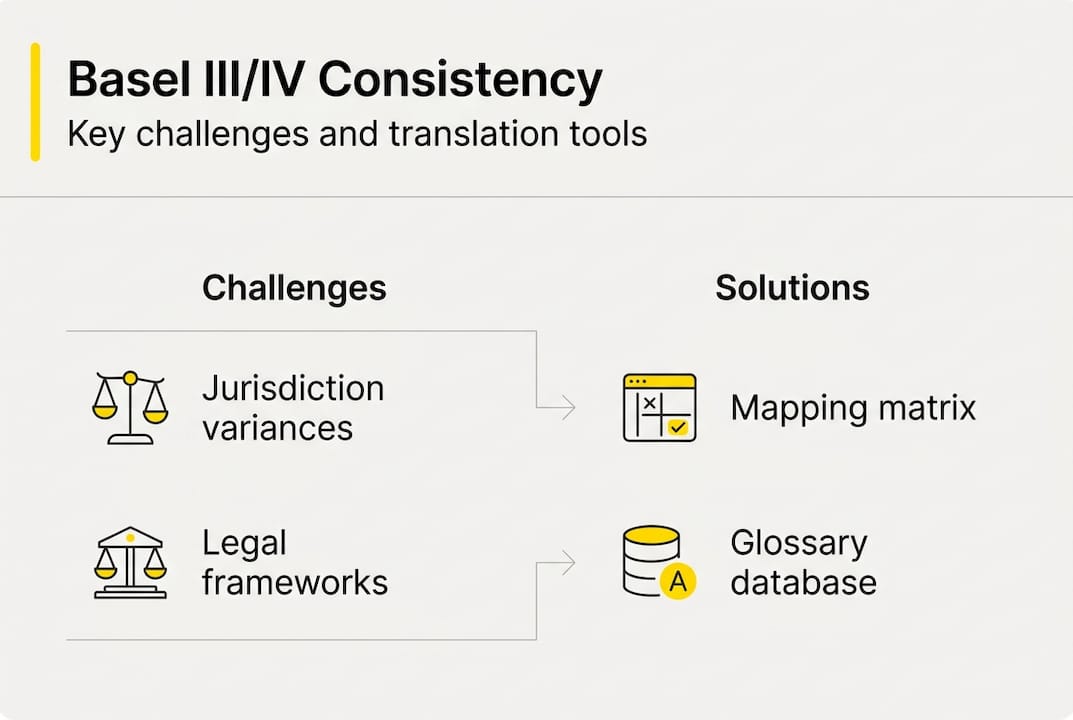
Different jurisdictions implement Basel III/IV through varying legal frameworks that directly affect how regulatory concepts translate into local languages. The US SSFA for securitizations diverges from Basel text due to Dodd-Frank prohibiting external ratings, creating terminology that has no direct Basel equivalent. EU jurisdictions show deviations in output floor phase-in schedules and CVA exemptions that require specialized terms not found in the original Basel framework.
These differences result in terminology variances that complicate literal translation approaches. A term like “output floor” may require three different translations within the EU alone, depending on whether the jurisdiction adopted the standard timing or negotiated phase-in adjustments. The Regulatory Consistency Assessment Program (RCAP) explicitly uses substantive compliance focus rather than exact wording, recognizing that regulatory intent matters more than linguistic precision.
Understanding these nuances is critical for compliance professionals managing translation workflows. You cannot simply hire a financial translator and expect terminology consistency across jurisdictions. The regulatory landscape itself creates legitimate term variations that must be mapped, documented, and managed through governance processes.
Key challenges include:
Jurisdictional legal frameworks that modify Basel concepts for local application
Regulatory terms that exist in one jurisdiction but not others
Timing differences in implementation creating temporary terminology gaps
Supervisory authority preferences for specific term choices within a language
Legacy terminology from Basel II that conflicts with Basel III/IV updates
Pro Tip: Create a jurisdiction mapping matrix that documents which Basel terms have direct equivalents versus which require adapted terminology based on local regulatory modifications. This becomes your master reference for all translation decisions.
When you encounter terminology errors in cross-border contracts, the financial impact can reach millions in delayed approvals and remediation costs. Basel reporting faces identical risks at scale.
Preparing for terminology consistency: tools and resources
Successful Basel III/IV translation starts with assembling authoritative resources before any linguistic work begins. The Basel Committee’s official glossaries provide substantive assessment anchors, supplemented by sworn and localized translations for jurisdiction-specific reporting. These glossaries define terms in the original English framework language, establishing the semantic foundation that all translations must preserve.

RCAP dashboards track jurisdiction-specific Basel III/IV implementation statuses, revealing where local regulations introduce terminology variations. As of September 2025, Basel III standards are effective in 80% of jurisdictions for credit risk, operational risk, and output floor requirements, but variations persist requiring ongoing monitoring. You need real-time awareness of these implementation differences to brief translators appropriately.
Employ sworn translators and local regulatory language specialists who understand both the source Basel framework and the target jurisdiction’s supervisory expectations. A translator fluent in German but unfamiliar with BaFin reporting conventions will produce technically correct but regulatorily inappropriate terminology. Subject matter expertise in prudential regulation is non-negotiable for this work.
Prepare internal style guides that reference Basel terms with approved translations for each jurisdiction. These guides should document:
Official Basel Committee term definitions in English
Approved translations for each target language and jurisdiction
Regulatory context explaining why certain terms vary by jurisdiction
Examples showing correct term usage in sample disclosures
Update history tracking when and why terminology changed
Establish governance policies for terminology validation and updates. Designate a terminology owner within your compliance function who reviews RCAP updates quarterly and authorizes changes to approved term lists. Without governance, terminology drift occurs as different translators make independent choices.
Pro Tip: Build a terminology database that tags each term with its jurisdictional scope. A term approved for ECB filings may not be appropriate for national competent authority submissions in the same language.
Resource type | Primary use | Update frequency |
Basel Committee glossaries | Semantic anchors for all translations | Annual or per Basel publication |
RCAP dashboards | Implementation status tracking | Quarterly |
Sworn translator network | Jurisdiction-specific linguistic expertise | Ongoing relationship |
Internal style guides | Translator briefing and QA reference | Quarterly review, ad hoc updates |
Terminology governance policy | Change control and approval authority | Annual policy review |
Integrate these resources into your terminology enforcement guide for technical translation to create a repeatable framework. The preparation phase determines whether your translation workflow produces consistent results or requires expensive rework cycles.
For organizations managing multiple regulatory frameworks simultaneously, compliant translations for regulated sectors require this same level of preparation discipline across all domains.
Executing consistent translation workflows for Basel III/IV documents
Once preparation is complete, execute translation through a structured workflow that enforces terminology consistency at every stage. Follow these steps systematically:
Define project scope by identifying the specific Basel III/IV regulatory requirements and jurisdictional mandates that apply to each document. A Pillar 3 disclosure for the ECB has different scope than one for the PRA, even though both implement Basel standards.
Develop and maintain a master terminology glossary updated per RCAP findings. This glossary must be version-controlled and distributed to all translators before work begins. Every translator working on your Basel documents must use the identical term list.
Implement the core translation workflow: initial translation by a financial specialist, review by a regulatory compliance expert familiar with the target jurisdiction, terminology consistency checks against your master glossary, and final quality assurance comparing output to Basel source intent.
Use terminology management tools that flag deviations from approved terms in real time. Modern translation platforms can enforce terminology rules automatically, preventing inconsistent choices from reaching the review stage.
Monitor RCAP implementation updates regularly to adjust terminology as jurisdictions modify their Basel adoption. Schedule these reviews quarterly to catch changes before they create compliance gaps.
Create feedback loops where supervisory authority comments on submitted documents inform terminology refinements. If a regulator questions a term choice, document the feedback and update your master glossary accordingly.
Pro Tip: Schedule biannual training sessions for translators and compliance reviewers covering recent Basel updates, new RCAP findings, and terminology changes. Consistent output requires consistent knowledge across your team.
Translation approach | Pros | Cons | Best for |
Outcomes-focused (substantive equivalence) | Captures regulatory intent, adapts to jurisdictional frameworks, aligns with RCAP methodology | Requires deep regulatory expertise, harder to automate, needs ongoing judgment | Basel III/IV supervisory documents, ICAAP reports, regulatory correspondence |
Line-by-line (literal translation) | Faster execution, easier to automate, consistent linguistic structure | Misses jurisdictional nuances, creates false precision, fails RCAP substance test | Internal working documents, preliminary drafts, non-supervisory materials |
The comparison reveals why translation workflows for regulatory compliance must prioritize substantive equivalence over literal accuracy. Regulators evaluate whether your disclosures convey the required prudential information, not whether every word maps one-to-one to the Basel source text.
When selecting translation providers, compare options using the framework in best translation services for regulated industries. Providers specializing in financial regulation will have Basel-specific terminology resources and regulatory expertise that general translation services lack.
Verifying and maintaining terminology consistency post-translation
Translation completion is not the endpoint. Verification and ongoing maintenance ensure terminology consistency survives regulatory updates and organizational changes. Conduct post-translation reviews that compare localized documents against Basel standards, focusing on whether substantive meanings align rather than whether words match literally.
Use systematic checklists to verify terminology consistency:
Cross-reference every regulatory term against your master glossary
Confirm jurisdiction-specific adaptations match current RCAP status
Validate that term usage context matches Basel Committee intent
Check that related terms maintain logical consistency across the document
Flag any terms that appear in multiple forms for remediation
Engage compliance teams and local regulatory experts in review cycles to capture jurisdictional nuances that translators may miss. A compliance officer familiar with daily supervisory interactions will spot terminology choices that, while technically correct, differ from regulator expectations. These insights are invaluable for refining your terminology standards.
Maintain rigorous version control and document change histories for auditability. Supervisory authorities may question why a term changed between reporting periods. Your version history should show exactly when the change occurred, what triggered it (such as an RCAP update or regulatory feedback), and who authorized it.
Pro Tip: Integrate feedback from supervisory authorities and RCAP updates into continuous training and glossary refinement. Every regulator interaction is an opportunity to improve terminology accuracy.
Monitor implementation deviations such as EU output floor phase-in timing and CVA exemptions773694_EN.pdf) to adapt terminology and remain compliant. These substantive differences affect not just term choice but the entire disclosure framework, requiring coordinated updates across multiple language versions.
Verification activity | Frequency | Owner | Output |
Post-translation terminology audit | Per document | Compliance terminology lead | Deviation report with remediation plan |
RCAP update review | Quarterly | Regulatory affairs | Updated jurisdiction mapping matrix |
Supervisory feedback integration | Ad hoc (post-submission) | Compliance and translation leads | Glossary updates and translator briefing |
Version control audit | Annual | Compliance operations | Auditability confirmation report |
For comprehensive guidance on maintaining translation compliance for technical documents, apply these verification principles across all your regulatory translation workflows.
Enhance your Basel III/IV translation accuracy with AD VERBUM
Managing terminology consistency across Basel III/IV regulatory reporting translations requires specialized expertise that combines linguistic precision with deep regulatory knowledge. AD VERBUM operates a proprietary AI ecosystem hosted on EU servers, delivering terminology governance through an AI+HUMAN hybrid translation workflow specifically designed for regulated financial sectors.
Our network of 3,500+ subject-matter expert linguists includes financial regulatory specialists who understand both Basel frameworks and jurisdiction-specific supervisory expectations. We integrate your Translation Memories and Term Bases first, then apply LLM-based translation constrained by your approved terminology, followed by certified expert review for regulatory compliance and contextual nuance. Quality assurance aligned to ISO 17100 and ISO 18587 ensures every Basel document meets the consistency standard prudential regulators demand.
Explore our localization services to see how terminology governance and regulatory expertise combine in workflows built for Basel III/IV complexity. Enhance discoverability of your localized regulatory documents with our multilingual SEO and LLMO capabilities, ensuring stakeholders find accurate information across all language versions.
Frequently asked questions
What is the Regulatory Consistency Assessment Program (RCAP)?
RCAP is the Basel Committee’s program for assessing how jurisdictions implement Basel standards, focusing on substantive regulatory alignment rather than literal text matching. The program evaluates whether local regulations achieve Basel’s prudential objectives, even when terminology or legal structures differ from the source framework. This outcomes-based approach recognizes that effective regulation matters more than word-for-word adoption, directly impacting how translation workflows should prioritize substantive equivalence over literal accuracy.
How can banks manage terminology differences across jurisdictions?
Banks should anchor all translations to Basel Committee glossaries as standard references, then employ sworn translators and local regulatory language specialists familiar with each jurisdiction’s supervisory context. Leverage RCAP implementation updates quarterly to monitor and adjust terminology as jurisdictions modify their Basel adoption. Maintain a master terminology database that documents approved terms by jurisdiction and language, with governance processes controlling when and how terms can change.
What are the most common terminology challenges in Basel III/IV translation?
Jurisdictional regulatory differences create the most frequent terminology challenges, as local legal frameworks modify Basel concepts for domestic application. Terms describing securitization risk approaches, output floors, and credit valuation adjustment (CVA) prove especially difficult because jurisdictions implement these requirements with substantial variations. The risk of losing intended compliance meaning intensifies when translators lack regulatory expertise, potentially creating terminology errors in cross-border contracts that trigger supervisory questions and delay approvals.
Why is outcomes-based assessment preferred over literal translation for consistency?
Literal translation overlooks substantive regulatory intent variations that arise when jurisdictions adapt Basel standards to local legal frameworks. Outcomes-based RCAP methodology evaluates whether regulations achieve Basel’s prudential goals rather than whether they use identical wording, promoting assessment of actual compliance effects. This approach better adapts to jurisdictional differences while maintaining Basel objectives, making it the preferred standard for translation workflows that must satisfy both linguistic accuracy and regulatory substance.
Recommended