


Navigate ICH E6(R3) GCP: Multilingual TMF Requirements

Many clinical operations teams assume multilingual trial master file compliance is primarily a translation quality problem. Get a certified vendor, receive a stamped document, file it. Done. ICH E6(R3) GCP dismantles that assumption entirely. The revised guideline introduces sweeping expectations around process documentation, traceability, and auditable evidence of how every translated record was produced, reviewed, and controlled. GCP inspectors from the EMA, MHRA, and national competent authorities are now evaluating the workflow behind the translation, not just the output. This guide breaks down exactly what changed, what auditors will examine, and how to close the compliance gaps before they become inspection findings.
Table of Contents
Key Takeaways
Point | Details |
ICH E6(R3) expands TMF audits | Auditors will scrutinize every step of multilingual TMF documentation, not just translation output. |
Traceability is mandatory | End-to-end records for each translation are now essential for regulatory compliance. |
Validated workflows reduce risk | Standardizing and documenting translation workflows makes TMFs audit-ready and defensible. |
Exception handling must be robust | Careful deviation documentation and justifications prevent critical compliance findings. |
Expert support streamlines compliance | Localization partners help embed ICH E6(R3) GCP standards efficiently into TMF operations. |
What has changed with ICH E6(R3) GCP for multilingual TMF?
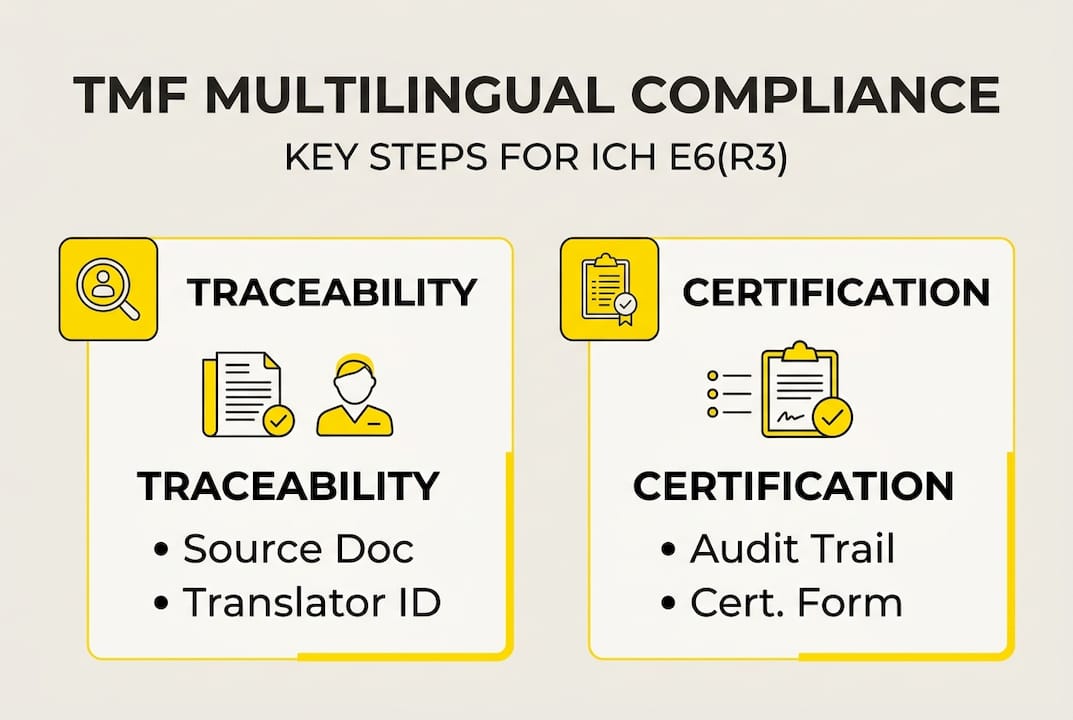
The transition from E6(R2) to E6(R3) is not a cosmetic update. For multilingual TMF management specifically, the revision codifies expectations that were previously implied or inconsistently enforced. The ICH E6(R3) documentation traceability requirements now explicitly address how translated documents must be traceable across their full lifecycle, from source text through reviewer sign-off to the final filed version.
Under E6(R2), many sponsors treated translation as a vendor-side activity with minimal internal oversight documentation. E6(R3) closes that gap. Sponsors and CROs are now expected to maintain evidence of who translated each document, what qualifications that person held, what review process was applied, and which version of the source document was used.
Requirement area | E6(R2) expectation | E6(R3) expectation |
Translator qualifications | Implied, rarely documented | Must be recorded and auditable |
Review process | Vendor discretion | Documented, sponsor-overseen |
Version traceability | Informal | Explicit version linkage required |
Back-translation | Rarely specified | Expected for critical site documents |
Certification | Inconsistent | Formal certification with audit trail |
The TMF Reference Model organizes TMF artifacts into zones and sub-zones. Translation records, including certification documents and reviewer credentials, now need to be positioned correctly within Zone 1 (Trial Management) and Zone 4 (Investigator Site File) depending on document type. Filing a translation certificate in the wrong zone, or failing to file it at all, is a finding.
Key areas under stricter audit scrutiny include:
Source document control: Which version of the protocol, informed consent form (ICF), or patient material was translated
Reviewer qualifications: Evidence that the reviewer holds relevant clinical or scientific credentials
Version traceability: A clear link between source version, translation version, and any amendments
Certification chain: Formal certification statements tied to specific document versions
“Multilingual TMF deficiencies tied to poor translation process documentation have become a recurring theme in GCP inspection findings across EU member states.”
If your clinical report translation process does not generate a documented audit trail at each step, you are already behind the standard. Understanding medical translation compliance as a process discipline, not just a language task, is the foundational shift E6(R3) demands.
New audit requirements: Traceability, validation, and certification
With the broad strokes of the revision covered, here is what auditors will drill into during multilingual TMF reviews. The EMA TMF inspection findings consistently flag end-to-end traceability failures as critical observations, meaning deficiencies that directly impact data integrity or participant safety assessments.
Document type | Traceability requirement | Validation step | Certification required |
Informed consent form (ICF) | Source version linkage | Back-translation + independent review | Yes |
Protocol | Amendment-level version control | Subject-matter expert review | Yes |
Patient diary / questionnaire | Source and target version | Cognitive debriefing or review | Yes |
Investigator brochure | Version and date stamping | Clinical SME review | Yes |
Site-specific materials | Local language confirmation | Qualified reviewer sign-off | Yes |
The sequential process regulators expect looks like this:
Initial translation by a qualified translator with documented clinical or scientific credentials
Reviewer credential validation confirming the reviewer’s qualifications are recorded and filed
Back-translation (required for ICFs and other critical patient-facing documents) by an independent translator not involved in the forward translation
Reconciliation review comparing back-translation against the source to identify meaning discrepancies
Formal certification with a signed statement linking the translator, reviewer, document version, and date
TMF filing in the correct Reference Model zone with all supporting evidence attached
The FDA TMF guidance mirrors many of these expectations, particularly around ICF traceability, making this a cross-jurisdictional compliance requirement rather than a regional one.
Pro Tip: The most common mistake sponsors and CROs make is treating the translation certificate as the only required record. Auditors increasingly request the reviewer’s CV, the back-translation comparison document, and the version reconciliation log as separate artifacts. If those do not exist, the certificate alone will not satisfy the inspection.
Building medical translation accuracy into your vendor qualification criteria, and requiring regulated translation workflows as a contractual deliverable, are the two fastest ways to close this gap before an inspection cycle begins.

Managing translation workflows for regulatory fit
Once the “what” is clear, the big question is operational: how do you operationalize these new standards day to day? Standardized translation workflows significantly reduce audit risk for multilingual TMFs, but the design of those workflows matters as much as their existence.
Must-have workflow steps for ICH E6(R3) alignment:
Validated vendor qualification: Documented evidence that your translation vendor holds relevant certifications (ISO 17100, ISO 13485 for medical devices) and that their linguists carry verifiable clinical credentials
Documented review cycles: A formal review log capturing who reviewed each document, their qualifications, the date, and any comments or changes made
Audit trail creation: System-level or document-level logs that record every action taken on a translation file, including version saves, reviewer access, and approval timestamps
Secure delivery: Encrypted transfer and storage of translated documents, with access controls that support data sovereignty requirements
Amendment tracking: A defined process for managing protocol or ICF amendments so that translated versions are updated, re-certified, and re-filed promptly
Pro Tip: Translation memory ™ and term base (TB) assets are not just efficiency tools. In a GCP context, they are consistency controls. When your TM enforces approved terminology across every document version, you reduce the risk of meaning drift between amendments. A well-maintained TM also creates an implicit version history that supports audit trail requirements. Require your vendor to provide TM reports as part of each project deliverable.
The document chains most vulnerable to workflow errors are amendment cycles for protocols and ICFs. When a protocol amendment triggers a cascade of translated updates across multiple site languages, teams frequently lose version synchronization. A single site receiving an outdated ICF translation is a critical finding. Ensuring compliant translations across amendment cycles requires a formal change control process, not just a re-translation request. When creating compliant translation RFPs, build amendment management requirements directly into the scope of work.
Robust workflow documentation also accelerates audit response. When an inspector requests evidence for a specific ICF translation, a well-structured workflow means you can produce the source version, translation, back-translation, reviewer credentials, and certification in a single retrieval action rather than a multi-day search.
Beyond translation: Documenting compliance and handling exceptions
Now that your workflows are robust, the final layer is airtight compliance documentation and exception management. This is where many otherwise solid programs develop cracks.
Sequential steps for documenting compliance data for each translation:
Assign a unique document ID to each translation project, linked to the source document version
Record translator name, language pair, qualifications, and assignment date
Log reviewer name, credentials, review date, and outcome (approved, revised, or rejected)
File back-translation and reconciliation report as separate TMF artifacts
Issue and file a formal certification statement referencing all of the above
Update the TMF index to reflect the new record in the correct Reference Model zone
Archive all working files, including tracked-change versions and reviewer correspondence
“Unexplained gaps or poorly justified deviations in translation documentation are a leading cause of critical TMF findings during MHRA GCP inspections.”
Deviations happen. A source document may be updated before the translation is finalized. A qualified reviewer may be unavailable, requiring a substitute. A site may request a language variant not covered in the original scope. None of these situations are automatically disqualifying, but all of them require a documented exception with a regulatory justification.
Best practices for handling deviations include:
Write a formal deviation note that describes what happened, why it occurred, and what risk mitigation was applied
Reference the specific ICH E6(R3) or applicable national guidance expectation that the deviation relates to
Obtain a qualified sign-off on the deviation note from a regulatory or QA lead
File the deviation note adjacent to the affected translation record in the TMF
Using defined translation workflows for compliance and understanding the full range of translation compliance types helps teams anticipate which exception scenarios are most likely and pre-build the documentation templates before they are needed under time pressure.
A practical perspective: What most teams miss about ICH E6(R3) multilingual TMF compliance
Having covered the core compliance process, here is an on-the-ground reality check about common missteps.
The most persistent trap we see is the false sense of security that comes from working with a certified translation vendor. ISO 17100 certification at the vendor level is necessary, but it does not transfer compliance responsibility to the vendor. ICH E6(R3) is explicit: sponsors are accountable for overseeing and documenting the translation process. A vendor certificate on file does not substitute for your internal QA check.
The second overlooked area is metadata. Timestamps, author IDs, system access logs, and version save records are part of your audit trail whether you manage them deliberately or not. Inspectors increasingly request system-generated metadata to cross-check document certification dates. If your metadata shows a document was accessed after its certification date with no explanation, that is a finding.
Pro Tip: Apply the same rigor to exception documentation that you apply to primary translation workflows. A well-documented deviation is defensible. An undocumented one is not, regardless of how reasonable the underlying decision was.
Managing multilingual clinical trial translation risks across EU sites requires embedding compliance thinking into daily TMF operations, not treating it as a pre-inspection cleanup exercise. The teams that perform best in GCP inspections are the ones who have made compliance documentation a standing workflow habit.
Take your multilingual TMF compliance further with AD VERBUM
ICH E6(R3) raises the bar for every sponsor and CRO managing multilingual TMF documentation. Meeting that bar requires a translation partner with certified clinical SME linguists, validated workflows, and the audit trail infrastructure GCP inspectors now expect.
AD VERBUM’s AI+HUMAN hybrid workflow integrates your existing Translation Memories and Term Bases, applies proprietary LLM-based generation with terminology governance, and delivers 100% SME-reviewed output aligned to ISO 17100, ISO 13485, and ISO 27001. Our EU-hosted infrastructure supports GDPR and HIPAA data sovereignty requirements. Explore our localization solutions for life sciences, review our approach to multilingual clinical documentation, or contact AD VERBUM to discuss your ICH E6(R3) compliance requirements directly.
Frequently asked questions
What documents must be included in the TMF in local language?
Any patient-facing or site-required TMF documents, including ICFs, patient diaries, and site-specific materials, must be available in the official local language as required by ICH E6(R3) local language expectations for contextual understandability.
What counts as traceability for translated TMF documents?
Traceability means a documented record showing the source document version, translator qualifications, certification statement, back-translation where required, and the full chain of custody for each version, as outlined in EMA TMF traceability inspection expectations.
How do I handle a translation exception in my TMF?
Document the exception with a formal deviation note, provide a regulatory justification referencing the applicable guidance, record the risk mitigation applied, and file the note adjacent to the affected record, consistent with MHRA exception documentation requirements.
Is an external translation vendor alone enough to meet ICH E6(R3) standards?
No. ICH E6(R3) sponsor oversight requires sponsors to document and oversee the translation process internally. Vendor certification supports compliance but does not replace the sponsor’s own QA controls and audit trail obligations.
Recommended
