


Secure Document Translation Process 2025: A Compliance Guide

What a secure document translation process requires in 2026
A secure document translation process in 2025 integrates human controls, technical infrastructure, certified QA, and documented compliance into a single auditable workflow. For regulated industries, security is not a feature to add later. It is a prerequisite that must be verified before a single file changes hands.
The core elements every compliance-responsible professional must implement or verify:
Certified vendor selection. Require ISO 27001 (information security management), ISO 17100 (translation services), and ISO 9001 (quality management) as baseline certifications. For AI-assisted workflows, ISO 42001 (AI management systems) and ISO 18587 (post-editing of machine translation) also apply directly.
Regulatory alignment. Confirm the provider’s documented alignment with GDPR, HIPAA, and, for medical device documentation, MDR. These are not interchangeable; each imposes distinct data handling obligations.
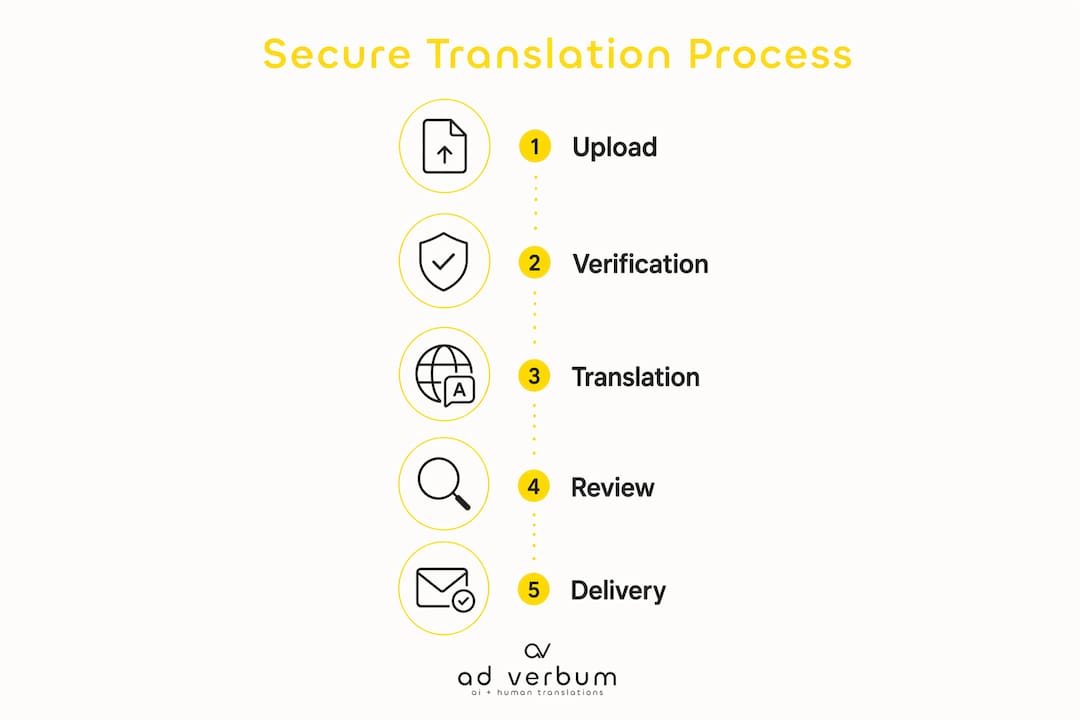
Data flow documentation. Map every stage from file upload through delivery. Any gap in that map is a potential audit finding.
Human oversight. Subject-matter expert (SME) review by credentialed linguists is non-negotiable for safety-critical, legal, or financial content.
Contractual controls. Non-disclosure agreements (NDAs), data processing agreements (DPAs), and explicit no-training clauses must be in place before processing begins.
Audit readiness. Maintain documented access logs, change management records, and incident response procedures. Auditors now treat translation tools as data subprocessors requiring formal vendor risk management.
Data retention limits. Source files must be deleted on a defined schedule, not stored indefinitely on vendor infrastructure.
Table of Contents
Human safeguards that reduce insider risk and unauthorized access
Technical infrastructure requirements for secure translation workflows
Platform-level security features that enforce policy automatically
Certifications and compliance frameworks that prove translation security
Best practices for a secure and compliant translation workflow
How AD VERBUM’s AI+HUMAN hybrid workflow addresses 2025 compliance requirements
Incident response and breach management in translation workflows
AD VERBUM delivers audit-ready translation for regulated industries
Where document translation workflows expose your data
Every stage of the translation lifecycle carries a distinct risk profile. Understanding where exposure occurs is the first step toward closing those gaps.
File transfer and upload. Unencrypted email attachments remain common in ad hoc workflows. A single unprotected transfer of a clinical trial protocol or a merger agreement creates a breach vector that no downstream control can retroactively fix.
Storage during processing. Files sitting on shared drives or general-purpose cloud storage without access segmentation are accessible to anyone with broad permissions. If a vendor’s infrastructure does not isolate client projects, one compromised account can expose multiple clients’ data simultaneously.
Translation tool selection. This is where shadow IT creates the most persistent risk. Shadow IT translation tools used without central security oversight are treated by auditors as unmonitored subprocessors. Staff who paste contract language into a free browser-based tool have effectively transferred that data to a third party with unknown retention policies.
Post-delivery retention. Many vendors retain source files long after delivery, either for convenience or because their AI systems use that content for model training. Free or public AI translation services fail minimized data processing, limited retention, and deletion-on-request obligations under GDPR.
Subcontractor chains. When a vendor subcontracts to freelancers without enforcing the same security controls, the security perimeter breaks. The original client’s data is now governed by whatever informal practices the subcontractor applies.
Mapping document paths from upload to final delivery, as required for SOC 2 and ISO 27001 audit readiness, is the most direct way to surface these exposure points before an auditor does.
Human safeguards that reduce insider risk and unauthorized access
Technical controls only go so far. The people handling your documents are equally part of the security perimeter, and personnel management is where many translation security programs have the most gaps.
Linguist vetting. Professional credentials matter, but security training matters too. A linguist with a law degree who has never handled a data processing agreement is not automatically equipped to manage confidential discovery documents. Vetting should cover both domain expertise and demonstrated familiarity with confidentiality protocols.

NDAs and confidentiality clauses. These must be executed before any document access, not after onboarding. The NDA should specify the document types covered, the duration of confidentiality obligations, and the consequences of breach. Generic boilerplate is insufficient for regulated content.
Role-based access control (RBAC). No translator should have access to files outside their assigned project. RBAC limits exposure to the minimum necessary, which directly supports HIPAA’s minimum necessary standard and GDPR’s data minimization principle.
Supplier controls for freelancers. ISO 27001 requires applying supplier controls to all external linguists to maintain an unbroken security chain. Freelance translators are integral to the security perimeter; agencies must enforce onboarding checks, secure file transfer mandates, and incident reporting duties to maintain certification. A vendor who cannot demonstrate these controls for their freelance network cannot credibly claim ISO 27001 compliance.
Pro Tip: Ask vendors for a copy of their supplier security onboarding checklist. If they cannot produce one, that gap is a material finding for your vendor risk assessment.
Technical infrastructure requirements for secure translation workflows
The infrastructure a translation provider runs on determines what security guarantees are actually achievable. Contractual commitments mean nothing if the underlying architecture cannot support them.
Encryption in transit and at rest. TLS for data in transit and AES-256 (or equivalent) for data at rest are baseline requirements. Vendor documentation of encryption protocols and network architecture diagrams should be available on request and reviewed as part of vendor due diligence.

Data sovereignty and hosting. For organizations subject to GDPR, data processed on servers outside the EU/EEA requires either an adequacy decision or appropriate safeguards under Article 46. Verify where files are actually processed, not just where the vendor is headquartered. These are often different locations.
Private vs. public cloud infrastructure. Only private, dedicated AI infrastructure that purges source text immediately ensures data security for confidential documents. Public cloud deployments with shared tenancy introduce risks that private infrastructure eliminates by design.
Zero or minimal-access architecture. The vendor’s own employees should not have routine access to client content. Technical controls, not just policy, should enforce this. Ask specifically whether engineers or support staff can access plaintext document content.
API security and credential management. Automated translation pipelines introduce additional attack surfaces. API keys must be rotated on a defined schedule, and all API calls should be logged for audit purposes. Credential exposure in automated workflows is a common finding in security reviews of translation integrations.
For a practical overview of legal translation data security controls, the specific requirements for legal documentation add another layer of obligation beyond general data protection.
Platform-level security features that enforce policy automatically
Good security policy is only as effective as the platform enforcing it. Manual compliance depends on people remembering to follow procedures; platform controls remove that dependency.
Automated data deletion. Secure translation platforms apply automated data retention limits and immediate deletion after translation to prevent data leakage. Retention windows that do not extend beyond delivery eliminate the indefinite storage risk that plagues many vendor relationships.
Audit logging. Every file access, download, and modification should generate a timestamped log entry tied to a specific user account. These logs are the primary evidence in any breach investigation or compliance audit.
Multi-factor authentication (MFA). MFA on all accounts with document access is a minimum control. Session timeouts and device management policies add further protection against credential compromise.
Project and client data segmentation. Platform architecture should prevent any cross-contamination between client projects. A pharmaceutical client’s clinical data and a financial client’s merger documents must be logically isolated at the infrastructure level, not just by policy.
Contractual no-training clauses. True data deletion must exclude data retention baked into model parameters. Strict vendor contracts with explicit no-training clauses ensure GDPR-compliant erasure is technically achievable.
Certifications and compliance frameworks that prove translation security
Certifications are the most efficient way to verify that a vendor’s security claims have been independently tested. Self-attestation is not equivalent.
ISO 27001 is the most widely recognized information security management standard. It demonstrates an organizational commitment to systematic information security management, beyond isolated good practices, and is increasingly demanded by clients before awarding translation contracts in regulated sectors.
ISO 17100 and ISO 18587 govern translation service quality and post-editing of machine translation output, respectively. Together, they define the QA process requirements that regulated content demands.
ISO 42001 addresses AI management systems. For any provider using AI in their translation workflow, this certification signals that AI use has been formally assessed for risk, governance, and safety.
ISO 9001 covers quality management broadly and underpins process consistency across the translation lifecycle.
GDPR, HIPAA, and MDR are regulatory frameworks, not certifications, but they carry legal force. GDPR applies to any processing of EU residents’ personal data regardless of where the vendor operates. HIPAA governs protected health information in the US. MDR applies to medical device documentation and imposes specific translation accuracy requirements with direct patient safety implications.
SOC 2 trust principles are increasingly relevant for US-based clients. Translation tools must be classified as data subprocessors in vendor inventories to meet SOC 2 audit requirements, with documented evaluation and monitoring.
For organizations subject to multiple frameworks simultaneously, a vendor holding ISO 27001, ISO 17100, and HIPAA alignment covers the most common overlap between US and EU regulatory obligations.
How to vet a secure translation provider in 2026
Vendor selection is a risk management decision. The following criteria distinguish providers with genuine security programs from those with marketing language.
Request certification documentation. ISO certificates should be current, issued by an accredited body, and cover the specific scope of translation services. Bureau Veritas, SGS, and BSI are examples of recognized certification bodies. Expired or narrowly scoped certificates do not cover your use case.
Review data flow diagrams. Ask for a documented map of how your files move through their systems, including any subprocessors. Gaps in that map are audit findings waiting to happen.
Evaluate subprocessor lists. Every third party that touches your data must be identified. If a vendor cannot produce this list, they cannot demonstrate GDPR Article 28 compliance.
Assess incident response plans. A credible plan includes detection timelines, notification procedures, and defined roles. Ask for the last time it was tested. A plan that has never been exercised is theoretical.
Check track record with regulated clients. References from clients in pharma, finance, defense, or legal services carry more weight than general testimonials. Ask specifically whether the vendor has been through a client security audit and what the outcome was.
Verify no-training clauses are contractually enforceable. This is particularly important for AI-assisted workflows. A verbal assurance is not sufficient; the clause must appear in the data processing agreement.
The machine translation risks associated with public NMT tools are well-documented. Inconsistent terminology control and governance limitations make them unsuitable for regulated documentation without enterprise-grade controls layered on top.
For a structured approach, the 7-step data security checklist for regulated sectors covers the due diligence sequence in detail.
Best practices for a secure and compliant translation workflow
Operational security in translation is not a one-time setup. It requires ongoing policy, training, and process discipline.
Combine AI+HUMAN hybrid workflows. AI generation without expert review introduces unacceptable risk in regulated content. The combination of LLM-based output constrained by client terminology, followed by SME review and ISO-aligned QA, is the model that meets both speed and compliance requirements simultaneously.
Establish data retention and destruction policies. Define maximum retention windows for source files, translated files, and translation memories. Document who is responsible for triggering deletion and how deletion is verified. This policy must extend to all subprocessors.
Conduct regular security training. Staff handling confidential documents need training specific to translation workflows, not just general data protection awareness. This includes recognizing shadow IT risks, handling secure file transfer protocols, and understanding their obligations under NDAs.
Implement ongoing audits and change management. Audit readiness requires documented change management, incident response, and access control procedures. Security posture degrades when systems change without corresponding security reviews.
Integrate cybersecurity practices from adjacent disciplines. Legal professionals handling translated documents face overlapping obligations. The cybersecurity protocols for legal professionals that govern client data protection apply equally to translated versions of those documents.
Maintain terminology governance. Translation Memories ™ and Term Bases (TB) are not just efficiency tools. They enforce consistent use of defined terms across documents, which directly supports regulatory compliance in sectors where terminology precision has legal or safety implications.
How AD VERBUM’s AI+HUMAN hybrid workflow addresses 2025 compliance requirements
AD VERBUM’s approach to secure translation is built on a specific architecture, not a general commitment to security. The LangOps System, hosted on private EU servers, processes client content without reliance on outsourced public cloud infrastructure. That design choice directly addresses the data sovereignty requirements that GDPR imposes and that HIPAA-aligned workflows demand.
The workflow follows a defined sequence. Client Translation Memories and Term Bases are ingested first, establishing the terminology governance layer before any generation occurs. The proprietary LLM-based system then produces target language output constrained by that client-specific guidance. A certified subject-matter expert reviews for technical accuracy, regulatory compliance, and contextual nuance. QA is then applied in alignment with ISO 17100 and ISO 18587, and with sector-specific requirements such as MDR where applicable.
AD VERBUM holds ISO 27001 and ISO 42001 certifications, both independently audited by Bureau Veritas, alongside ISO 9001, ISO 17100, ISO 18587, ISO 13485, and AQAP2110 for NATO defense work. That combination covers the most demanding regulated sectors: life sciences, legal, finance, defense, and manufacturing.
The distinction between AD VERBUM’s proprietary LLM-based AI and standard NMT tools is material for compliance purposes. Public NMT engines offer inconsistent terminology control and variable handling of negation and domain nuance. AD VERBUM’s system enforces terminology, handles document-level context, and keeps all processing within a private EU-hosted environment. For content where a mistranslation has regulatory or patient safety consequences, that architecture difference is the relevant comparison.
Control | AD VERBUM implementation |
Data hosting | Private EU servers, no public cloud for core processing |
Certifications | ISO 27001, ISO 42001, ISO 17100, ISO 18587, ISO 9001, ISO 13485, AQAP2110 |
Compliance alignment | GDPR, HIPAA, MDR |
Human oversight | AI+HUMAN hybrid with SME review |
Terminology governance | Client TM and TB integration at workflow entry |
QA standard | ISO 17100 and ISO 18587 aligned |
Audit body | Bureau Veritas (independent) |
For organizations managing regulated document translation workflows, AD VERBUM’s combination of private infrastructure, multi-standard certification, and SME review covers the audit evidence requirements that regulated clients face in practice.
Incident response and breach management in translation workflows
A translation workflow breach is not hypothetical. Source files contain the same sensitive data as the originals: patient records, financial projections, legal strategy, defense specifications. The response obligations are identical to a breach of the source document.
Detection. Audit logs are the primary detection mechanism. Without comprehensive logging of file access and data transfers, breach detection depends on chance. Platforms without audit logging cannot meet the detection timeline requirements under GDPR Article 33 (72-hour notification to supervisory authority) or HIPAA Breach Notification Rule requirements.
Containment. The first response is access revocation and session termination for the affected accounts or systems. If a subcontractor is involved, their access must be suspended immediately while the scope of exposure is assessed.
Notification. GDPR requires notification to the relevant supervisory authority within 72 hours of becoming aware of a breach involving EU residents’ personal data. HIPAA requires notification to affected individuals, HHS, and in some cases media outlets, within defined timeframes depending on the number of individuals affected. Translation vendors processing this data as subprocessors must notify the controller promptly enough to meet these deadlines.
Post-incident review. Every incident, including near-misses, should trigger a documented review. The output is a corrective action plan with assigned owners and completion dates. This documentation is evidence of a functioning security management system under ISO 27001.
Contractual obligations. The data processing agreement must specify the vendor’s incident notification timeline, the information they must provide, and their cooperation obligations during investigation. Vendors who cannot commit to these terms contractually should not be processing regulated content.
For organizations managing data recovery alongside breach response, the data recovery best practices framework for legal experts covers the procedural steps that apply equally to translated document sets.
AD VERBUM delivers audit-ready translation for regulated industries
Regulated industries need more than a translation vendor. They need a provider whose security architecture, certifications, and documented processes can withstand an audit.
AD VERBUM’s AI+HUMAN hybrid translation combines a private EU-hosted LangOps System with a large network of certified subject-matter experts covering life sciences, legal, finance, defense, and manufacturing. Every project runs through ISO 17100 and ISO 18587 aligned QA, with ISO 27001 and ISO 42001 certifications independently verified by Bureau Veritas. Source files stay on private infrastructure, terminology governance is enforced from the first step, and the workflow produces the audit trail your compliance team needs.
For organizations where a translation error carries regulatory, financial, or patient safety consequences, AD VERBUM’s professional localization services cover 150+ languages with the same security and QA standards applied across every project. Request a quote to see how the workflow maps to your specific compliance requirements.
Key Takeaways
A secure document translation process in 2025 requires verified certifications, private infrastructure, contractual data controls, and documented human oversight at every stage of the workflow.
Point | Details |
Certifications are verifiable proof | Require ISO 27001, ISO 17100, and ISO 9001 as baseline; add ISO 42001 for AI-assisted workflows. |
Shadow IT is an audit liability | Translation tools used without central oversight are treated as unmonitored subprocessors in SOC 2 and ISO 27001 audits. |
No-training clauses are contractually required | GDPR-compliant deletion is only achievable when vendor contracts explicitly prohibit use of content for model training. |
Incident response must meet regulatory timelines | GDPR requires supervisory authority notification within 72 hours; HIPAA imposes its own breach notification deadlines. |
AD VERBUM for regulated content | AD VERBUM’s private EU-hosted LangOps System, Bureau Veritas-audited certifications, and AI+HUMAN hybrid workflow meet the audit evidence requirements regulated industries face. |
Recommended
