


The Role of Subject-Matter Experts in Translation

Subject-matter experts (SMEs) in translation are domain specialists who verify technical correctness, regulatory compliance, and terminology accuracy in translated content, providing a quality layer that linguistic review alone cannot deliver. In regulated industries, the role of subject-matter experts in translation is not optional. It is the difference between a document that passes regulatory audit and one that creates liability. ISO 17100 mandates a translator plus separate reviser as the baseline workflow, but for medical, legal, and defense content, an additional SME review layer is what separates compliant output from technically flawed text. Life Sciences, Legal, Finance, and Manufacturing sectors depend on SME input precisely because a linguistically fluent translation can still contain a fatally wrong clinical term, an incorrect regulatory code, or a misapplied legal standard.
How subject-matter experts enhance accuracy and compliance in translation workflows
The standard industry term for the SME-inclusive workflow is the TEP+SME model: Translate, Edit, Proofread, plus Subject-Matter Expert review. Each stage has a defined scope, and conflating them is a process failure. A translator converts meaning across languages. A reviser checks linguistic quality against the source. An SME checks whether the translated content is technically correct within its domain. These are distinct competencies, and assigning one person to cover all three introduces unacceptable risk in compliance-grade work.
SME tasks in translation focus specifically on nomenclature, numeric units, regulatory formatting, and specialized wording rather than language style. A medical SME reviewing a pharmacovigilance report will verify INN drug names, dosage units, and adverse event classification codes. A legal SME reviewing a contract will check that jurisdictional terms, liability clauses, and defined terms carry their correct legal weight in the target language. Neither task is linguistic. Both are critical.
The practical steps an SME follows in a compliant workflow are:
Review all domain-specific terminology against the approved termbase and client glossary.
Verify numeric values, units of measure, and regulatory codes against the source document.
Check that regulatory formatting requirements for the target market are met (e.g., EU MDR labeling structure).
Flag any translation choices that alter legal meaning, clinical interpretation, or technical specification.
Confirm that the translated document would be accepted by the relevant regulatory body or legal jurisdiction.
Pro Tip: Formalize the SME review criteria before the project starts. A written checklist specifying what the SME must check, and what falls outside their scope, prevents scope creep and keeps the review focused on compliance value rather than stylistic preference.
Formalizing review criteria is not administrative overhead. It is the mechanism that makes SME input auditable and repeatable across projects and languages.
Does SME involvement actually change translation quality outcomes?
The short answer is yes, and the difference is most visible in compliance-demanding content. The table below compares the two most common quality assurance models in professional translation.
Workflow model | Who reviews | Risk level for specialized content | Compliance suitability |
Translator + reviser only (ISO 17100 baseline) | Two linguists | Moderate to high for regulated text | Suitable for general and low-risk content |
Translator + reviser + SME (TEP+SME) | Two linguists plus domain expert | Low for regulated text | Required for medical, legal, defense, and technical content |
AI+HUMAN hybrid with SME review | LLM output plus certified SME | Low when SME review is mandatory | Suitable for regulated content with audit trail |
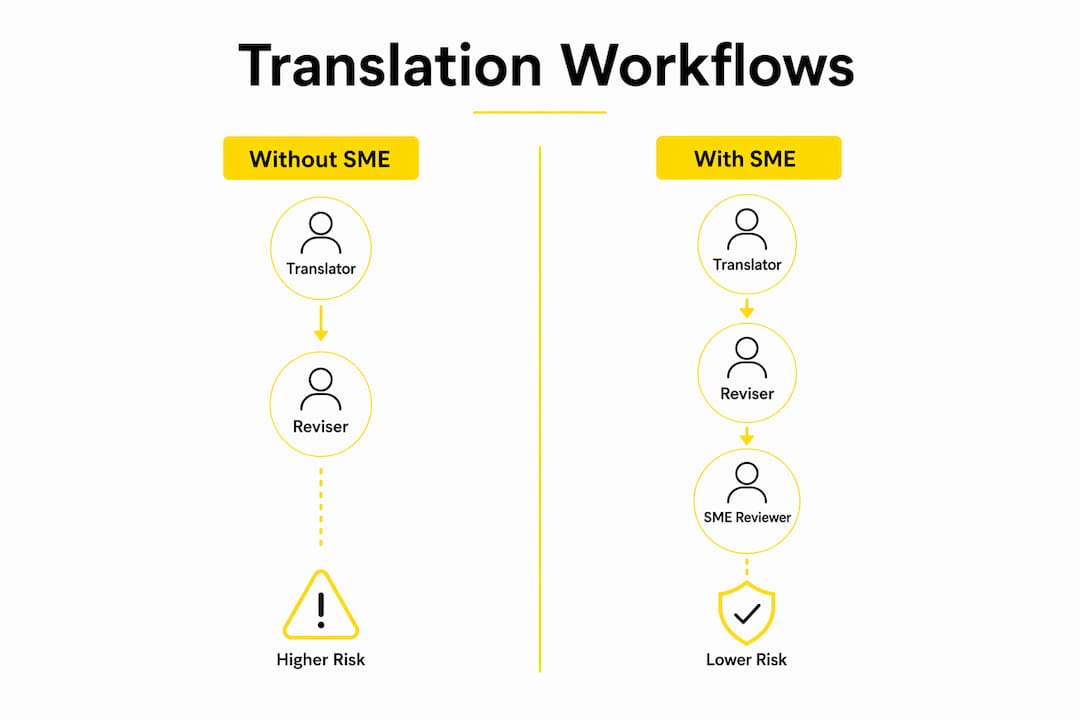
SME involvement raises the quality bar beyond what translator and reviser models can achieve, with measurably lower error rates in specialized content. The reason is structural. A reviser checks whether the translation is linguistically equivalent to the source. An SME checks whether the translation is functionally correct within its professional context. Those are different questions, and only the second one matters when a document governs patient safety, legal liability, or defense specifications.
Without SME review, the failure mode is not random. Errors cluster around the exact points where domain knowledge is required: clinical terminology, regulatory cross-references, jurisdiction-specific legal constructs, and safety-critical technical specifications. These are also the points where errors carry the highest cost.
What are the responsibilities and decision-making criteria for SMEs in translation?
SME responsibilities in translation have a defined scope, and staying within that scope is what makes the review valuable. An SME who rewrites sentences for stylistic preference is not performing an SME review. An SME who flags a mistranslated INN drug name or an incorrect liability standard is.
The core responsibilities of an SME reviewer include:
Verifying that all domain-specific terms match the approved termbase and reflect current regulatory or professional standards.
Distinguishing critical errors (those that alter meaning, compliance status, or safety) from non-critical errors (minor phrasing variations with no functional impact).
Confirming that regulatory language, numeric codes, and classification systems are rendered correctly in the target language.
Providing documented rationale for any change request, so the decision is auditable.
Feeding terminology decisions back into the client’s termbase for future consistency.
SMEs define what “good” means for a given document type by distinguishing harmless mistakes from those that erode trust or create compliance exposure. This upstream influence on quality standards is one of the most underutilized aspects of SME involvement. When an SME contributes to the project’s instructions, evaluation criteria, and termbase at the start of a project rather than only at the end, the entire translation output improves before the SME review even begins.
Terminology enforcement is a direct output of SME involvement. SMEs align terms used in translation with client glossaries and regulatory requirements, preserving consistency across document sets, languages, and product versions. In a medical device context, this means every translated manual, label, and IFU uses the same approved term for the same component, which is an MDR requirement, not a preference.

Practical examples of SME review preventing compliance failures
Two scenarios illustrate where SME review creates concrete, measurable value.
Medical device instructions for use (IFU). A translated IFU for a Class IIb medical device must meet EU MDR Annex I requirements for labeling and instructions. A linguist can produce a fluent translation. Only an SME with medical device regulatory knowledge can confirm that the translated contraindications use the correct clinical terminology, that warning symbols are referenced correctly, and that the translated text would satisfy a notified body review. Without that review, the device cannot be placed on the EU market. The cost of a failed audit far exceeds the cost of the SME review.
Cross-border legal contract. A commercial contract translated from English into German for use in German courts requires that legal terms carry their correct meaning under German civil law, not just their linguistic equivalent. “Indemnification” does not translate directly into German legal practice. An SME with German legal expertise identifies where the translated term creates a different legal obligation than the source intended, preventing a liability exposure that no amount of linguistic review would catch.
SME review in medical, legal, and technical sectors prevents costly errors by enforcing terms that directly impact compliance and liability. The failure mode when SME input is absent is not a visible translation error. It is a document that reads correctly but functions incorrectly within its professional context. Mitigating this risk requires building SME review into the workflow as a mandatory step, not an optional upgrade.
Professional subject-matter knowledge enables reviewers to make nuanced decisions about legal context, target audience, and communicative purpose that AI cannot replicate. This is not an argument against AI translation. It is an argument for the AI+HUMAN hybrid model, where AI handles volume and speed, and SMEs handle judgment and compliance verification.
Key takeaways
SME review is the only mechanism that verifies technical correctness and regulatory compliance in specialized translation, and no linguistic review process substitutes for it.
Point | Details |
SME role is distinct from linguistic review | SMEs verify technical correctness and compliance, not language style or fluency. |
ISO 17100 baseline is insufficient for regulated content | Medical, legal, and defense content requires an SME layer beyond the standard translator plus reviser model. |
Formalized review criteria are required | Written checklists scoping SME responsibilities make the review auditable and repeatable. |
SMEs influence upstream quality | Early SME involvement in termbase and instruction design improves output before review begins. |
Failure mode without SMEs is non-obvious | Documents without SME review can read correctly while functioning incorrectly in their professional context. |
Why I think most teams underestimate the SME’s upstream role
The conversation about SMEs in translation almost always focuses on the review stage. Does the SME catch errors before the document ships? That is the wrong frame, and it leads teams to treat SME involvement as a final checkpoint rather than a process input.
In my experience working with compliance-grade translation workflows, the projects with the fewest SME-flagged errors at review are the ones where the SME contributed to the termbase, the style guide, and the review criteria at the project start. When an SME defines what a critical error looks like before translation begins, the translator and reviser work to a higher standard from the first segment. The SME review at the end becomes a confirmation, not a rescue operation.
The second thing most teams miss is the distinction between an SME and a bilingual domain expert. A bilingual cardiologist is not automatically qualified to review a translated clinical trial protocol. SME review in translation requires both domain knowledge and familiarity with translation quality criteria, regulatory documentation standards, and termbase governance. AI tools cannot replace this judgment because they cannot assess whether a translation choice fits the compliance purpose of the document. They can propose options. The SME decides which option is correct.
The combination of AI generation and SME judgment is where the real quality gain sits. AI and SME judgment together widen the quality gap between strong and weak translation workflows, not narrow it. Teams that treat SME review as a cost to minimize are optimizing for the wrong variable.
How AD VERBUM integrates SMEs into every regulated translation project
AD VERBUM’s AI+HUMAN hybrid translation workflow is built around mandatory SME involvement at every stage, not as an add-on. The process begins with ingesting client Translation Memories and Term Bases, then the proprietary LLM-based LangOps System generates target language output constrained by client terminology. A certified subject-matter expert then reviews for technical accuracy, regulatory compliance, and contextual nuance. Final QA is aligned to ISO 17100 and ISO 18587, with sector-specific requirements such as MDR applied where relevant. With a network of 3,500+ expert linguists covering medical, legal, engineering, and defense domains across 150+ languages, AD VERBUM delivers compliant translation services that satisfy audit requirements in Life Sciences, Legal, Finance, and Manufacturing. For localization projects requiring the same compliance depth, the localization solutions page details how SME oversight scales across multilingual content programs.
FAQ
What is subject-matter expertise in translation?
Subject-matter expertise in translation is domain-specific professional knowledge that enables a reviewer to verify the technical correctness, regulatory compliance, and terminology accuracy of translated content. It is distinct from linguistic competence and covers fields such as medicine, law, engineering, and finance.
Why does ISO 17100 require more than a translator and reviser for specialized content?
ISO 17100 establishes a translator plus separate reviser as the minimum baseline for professional translation quality. For regulated or technically specialized content, an additional SME review layer is required because linguistic review cannot verify domain-specific correctness, regulatory formatting, or compliance terminology.
What specific tasks does an SME perform in a translation review?
An SME verifies nomenclature, numeric units, regulatory codes, and domain-specific terminology against approved termbases and regulatory standards. The SME does not revise language style. The focus is on whether the translated content is technically and legally correct within its professional context.
What happens when SME review is skipped in regulated translation?
Without SME review, translated documents in regulated sectors can contain technically incorrect terms, misapplied regulatory codes, or legally ambiguous constructs that read fluently but fail compliance review. The cost of a failed regulatory audit or legal dispute consistently exceeds the cost of the SME review that would have prevented it.
How do SMEs contribute to terminology consistency across multilingual projects?
SMEs enforce terminology by aligning translation choices with client glossaries and regulatory requirements, then feeding approved terms back into the project termbase. This creates consistent terminology across all documents, languages, and product versions, which is a direct requirement under frameworks such as EU MDR for medical device documentation.
Recommended
