


How to vet linguists for EU dual-use documentation compliance

An unvetted linguist handling your Annex I technical specifications is not a paperwork problem. It is a potential unauthorized technology transfer, triggering liability under Regulation (EU) 2021/821 even if no hardware ever crosses a border. Export control officers and security managers at EU defense contractors know that intangible transfers, meaning the conveyance of controlled technical data through any medium, fall within the regulation’s scope. Yet most organizations have detailed processes for physical shipments and almost nothing written down for linguist access. This guide closes that gap with a structured vetting workflow aligned to EU and NATO expectations, including AQAP 2110 quality records and national competent authority (NCA) documentation standards.
Table of Contents
Understand the regulatory background and compliance landscape
Prepare for linguist vetting: Core requirements and documentation
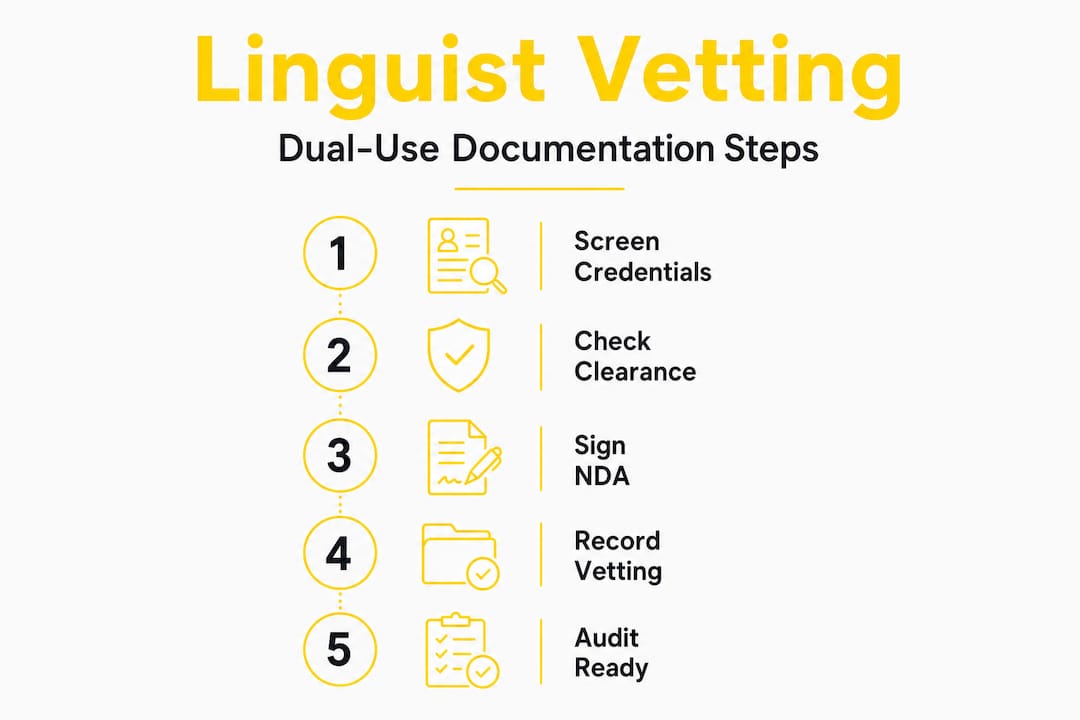
Step-by-step process: How to vet linguists for controlled documentation
Monitor, verify, and address common pitfalls in linguist vetting
Why industry benchmarks fall short and what real compliance demands
Leverage proven workflows and expert support for dual-use documentation compliance
Key Takeaways
Point | Details |
Due diligence is essential | EU law requires strong process controls for handlers of dual-use documentation, even if linguist rules aren’t explicit. |
Enhanced vetting needed | For Annex I items, basic NDAs are insufficient—security clearances and compliance training are crucial. |
Workflow must ensure zero errors | Mission-critical documentation demands a 100% revision workflow to prevent leakage or misinterpretation. |
Continuous monitoring is key | Regularly revalidate linguist credentials and audit translation processes to assure ongoing compliance. |
Expert support available | Specialized providers offer frameworks aligned with NATO, AQAP 2110, and ISO 27001 requirements. |
Understand the regulatory background and compliance landscape
The starting point is understanding what the law actually says, and just as importantly, what it does not say. Regulation (EU) 2021/821 controls the export of dual-use items listed in Annex I, including the transfer of related technology and software by electronic means. Article 2(2)(b) makes clear that “export” includes the oral or written transmission of controlled technology to a foreign national, even within the EU. That definition reaches every person who reads, processes, or translates a controlled technical document.
What the regulation does not do is specify how to vet the individuals who handle those documents. That gap is real, and it is not accidental. The regulation assumes that security practices, industry standards, and national guidance fill the space. As European research security analysis confirms, export control awareness is emphasized for personnel handling sensitive information, but no linguist-specific framework exists at the EU level.
That means you are working from a patchwork of sources: AQAP 2110 for quality management in defense acquisition, ISO 27001 for information security management, and national competent authority expectations from bodies like Germany’s BAFA (Bundesamt für Wirtschaft und Ausfuhrkontrolle), France’s DGA (Direction Générale de l’Armement), and Spain’s UAMA (Unidad de Apoyo a la Movilidad Armada). Each of these authorities will look for documented evidence of due diligence during inspections. Generic vendor assurances will not satisfy them.
Regulatory layer | What it covers | Linguist relevance |
Regulation (EU) 2021/821 | Item and technology export controls, deemed transfers | Establishes legal exposure for uncontrolled access |
AQAP 2110 | Quality management in NATO defense procurement | Requires documented personnel qualification records |
ISO 27001 | Information security management system (ISMS) | Controls access to classified or sensitive data assets |
BAFA / DGA / UAMA | National licensing and audit expectations | Inspect due diligence records for intangible transfers |
The practical implication is this: your due diligence record for linguist access must be audit-ready before a project begins, not assembled retrospectively when an NCA requests documentation. EU technical data risks are not theoretical. They materialize precisely when process documentation is absent.
Prepare for linguist vetting: Core requirements and documentation
Before you initiate a vetting process, you need to define what you are screening for and what documentation you will require. This is not a one-time checklist. It is a structured intake process with records that survive the project lifecycle and support future NCA inspections.
The core documentation package you should request from every linguist working on Annex I dual-use content includes:
Curriculum vitae with verifiable subject-matter credentials in the relevant technical domain, such as aerospace engineering, electronics, or propulsion systems.
Nationality and right-to-work confirmation aligned with Article 2(2)(b) screening. For any linguist who is a national of a country subject to EU arms embargoes or heightened dual-use controls, escalated review or rejection may be required.
Security clearance certificates, where applicable, issued by a recognized national authority. For projects subject to NATO classification levels, the relevant Personnel Security Clearance (PSC) level should be specified.
Enhanced NDA that explicitly references export control obligations, end-use and end-user undertakings, and data security requirements including ISO 27001 controlled processing environments.
Compliance awareness declaration confirming the linguist has received export control training and understands the deemed transfer concept under Regulation (EU) 2021/821.
References from prior regulated projects, preferably verifiable contacts at defense or dual-use contractors who can confirm the linguist’s handling of sensitive documentation.
The contrast between standard and enhanced documentation is significant. As European research security findings note, a standard NDA is adequate for non-classified commercial work, but dual-use projects require layered controls that combine NDA terms with clearance verification and security management alignment. Generic vendor NDAs rarely meet this bar.

Pro Tip: Build a two-tier NDA template. Tier one applies to all translation projects. Tier two activates automatically when the content is classified as Annex I dual-use, adding export control clauses, end-use undertakings, and an explicit prohibition on subcontracting without prior written authorization. Your legal team can standardize this in advance so project activation is fast and defensible.
Use a translation compliance checklist to verify that every document in the intake package is complete before any linguist receives access to controlled content. Missing items are not a minor administrative issue; they are a gap in your audit trail. Pair that with an ISO 27001 security measures review of your vendor’s information security management system to confirm that data handling at the vendor level meets your own ISMS requirements.
Documentation item | Standard project | Dual-use / Annex I project |
CV with domain credentials | Required | Required, with technical domain verification |
Nationality screening | Basic right to work | Article 2(2)(b) nationality risk assessment |
NDA | Standard commercial | Enhanced: export control, end-use undertaking |
Security clearance | Not typically required | Required or documented exception |
Compliance awareness declaration | Not required | Mandatory, with training record |
Reference check | Optional | Required, verifiable prior defense exposure |
Step-by-step process: How to vet linguists for controlled documentation
With your documentation requirements defined, the vetting process itself follows a structured sequence. Each step generates a record that contributes to your audit trail.
Initial screening against nationality and clearance criteria. Run the linguist’s nationality and country of residence against current EU restrictive measures and your own company’s third-country risk policy. Flag any dual nationality or recent travel history that requires additional scrutiny. Confirm that security clearance certificates are current and issued by a recognized authority.
Technical qualification assessment. Review the CV for verifiable experience with dual-use technical content in the relevant control list category. A linguist who specializes in pharmaceutical regulatory submissions is not automatically qualified to handle Category 7 (sensors and lasers) documentation, even if the language pair matches. Subject-matter competence is a separate screening dimension.
Blind revision exercise on representative content. Before granting project access, provide a short test segment drawn from non-sensitive but technically representative material. Assess terminology precision, handling of negation (a known failure point for automated systems and undertrained linguists alike), and consistency with your Term Base. Score the exercise against documented pass/fail criteria.
NDA and compliance declaration execution. Only after steps one through three are passed should the linguist receive the enhanced NDA and compliance awareness declaration for signature. Execute these documents before any controlled content is shared. Retain signed originals in your project file.
Project-level access control implementation. Segment document access so that each linguist receives only the segments relevant to their assignment. Do not share full technical files when section-level access is sufficient. Log all access events within your document management system or ISMS-controlled workflow.
Second-party review or 100% revision requirement. For mission-critical dual-use documentation, independent revision by a second qualified expert is not optional. As industry practice confirms, leading agencies enforce 100% revision workflows and report zero-error rates for critical jobs, though no public empirical benchmarks exist for error rates across the sector.
AQAP 2110 quality records completion. Document the qualification basis, test results, NDA execution date, revision records, and QA sign-off in a format consistent with AQAP 2110 requirements. These records must be retained for the duration specified in your quality plan and be retrievable on NCA request.
“For export-controlled technical documentation, the question is never whether 100% revision is necessary. The question is whether your revision workflow is rigorous enough to catch the errors that matter most: those involving control parameters, performance thresholds, and technical specifications that define whether a technology meets Annex I criteria.”
Review translation fault rates for insight into where controlled documentation workflows most commonly fail, and use that data to calibrate your revision criteria. For a broader picture of how compliant workflows are structured across regulated sectors, regulated translation workflows provide useful reference architecture.
Pro Tip: Assign a project security coordinator, distinct from the project manager, whose sole responsibility is to verify that access controls, NDA execution, and revision records are complete before a deliverable is released. This role is lightweight to administer but creates a clean separation of duties that NCAs expect to see.
Monitor, verify, and address common pitfalls in linguist vetting
Vetting is not a one-time gate. Linguists working on long-running programs or returning for subsequent projects require periodic revalidation, and your monitoring process must be documented to satisfy AQAP 2110 and ISO 27001 audit requirements.
Red flags to watch for during ongoing monitoring:
Security clearance certificates that have lapsed or are approaching expiration without renewal documentation
Revision records that show declining accuracy rates on technical terminology across successive projects
Changes in the linguist’s employment status, residency, or nationality that were not proactively disclosed
NDA terms that predate a change in your export control classification or jurisdiction
Missing or incomplete quality records for prior projects, making AQAP 2110 compliance unverifiable
Any indication of unauthorized subcontracting or document sharing outside the approved project team
When a red flag is identified, your response should be graded by severity. Minor documentation gaps trigger a remedial action request with a defined deadline. Accuracy concerns trigger escalated revision review for all recent deliverables from that linguist. Undisclosed changes in clearance status or nationality trigger immediate suspension and a formal review before any reinstatement.
Issue type | Immediate action | Follow-up requirement |
Lapsed clearance certificate | Suspend project access | Await renewed certificate before reinstatement |
Declining revision accuracy | Escalated 100% re-review of recent work | Remedial technical assessment |
Undisclosed status change | Immediate suspension | Formal nationality/clearance re-screening |
Missing AQAP records | Document hold pending reconstruction | Gap analysis report for quality file |
Suspected unauthorized sharing | Incident report, legal notification | Security investigation per ISO 27001 ISMS |
Tracking error statistics across your linguist pool is not just a quality management function. It is a compliance record. Regulation (EU) 2021/821 does not specify internal monitoring requirements, but NCAs conducting inspections will ask how you identify and respond to failures in your intangible transfer controls. A documented audit log of error rates, revision outcomes, and remedial actions is your answer. As industry benchmarking makes clear, zero-error claims from vendors need substantiation through your own oversight records, not vendor assurances alone. Consult data security best practices to ensure your logging and retention practices meet ISMS standards.
Why industry benchmarks fall short and what real compliance demands
Most organizations treat linguist vetting as a procurement function. They issue an RFP, collect vendor certifications, and file the responses. That approach is defensible for commercial translation. It is not sufficient for Annex I dual-use documentation.
The uncomfortable reality is that no publicly available benchmark tells you what an acceptable error rate is for controlled technical translation. As the available industry data shows, the most rigorous agencies enforce 100% revision and claim zero errors on mission-critical jobs, but these are self-reported figures without independent verification. That is not a criticism of those agencies. It reflects the absence of a sector-wide standard.
What that means for export control officers is that you cannot outsource the compliance judgment to a vendor’s marketing materials. You have to build your own oversight infrastructure: documented vetting records, project-level access logs, revision outcomes, and annual revalidation schedules. The vendor’s ISO 27001 and ISO 17100 certifications matter because they establish a minimum framework, but they are inputs to your due diligence, not substitutes for it.
There is also a deeper issue with one-size-fits-all checklists. A linguist who passed vetting for Category 5 (telecommunications) documentation three years ago needs a fresh assessment before working on Category 7 (sensors) material. The technical domain is different, the control parameters are different, and the nationality risk calculus may have shifted. Real compliance demands case-by-case reevaluation, not a standing approval that persists indefinitely. Deemed export risk factors illustrate how quickly the risk profile of a linguist assignment can change when the content category shifts, even within a single contractor relationship.
Surface-level vendor claims require substantiation through your own continuous oversight, and that oversight must generate records that survive an NCA inspection. That is the bar. Everything else is preparation.
Leverage proven workflows and expert support for dual-use documentation compliance
Managing linguist vetting, access controls, revision workflows, and AQAP 2110 quality records simultaneously is a significant operational load for any export control or security team.
AD VERBUM’s specialized localization practice for defense and dual-use documentation is built around exactly this compliance architecture. With ISO 27001 certified infrastructure hosted on EU servers, ISO 17100 and ISO 18587 aligned QA workflows, and a network of 3,500+ subject-matter expert linguists including qualified engineers, AD VERBUM operates an AI+HUMAN hybrid translation model where every output is reviewed by a vetted domain expert before delivery. The proprietary LangOps System enforces terminology governance from your Translation Memories and Term Bases throughout the process, reducing the risk of critical meaning errors in controlled technical content. Review vetted workflow features and explore industry-specific expertise to assess fit with your program requirements.
Frequently asked questions
Is there an explicit EU regulation for linguist vetting in dual-use documentation?
No. The regulation covers item controls and intangible transfers broadly, with security practices and industry standards such as ISO 27001 and AQAP 2110 filling the specific gap for personnel handling controlled content.
What type of NDA is required for dual-use translations?
An enhanced NDA that references export control obligations, end-use undertakings, and ISO 27001 data security requirements is the recommended baseline for any Annex I dual-use project, going well beyond a standard commercial confidentiality agreement.
How often should linguists for sensitive documentation be re-vetted?
Annual revalidation of clearance status, nationality screening, and revision accuracy records is considered best practice for linguists working on export-controlled programs, with immediate reassessment triggered by any change in the linguist’s personal or professional circumstances.
Are there industry benchmarks for error rates in dual-use translation workflows?
No public benchmarks exist. Leading agencies enforce 100% revision workflows and self-report zero-error rates for critical assignments, but independent verification is absent, making your own audit records the most defensible evidence of compliance.
Recommended

