


Coordinate Notarisation and Apostille for EU M&A Deals

Cross-border M&A transactions in the EU stall more often than most legal ops teams expect, and the cause is rarely substantive legal disagreement. It is almost always a broken document chain: a power of attorney notarized but never apostilled, a company extract translated by an uncertified linguist, or a board resolution rejected because the notary’s commission had quietly expired. Understanding the precise regulatory distinctions between what EU Regulation 2016/1191 exempts and what the Hague Convention still governs, and then building a jurisdiction-aware workflow around those rules, is the single most reliable way to keep deal timelines intact.
Table of Contents
Key Takeaways
Point | Details |
Corporate documents rarely exempt | M&A and restructuring documents almost always require full notarisation and apostille. |
Detailed workflow needed | Successful coordination depends on clearly mapping requirements and executing each authentication step. |
Jurisdictional quirks cause delays | Local variations and edge cases can result in refusals unless proactively addressed. |
Express services speed up process | Rapid turnaround options are available, but require advance planning and skilled partners. |
Digital proposals emerging | Technology-driven solutions for authentication are under development, but not yet standard in 2026. |
Know the legal framework: Regulation vs Hague Convention
The starting point for any multi-jurisdiction execution plan is knowing which legal instrument governs your specific documents. Many legal ops professionals assume that EU membership simplifies everything. It simplifies some things, but not the documents you are most likely handling in an M&A context.
Regulation (EU) 2016/1191 exempts certain public documents issued in one EU Member State from apostille, certified copies, and translation requirements when used in another EU Member State. That sounds sweeping, but the scope is narrow. The exemption covers civil status documents: birth certificates, marriage records, death certificates, court judgments on personal status, and similar civil records.
Corporate and business-related documents are explicitly not covered by the exemption and still require apostille or legalization. Powers of attorney, notarized board resolutions, company extracts from national registries, shareholder agreements prepared as notarial acts, certificates of good standing: all of these fall outside the Regulation’s protective umbrella. For EU translation compliance in corporate transactions, the full Hague Convention authentication chain remains the applicable standard.
Quick-reference: exempt vs non-exempt document types
Document type | Covered by Reg. 2016/1191? | Apostille required? |
Birth certificate | Yes | No (within EU) |
Marriage certificate | Yes | No (within EU) |
Criminal record extract (personal) | Yes | No (within EU) |
Power of attorney (corporate) | No | Yes |
Board resolution (notarized) | No | Yes |
Company extract / commercial registry | No | Yes |
Certificate of good standing | No | Yes |
Shareholder agreement (notarial act) | No | Yes |
Key takeaways for your pre-deal checklist:
Identify every document in the execution bundle and classify it as civil or corporate before any authentication steps begin.
Do not assume that EU origin creates an exemption for corporate documents.
Verify each receiving jurisdiction’s specific requirements: some Member States layer additional local formalities on top of the Hague Convention baseline.
Pro Tip: Run the exemption check first, before engaging notaries. Misclassifying even one document wastes notary fees and introduces delays that compound across a multi-jurisdiction bundle.
Preparation: Identify requirements and set your execution workflow
Once the legal framework is clear, the next priority is mapping out document requirements and setting realistic workflow expectations for each jurisdiction involved. This is where the difference between a smooth closing and a three-week delay is made.
For M&A and corporate restructuring, powers of attorney, board resolutions, and company extracts typically require notarisation followed by apostille under the Hague Convention, because they are not exempted by EU Regulation 2016/1191. Beyond that baseline, member-state-specific sworn translator requirements add another layer of complexity that trips up even experienced teams.

Germany requires beeidigte Übersetzer (sworn translators) certified by a German court for translations to be accepted in German legal proceedings or before German authorities. France mandates traducteurs assermentés accredited by a French Court of Appeal. Spain recognizes traductores jurados appointed by the Spanish Ministry of Foreign Affairs. Italy has its traduttori giurati, whose oath and certification must be formalized before a local tribunal. These are not interchangeable. A French assermenté translator cannot certify a document for use in German administrative proceedings, and vice versa.
Workflow example by document type
Document | Notarization | Apostille authority | Sworn translator jurisdiction | Notes |
Power of attorney | Local notary public | Foreign Ministry or court | Receiving country’s certified linguist | Verify POA format requirements |
Board resolution | Local notary public | Foreign Ministry or court | Receiving country’s certified linguist | Some jurisdictions require specific wording |
Company extract | Issuing registry authority | Foreign Ministry or court | Receiving country’s certified linguist | Check expiry: many have 3-month validity |
Certificate of good standing | Issuing authority | Foreign Ministry or court | Receiving country’s certified linguist | May need both translation and notarization |
Preparation checklist for legal ops teams:
List every document in the execution bundle and its country of origin.
Confirm whether the receiving jurisdiction’s authorities accept electronic or only physical originals.
Identify the competent apostille authority for each issuing country (court, foreign ministry, or designated authority).
Confirm which sworn translator category is required in the receiving jurisdiction: Germany’s beeidigte Übersetzer, France’s traducteur assermenté, Spain’s traductor jurado, or Italy’s traduttore giurato.
Check document validity windows: company extracts and certificates of good standing often expire within 30 to 90 days.
Build translation timelines into your deal schedule before notarisation begins, not after.
A proper translation audit for M&A before the document bundle goes live will surface gaps in certification coverage and terminology consistency that could otherwise trigger refusals at closing. A regulated document workflow that integrates translation Memory and Term Base assets ensures that defined terms remain consistent across a multi-document bundle even when timelines compress.
Pro Tip: Plan for translation needs as early as you plan for notarisation. Sworn translator availability varies significantly by language pair and jurisdiction. In some markets, certified translator queues run weeks long during Q4 deal season.
Execution: Step-by-step coordination across EU jurisdictions
After preparation, it is essential to execute and coordinate each authentication layer without gaps or missed steps. Even a single break in the chain invalidates the entire document for use in the receiving jurisdiction.
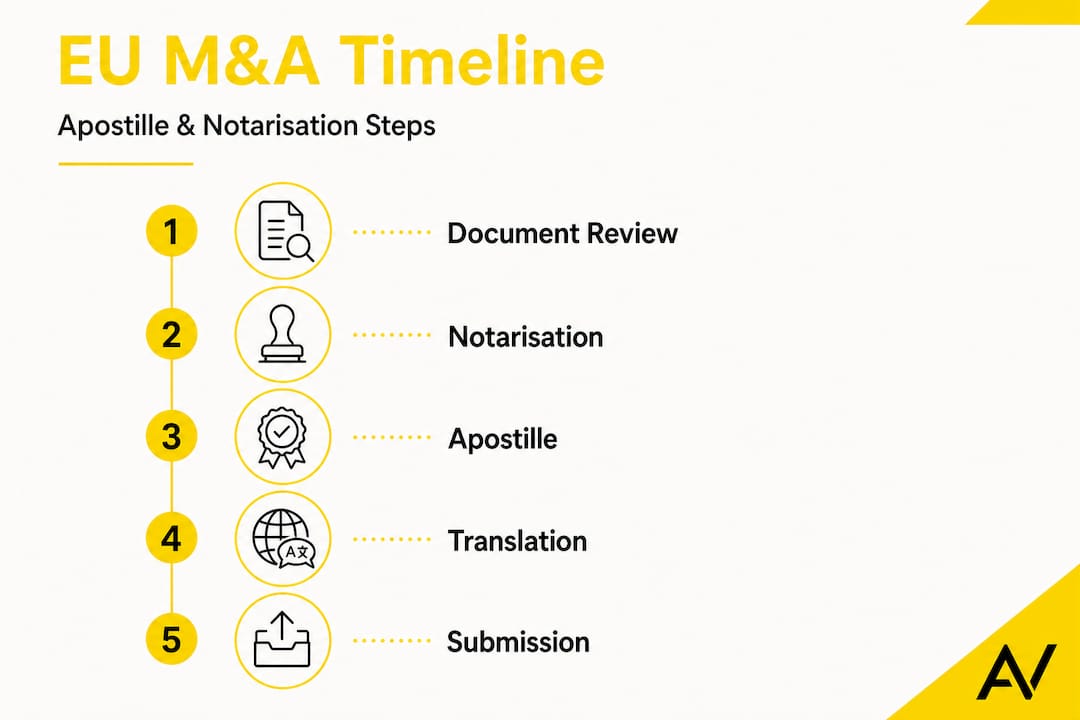
The coordination sequence for a standard corporate document running through the Hague Convention route is as follows:
Notarisation. The document is signed before a locally licensed notary public in the issuing jurisdiction. The notary verifies signatory identity, confirms the document’s legal form, and applies their seal and signature. Confirm the notary’s commission expiry date before the appointment.
Apostille issuance. The competent authority in the issuing country, typically the foreign ministry, a designated court, or a regional authority, attaches the apostille certificate to the notarized document. The apostille authenticates the notary’s signature and seal, not the document’s content.
Certified translation. If the receiving jurisdiction requires a translation, engage the jurisdiction-specific cross-border legal translation partners who hold the correct sworn certification for that Member State. The translation must be attached to the original apostilled document, not circulated as a standalone file.
Cross-border verification via IMI. If doubts arise about document authenticity or the validity of an apostille, use the Internal Market Information System for verification.
“Coordination involves: 1) Notarisation by local notary public in issuing jurisdiction; 2) Apostille by competent authority (e.g., court, foreign ministry); 3) Translation if required by receiving jurisdiction; 4) Use Internal Market Information System for verification if doubts arise.”
Edge cases that break document chains mid-execution:
The notary’s commission expired between document preparation and signing, invalidating the entire notarization.
The apostille authority in the issuing country changed its competent office, and the apostille was obtained from the wrong body.
The sworn translator’s certification is valid in their home jurisdiction but not recognized by the receiving authority.
The document format does not match the receiving jurisdiction’s formal requirements: incorrect page size, missing notary block, or wrong date format.
The company extract used was issued more than 90 days before closing, falling outside the receiving jurisdiction’s validity window.
Translation was done as a standalone certified copy rather than attached to the original apostilled document, causing the chain to be broken.
Pro Tip: Maintain document chain integrity as a non-negotiable standard. Always verify official seals, signatory validity, and apostille authority against the receiving jurisdiction’s published list of competent authorities before submission.
Troubleshooting: Common mistakes and edge cases
Even the best execution can meet resistance. Here is how to spot trouble and keep deals moving when receiving authorities push back.
The most common source of refusals in cross-border M&A document execution is not fraud or bad faith. It is formatting, expired notary commissions, language issues, and jurisdiction-specific local requirements. Italy, for example, requires notarization for certain corporate acts that other Member States handle administratively. Knowing this before submission saves weeks.
Refusal prevention checklist:
Confirm the notary commission expiry date is valid at least 30 days beyond the document execution date.
Verify that the apostille format matches the Hague Convention’s standard 10-field certificate. Non-compliant formats are a leading cause of rejection.
Use only sworn translators certified by the receiving jurisdiction’s recognized authority, not a generalist legal translator.
Check that company name spellings are identical across all documents in the bundle: registry extract, power of attorney, and board resolution must match character-for-character.
Review whether the receiving jurisdiction has specific local rules, such as Italy’s notarial requirements for corporate acts or Germany’s specific Beglaubigung stamp requirements.
Confirm document authenticity with the issuing authority if the receiving party raises questions, and use the IMI system proactively.
Warning: A single expired notary commission, discovered only at submission, can derail an entire cross-border deal. Always request a fresh commission confirmation from the notary as part of your pre-execution checklist.
Pro Tip: Use the IMI system and direct contact with the receiving jurisdiction’s competent authority to clarify edge cases before submission, not after rejection. Proactive verification is faster than remediation.
A good resource for technical translation compliance protocols will also help you build the internal audit trail documentation that some receiving authorities now request alongside the authentication chain itself.
Expected turnaround and practical timeline management
Once you have avoided pitfalls, managing expectations and planning for timing empowers smooth deal closure. The range of processing times across EU jurisdictions is wide enough to make generic estimates almost useless.
Processing can take days to weeks, with express services offering 1 to 2 day turnaround for notarisation and apostille in many jurisdictions when urgency is declared and fees are paid. Standard government-channel apostille processing in some Member States runs 5 to 15 business days. In peak periods like Q4 fiscal year end, queues can extend further.
Factors that slow the process:
Government authority backlogs in the issuing country’s apostille office.
Multi-document bundles submitted simultaneously that require sequential apostilling.
Sworn translator availability in less common language pairs.
Document corrections required after initial notary review.
Receiving jurisdiction requests for additional authentication layers beyond the Hague Convention minimum.
Factors that accelerate the process:
Express apostille services offered by accredited private agents in many EU Member States.
Pre-vetted notary relationships in key jurisdictions.
Pre-built Term Bases and Translation Memories that allow sworn translators to work faster without sacrificing precision.
Digital apostille systems now live in several EU countries, reducing physical courier time.
Actionable timeline guidance for legal ops teams: build a minimum 15 business day buffer for standard apostille chains across two or more jurisdictions. For three or more jurisdictions, extend that buffer to 25 business days minimum. Express services can compress individual steps, but they cannot eliminate the sequential dependencies in the chain. For clinical and life sciences transactions with additional regulatory filings, the trial translation risk management protocols that apply to those sectors provide a useful template for building contingency time into your master deal schedule.
What legacy EU rules miss about real-world corporate document execution
With timelines in mind, it is worth stepping back and examining why this problem persists at all in 2026, and what is actually changing.
The regulatory gap between personal document simplification and corporate document burden is not accidental. EU Regulation 2016/1191 was designed with citizens in mind: people moving between Member States who needed to use civil records abroad without bureaucratic friction. The drafters made a deliberate choice to leave corporate documentation outside the scope. That was a pragmatic decision at the time, but it has aged poorly in an environment of accelerating cross-border M&A activity and digital-first deal execution.
The corporate documentation authentication burden prompts growing calls for digital reforms, and several EU Member States have now launched pilot programs for digital apostilles under the e-APP framework. Digital notarisation is also advancing in jurisdictions like France and the Netherlands. But these pilots are not yet standardized, and accepting a digitally apostilled document from one Member State remains at the discretion of the receiving authority in another.
What does this mean for legal ops teams today? It means the full physical authentication chain remains mandatory for most corporate M&A documents. But it also means teams that build digital-ready workflows now, with proper audit trails, certified electronic signatures where accepted, and structured translation asset management, will have a head start when digital authentication becomes the norm rather than the exception.
The pressure point is not the technology. It is governance. Whether you use a physical apostille chain or a digital e-APP certificate, the receiving authority needs to trust the authentication trail. That trust is built through certified processes, jurisdiction-specific sworn translator networks, and ISO-aligned quality controls. The best M&A translation partners are already building these governance frameworks in anticipation of the digital shift. The CNUE authentic acts framework provides a useful reference for understanding how notarial practice is adapting across EU Member States.
Pro Tip: Monitor CNUE digital pilot developments and track which Member States accept e-APP digital apostilles. Building this knowledge into your jurisdiction-specific playbooks now saves significant remediation effort when digital standards crystallize.
Next steps: Streamline your cross-border document workflow
When your deal schedule cannot absorb authentication delays, having the right operational partner matters as much as having the right legal strategy.

AD VERBUM supports legal ops teams and paralegals managing multi-jurisdiction M&A document execution through its AI+HUMAN hybrid translation workflow, a process designed specifically for regulated, audit-sensitive environments. The workflow ingests your existing Translation Memories and Term Bases first, ensuring terminology consistency across every document in the bundle. The proprietary LangOps System then generates target language output governed by your terminology and style requirements, followed by review from certified subject-matter experts, including legal scholars and sworn translators with jurisdiction-specific credentials. QA is aligned to ISO 17100 and ISO 18587. Security is ISO 27001 certified, with private EU-hosted infrastructure and no reliance on public cloud tooling for core processing. If you are ready to bring structure and speed to your next cross-border execution, explore AD VERBUM’s legal localization services or speak to a document workflow expert directly.
Frequently asked questions
Are M&A corporate documents covered by Regulation (EU) 2016/1191 exemptions?
No. Corporate and business-related documents are explicitly excluded from the Regulation’s exemptions and require full notarisation and apostille under the Hague Convention.
What are the key steps to coordinate notarisation and apostille in multiple EU countries?
Notarize locally with a licensed notary, obtain an apostille from the competent authority in the issuing country, arrange certified translation by a jurisdiction-specific sworn translator if required, and verify via IMI if the receiving authority raises authenticity questions.
How long does the notarisation and apostille process usually take?
Processing ranges from days to weeks, depending on the jurisdiction and apostille office backlog, with express services compressing individual steps to 1 to 2 business days in many EU Member States.
What are common reasons a receiving authority might refuse an authenticated document?
Refusals frequently result from expired notary commissions, incorrect apostille format, use of non-recognized sworn translators, or jurisdiction-specific formatting requirements that were not identified during preparation.
Is digital authentication becoming standard for corporate documents in the EU?
Not yet. Digital authentication pilots are active in several EU Member States under the e-APP framework, but acceptance by receiving authorities remains discretionary rather than standardized across the bloc.
Recommended

