


European Defence Fund Bids: Translation and Compliance Guide
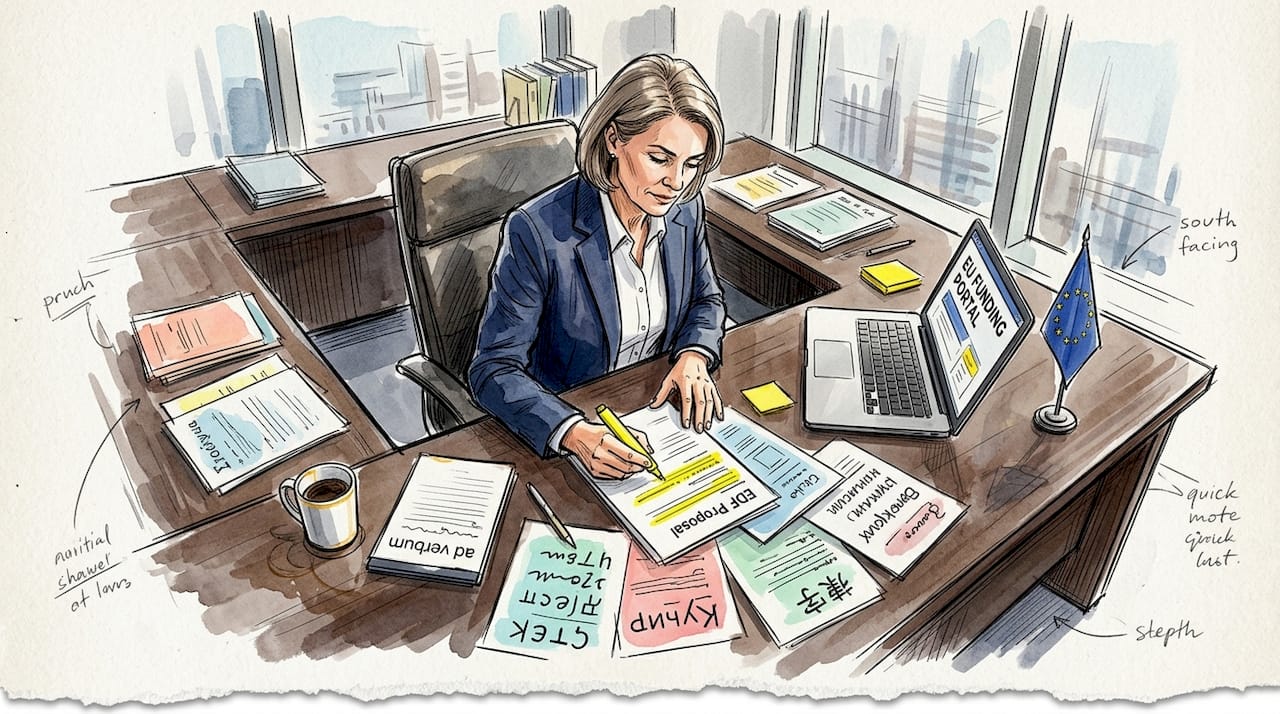
The European Defence Fund represents one of the most significant funding opportunities in EU defence history, and yet consortium leads consistently underestimate what it takes to get a bid over the line. Understanding what is the European Defence Fund and how are bids translated into compliant, multilingual submissions is not a peripheral concern. It sits at the core of whether a proposal survives admissibility checks or gets rejected on procedural grounds before evaluators ever read the technical content. This guide addresses both dimensions with precision.
Table of Contents
Key Takeaways
Point | Details |
EDF budget and pillars | The fund covers 2021–2027 with €7.3 billion split across research and capability development pillars. |
Consortia minimum requirements | Most calls require at least three independent legal entities from three or more EU Member States or associated countries. |
Translation is a compliance activity | Under EU dual-use Regulation (EU) 2021/821, translating controlled technical data is a regulated transfer, not an administrative task. |
Version control is eligibility-critical | Inconsistent document versions across consortium partners can trigger admissibility failure during evaluation checks. |
Certified partners reduce legal exposure | ISO 17100 and ISO 27001 certifications are minimum indicators of a translation partner fit for defense bid documentation. |
What Is the European Defence Fund and How Are Bids Translated
The European Defence Fund (EDF) is a €7.3 billion programme running from 2021 to 2027. It divides into two funding pillars: approximately €2.7 billion for cooperative defence research, and €5.3 billion for capability development. Both pillars require cross-border collaboration as a structural condition of eligibility, not as an optional feature.
The fund’s strategic objective is to reduce fragmentation across EU defence markets by incentivizing joint development of technologies and capabilities. For proposal managers, this means the EDF is not a grant you apply for independently. Every call is designed around consortium participation, which immediately creates multilingual documentation requirements.
Eligibility criteria for consortia
Consortia must include at minimum three independent legal entities established in at least three different EU Member States or EDF-associated countries. Some call categories, particularly those targeting disruptive technologies, allow smaller consortium structures, but these are explicitly flagged in the work programme.
Entities must have their management and control located within the EU or an approved associated country. Third-country ownership triggers substantive security compliance checks that can delay or disqualify a bid. This applies to subsidiaries with parent companies headquartered outside the EU, so legal due diligence on consortium governance structure must happen before the proposal is drafted.
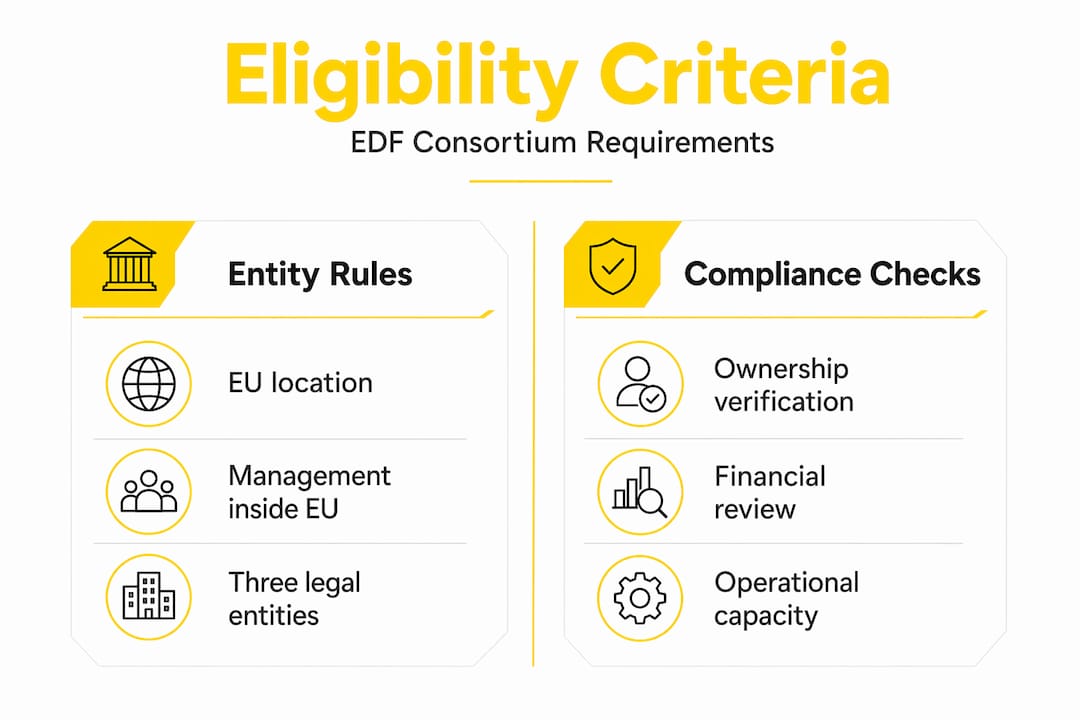
Financial and operational capacity assessments are conducted during the evaluation process. Each consortium member must independently demonstrate they can execute their work package.
Pro Tip: Run a third-country ownership check on every proposed consortium partner as one of your first pre-submission tasks. Discovering a disqualifying ownership structure two weeks before the deadline is a preventable failure.
Annual work programmes and the submission process
The EDF operates on an annual work programme cycle. The EDF 2026 Work Programme covers 31 topics organized into thematic calls, with specific actions targeting priority areas such as hypersonic threat countermeasures. Each topic defines the funding envelope, eligibility conditions, and the precise scope against which proposals are evaluated.

Submissions go through the EU Funding and Tenders Portal. The evaluation sequence is multi-stage and non-negotiable.
Evaluation stage | What is assessed | Translation relevance |
Admissibility check | Completeness of submission package | All required documents must be present and correctly formatted |
Eligibility check | Consortium structure, entity status, ownership | Governance documents often require certified translation |
Scientific and technical excellence | Quality of research or capability approach | Technical annexes must be terminologically consistent across languages |
Ethics screening | Dual-use, export control, human rights | Compliance declarations must be accurately translated and legally sound |
The volume of competition is substantial. 410 proposals were submitted for the EDF 2025 call, competing for €1.065 billion in funding, with evaluation results expected in April 2026. At that level of competition, procedural errors that disqualify a bid are not minor oversights. They are costly failures that could have been prevented.
Pro Tip: Download the call fiche and the model grant agreement for your specific topic before writing a single page of the proposal. Your translated documents must align with the exact language packages in those source documents, not with general EDF guidance.
Multilingual translation requirements and export-control compliance
This is where most consortium leads underestimate the scope of what they are dealing with. Translation of bid proposals under the EDF is not a formatting step. Under EU dual-use Regulation (EU) 2021/821, the transfer of controlled technical data, including its translation into another language, constitutes a regulated technology transfer. The compliance obligations follow the content, not the administrative process.
When a consortium spans three Member States and the technical documentation contains controlled items, every translated version of that documentation must comply with the export control licensing requirements of each state where an export declaration occurs. That means coordinating translation workflows with export licensing assessments simultaneously, not sequentially.
The practical implications for EU defence project bids are significant:
Controlled technical data must only be handled by translators with appropriate security clearances or working within a governed, access-controlled environment.
Sharing defense-related technical files with unvetted language service providers can constitute an unlicensed transfer under EU law. Read more on EU technical data risks before selecting any translation vendor.
Translation memories and terminology databases built for a consortium must themselves be secured and version-controlled.
Document handling procedures must be documented and auditable to satisfy both the EDF grant conditions and any applicable national security obligations.
The translator’s role in an EDF context is closer to that of a regulated contractor than a service vendor.
Export control and translation must be planned as a single integrated workflow. Organizations that treat these as separate workstreams consistently run into coordination failures close to submission deadlines.
Pro Tip: Ask any prospective translation partner directly: do you have ISO 27001 certification, and is your processing infrastructure hosted within the EU? If the answer to either question is no, that partner is not appropriate for EDF technical documentation.
Best practices for translation workflows in EDF bids
Managing translation in a multi-partner, multilingual consortium requires treating it as a document control discipline, not a language task. The following sequence reflects how compliant workflows are structured in regulated EU defence projects.
Start from the source documents. Translation planning must begin with the exact call fiche and grant agreement language packages. General EDF guidance documents are not sufficient anchors for terminology alignment.
Establish a terminology governance framework early. Build a project-specific term base covering technical, legal, and regulatory vocabulary before translation begins. Every consortium partner should validate this before it is locked. Inconsistent use of a single term across document versions has caused eligibility failures in prior EDF calls.
Apply version control to every translated document. Treat each translated file as a controlled document. Assign version numbers, record approval dates, and log who reviewed each version. This audit trail is required during grant agreement preparation and may be requested during post-award audits.
Coordinate translation and export control licensing in parallel. Do not wait for the export control assessment to complete before starting translation. Map which document sections contain controlled content and flag those sections for dual review by both the legal and translation teams simultaneously. See the regulated document translation workflow for a structured approach to this.
Select translation partners with verifiable compliance credentials. ISO 17100 defines the process requirements for translation services. ISO 27001 sets the information security management standard. For EDF work, AQAP 2110 is the relevant NATO quality assurance standard for defense development. Your translation partner should be able to demonstrate alignment with at least the first two, and ideally all three.
Prepare multilingual governance documentation before the technical annexes. Consortium agreements, declarations of honor, financial identification forms, and legal entity validation documents frequently require certified translation. Early preparation of these materials reduces the risk of eligibility delays.
Pro Tip: Create a translation-specific project plan with milestone dates that run parallel to your proposal writing schedule. Translation review cycles for technical content typically take longer than expected when subject-matter expert review is included.
Consequences of translation and compliance failures
Bid rejection is the most visible outcome of translation failures, but it is not the only one. Poor translation and compliance management in EU defence project bids can produce consequences that extend well beyond the submission deadline.
Admissibility failure. Missing or incorrect document versions, untranslated mandatory annexes, or terminology inconsistencies between documents submitted by different consortium partners can trigger an admissibility rejection. This happens before any scientific evaluation occurs.
Eligibility disqualification. Governance documents with translation errors or missing certified translations can cause an eligibility check failure, even when the underlying consortium structure is technically compliant.
Export control violations. Sharing controlled technical documentation with a translation provider who does not meet the required security and legal standards constitutes a potential violation of Regulation (EU) 2021/821. The financial penalties and reputational damage from such a violation are disproportionate to the cost of using a compliant partner.
Post-award audit exposure. Even if a bid is funded, grant agreement obligations include documentation accuracy and version consistency requirements. Poorly managed translation workflows create audit liabilities that can result in recovery actions years after the project starts.
Consortium relationship breakdown. When partners in different Member States work from inconsistent translated versions of a consortium agreement, disputes about roles, deliverables, and cost eligibility arise. These disputes are rarely resolved quickly and often affect project execution.
The mitigation approach is consistent across all of these risk categories: treat translation as part of your compliance management process from day one, assign it to qualified and certified partners, and maintain document governance that would satisfy an external audit.
My perspective on translation complexity in EDF bids
I have seen consortium leads allocate significant resources to the technical content of their proposals while treating translation as a line item to handle in the final two weeks. That approach does not work in the EDF context, and the consequences are predictable.
What I have learned working with organizations on regulated EU defence bids is that the translation risk is almost always underestimated because it is invisible until it fails. A terminology inconsistency between a French-language consortium agreement and a German-language work package description does not announce itself. It surfaces during eligibility review, at a point when there is no time to fix it.
The regulatory evolution has made this harder, not easier. The interaction between EU export controls and translation obligations under Regulation (EU) 2021/821 has tightened the compliance requirements in ways that were not fully visible two years ago. Most general translation service providers are not equipped to operate within this framework. The question of whether sharing defense data with a language service provider constitutes an unlicensed export is one that should be answered before any file is shared, not after. I have found this analysis on defense data sharing useful when advising teams on vendor selection criteria.
The organizations that succeed in EDF bidding rounds treat translation governance as they treat legal review. They start early, they verify credentials, and they maintain audit trails. The ones that treat it as an administrative afterthought tend to find out why that was a mistake at the worst possible moment.
— Viestarts
How AD VERBUM supports EDF consortia
For consortium leads and proposal managers working on European Defence Fund bids, the translation partner you select carries direct compliance implications.
AD VERBUM holds ISO 17100 and ISO 27001 certifications, with AQAP 2110 alignment in progress, and operates a private EU-hosted infrastructure with no reliance on public cloud tooling for core processing. The AI+HUMAN hybrid translation workflow ingests your existing Translation Memories and Term Bases, applies a proprietary LLM-based system constrained by your terminology governance, and routes every output through certified subject-matter expert review before ISO 17100 and ISO 18587 aligned QA. For defense documentation, that means 3,500+ expert linguists, including engineers and legal scholars, handling content that cannot afford ambiguity. Explore the localization services built for regulated cross-border documentation, and review how the process works before your next EDF call deadline.
FAQ
What is the European Defence Fund?
The European Defence Fund is an EU programme running from 2021 to 2027 with a total budget of €7.3 billion, funding cooperative defence research and capability development across Member States through competitive consortium-based calls.
How many entities are required to form an EDF consortium?
Most EDF calls require a minimum of three independent legal entities established in at least three different EU Member States or associated countries, though specific call categories may allow smaller consortia.
Why does translation of EDF bids require export-control compliance?
Under EU dual-use Regulation (EU) 2021/821, translating controlled technical data constitutes a regulated technology transfer, meaning translation workflows must coordinate with export licensing assessments and use security-governed translation partners.
What certifications should an EDF translation partner hold?
At minimum, ISO 17100 for translation process quality and ISO 27001 for information security management. For defense-specific projects, AQAP 2110 alignment is the applicable NATO quality assurance standard for development work.
What causes EDF bid rejection at the admissibility stage?
Incomplete submission packages, inconsistent document versions across consortium partners, missing mandatory annexes, and untranslated governance documents are the most common triggers for admissibility failure before scientific evaluation begins.
Recommended