Audit Ready iXBRL Financial Document Translation for Compliance Teams

The safest route for filing-grade financial document translation is an audited AI+HUMAN hybrid workflow that locks terminology, reconciles every number, runs under signed NDAs, and closes with ISO-aligned quality assurance. Skip any of those controls and you inherit the risk of a misstated line item reaching a regulator or an investor. Providers built around subject-matter expert review can deliver this level of control, with faster turnaround and a documented audit trail as the direct payoff.
Table of Contents
What Financial Document Translation Actually Covers
Financial document translation is the conversion of accounting, regulatory, and transactional records from one language to another while preserving legal meaning, numeric accuracy, and formatting fidelity. It differs from general business translation in one critical way: a single misplaced decimal or mistranslated footnote can constitute a material misstatement, not just an awkward sentence.
The category spans several distinct use cases:
Reporting and disclosure — annual reports, interim statements, and investor letters that must match the tone and terminology of the source filing
Audit support — audit workpapers, management letters, and internal control memos reviewed by external auditors
M&A and transactional work — due diligence files, loan agreements, and deal schedules translated under time pressure
Investor communications — shareholder letters, earnings call transcripts, and prospectus summaries
Fintech and banking UX — account terms, disclosures, and app interfaces that carry regulatory language
Routine translation suffices for internal memos or informal summaries. Filing-grade delivery, meaning a certified or notarized translation with a signed accuracy statement, becomes necessary the moment a document supports a regulatory filing, a court proceeding, a loan closing, or a cross-border acquisition. Financial translation work in this tier has to align terminology to IFRS or US GAAP conventions and preserve every numeric format exactly as the source presents it.
Why Small Errors Create Large Regulatory Exposure
A translation error in a financial document rarely stays contained. It moves downstream into filings, investor decisions, and sometimes litigation, and the cost of catching it after publication is far higher than the cost of preventing it.
Three risk categories deserve specific attention:
Numeric formatting mismatches. A comma used as a decimal separator in one locale and a thousand separator in another can turn $1,234.56 into an entirely different figure if a translator or an unsupervised machine engine swaps the convention.
Currency and date ambiguity. Day/month/year formats and unlabeled currency symbols create real confusion in cross-border filings, particularly when multiple entities report in different base currencies.
Footnote and disclosure drift. Footnotes carrying covenant terms or contingent liabilities often get compressed or paraphrased, which changes their legal weight.
There’s also a data-protection dimension that has nothing to do with linguistics. Draft earnings figures, unreleased M&A terms, and other material non-public information (MNPI) pass through translation vendors before they pass through the public record. A vendor without scoped access controls, encrypted transfer, and a deletion policy is a leak vector, regardless of how good its linguists are.
Pro Tip: Ask any vendor how they would prove, after delivery, that a specific reviewer never had access to a specific file. If they can’t answer with a concrete access-control mechanism, they can’t actually scope MNPI exposure.
Independent guidance from the American Translators Association treats credential verification and specialization as baseline vetting, not an optional extra, precisely because the downside of a generalist handling specialized financial language is asymmetric: one bad clause costs far more than a qualified reviewer costs to hire.
Which Documents Need Special Handling, and What to Specify Upfront
Not every financial document carries the same format risk. Knowing which family a document falls into determines what you need to request from a vendor before work starts.
Reporting and disclosure filings. Annual reports, Form 10-K or 20-F equivalents, and prospectuses often require iXBRL tagging alongside the translated narrative. A financial prospectus translation that ignores iXBRL structure creates rework at the filing stage, not before it.
Audit and compliance documents. Management letters, audit workpapers, and tax returns demand terminology that matches the audit firm’s own house style, which is why bilingual reviewers with accounting backgrounds matter more here than raw translation speed.
Transactional documents. Loan agreements, M&A schedules, and KYC/AML compliance files move fast and touch sensitive counterparties, so turnaround and confidentiality controls carry as much weight as linguistic accuracy.
Format-locked deliverables. Anything built in Excel, InDesign, or iXBRL needs a vendor that can return the same file structure, not a flattened text dump that someone then has to rebuild by hand.
When scoping a project, specify the source file format, whether iXBRL validation is required, and whether the final deliverable needs a translator declaration or certificate of accuracy. Vendors that handle this tier routinely provide format-preserved deliverables with certification attached at delivery, which saves a compliance team from chasing down a signed statement after the fact.
The Audit-Ready Workflow You Should Require
A defensible financial translation workflow follows a specific sequence, and every step should be verifiable, not just claimed in a sales conversation.
Before work starts:
Run a conflict-of-interest check against the counterparties named in the document
Execute a scoped NDA that names exactly which files and personnel are covered
Classify the document for MNPI and apply access restrictions accordingly
Asset integration:
Ingest the client’s existing Translation Memories ™ and Term Bases (TB) before any generation begins
Lock the glossary so line-item labels stay identical across every related filing
Generation and review, following the AI+HUMAN hybrid sequence: asset integration first, then LLM-based generation constrained by the locked terminology, then certified subject-matter expert review for technical accuracy and regulatory nuance, then a final quality assurance pass aligned to ISO 17100 and ISO 18587.
Numeric quality assurance:
Reconcile every table against the source, cell by cell
Check footnotes and cross-references for compression or drift
Validate iXBRL tags against the source taxonomy where applicable
Security controls:
Encrypted transfer for every file exchange
Role-based access limited to named reviewers
Audit logs recording who touched which file and when
A written retention and deletion policy the client can invoke on request
Final deliverables should include a translator declaration, a certificate of accuracy where required, and the fully formatted file, not a marked-up draft.
Pro Tip: Request the audit log format before the project starts, not after. A vendor that can’t show you a sample log has probably never had to produce one for a regulator.
How to Evaluate a Financial Translation Provider
Procurement decisions in this category come down to verifiable evidence, not vendor claims. Use the following as a screening checklist.
Confirm certifications. ISO 17100 governs translation service quality, ISO 18587 governs post-editing of machine-generated output, and ISO 27001 governs information security. Ask for certificates, not a mention on a webpage.
Verify reviewer credentials. A CFA charterholder or CPA on the review team is a meaningfully different guarantee than “financial background” in a bio.
Request a sample. Ask for a short sample translation of an actual page from your document type, plus a worked example of a numeric reconciliation.
Ask for security evidence. SOC 2 or ISO 27001 audit summaries should be available on request, not treated as confidential.
Clarify operational terms. Confirm TM reuse rights, whether glossaries stay locked across future projects, turnaround SLAs, and how disputes over accuracy get resolved.
Red flags include a vendor that can’t produce an audit log, one that relies solely on consumer-grade machine translation without a human review layer, and one that can’t certify a translation or preserve your original file format on delivery. Court and certified-translation bodies such as ALCUS document what a legitimate certified or notarized process looks like, which is a useful benchmark when a vendor’s certification claims sound vague. AD VERBUM’s own certified translation vendor checklist covers this same ground in more procurement detail.
Pro Tip: Ask a finalist vendor to walk you through one project where their numeric reconciliation caught an actual error before delivery. A vendor with a real process will have a real story; one without will pivot to generalities.
Two Examples: An Annual Report and a Loan Agreement
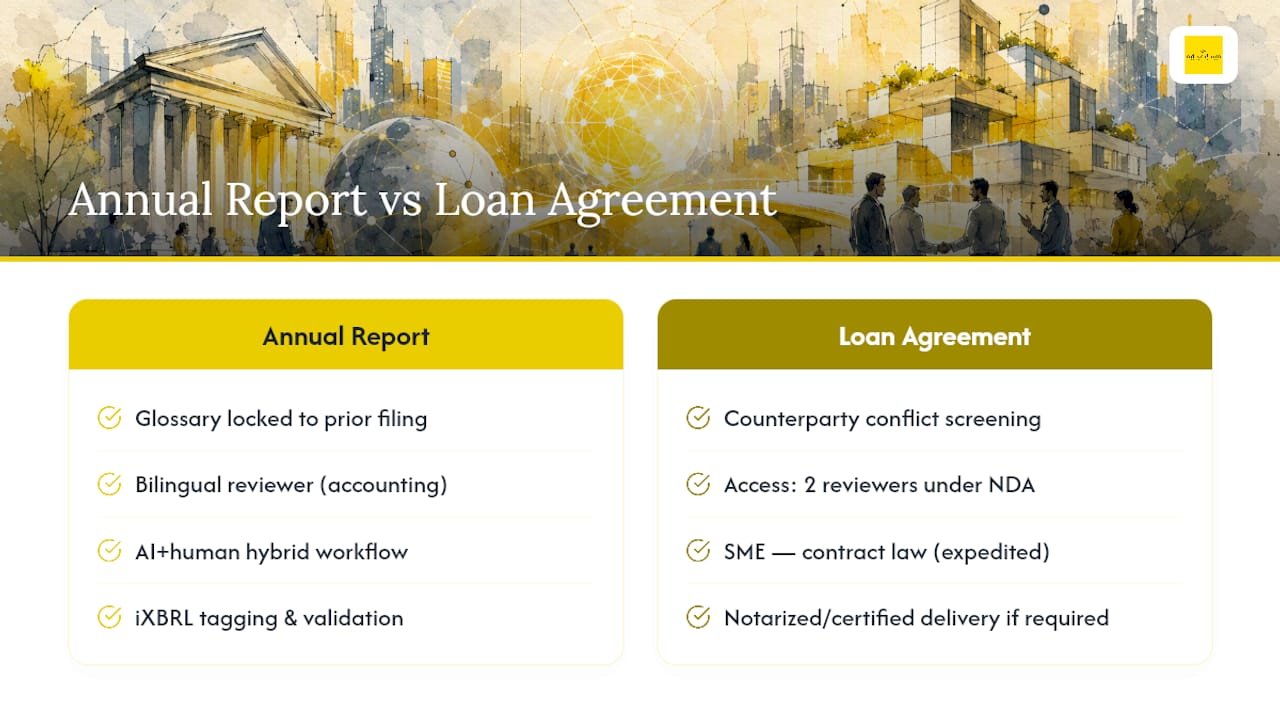
Annual report, filing-grade. The glossary gets locked against the prior year’s filing before translation starts. A bilingual reviewer with an accounting background checks every table against the source. The narrative sections get translated under the AI+HUMAN hybrid sequence, then the tagged data gets converted and validated against iXBRL requirements. Delivery includes a signed certificate of accuracy.
Loan agreement, transactional. Counterparties get screened for conflicts first. Access is scoped to two named reviewers under NDA. A subject-matter expert with contract law exposure handles an expedited review given deal timelines. Where the receiving jurisdiction requires it, delivery includes notarized or certified translation. Legal and compliance owners should request the same declaration and access log for both document types, consulting a Corporate Law Firm in Spain | Startups & International Business when understanding cross-border legal documentation nuances.
Where Financial Translations Break, and How to Prevent It
Three failure modes account for most disputes over financial translation quality, and each has a specific, checkable mitigation.
Numeric drift. Figures shift during formatting or re-keying. Mitigation: a dedicated reconciliation pass with table-check tooling before delivery, not a general proofread.
Terminology inconsistency. The same line item gets translated two different ways across related documents. Mitigation: locked glossaries, reused translation memories, and SME sign-off on terminology before generation starts.
MNPI exposure. Draft financials leak through an unscoped vendor relationship. Mitigation: scoped access under NDA, deletion on request, and audit logs that prove who accessed what.
A documented NDA-protected workflow with reconciliation built in is the standard defense against all three, and it’s worth asking any vendor to show you where each mitigation sits in their process, not just claim it exists.
When AD VERBUM’s LangOps Approach Fits
An AI+HUMAN hybrid workflow, built on a proprietary LangOps System, fits best when the document is headed for a regulated filing, touches MNPI, or needs an audit trail a compliance officer can defend later. The combination of EU-hosted infrastructure, ISO 27001 and ISO 42001 certification, and certified subject-matter expert review addresses the specific risk profile of financial filings rather than general business content.
Before engaging any provider, including AD VERBUM, ask for a description of the actual LangOps workflow sequence, a current certification list, evidence of reviewer credentials, and security documentation covering access control and retention. A simpler in-house translation process can be defensible for internal, non-filing materials with no MNPI exposure. Once a document heads toward a regulator, an auditor, or a public filing, the required controls change.
The Real Gap in How Most Teams Buy This Service
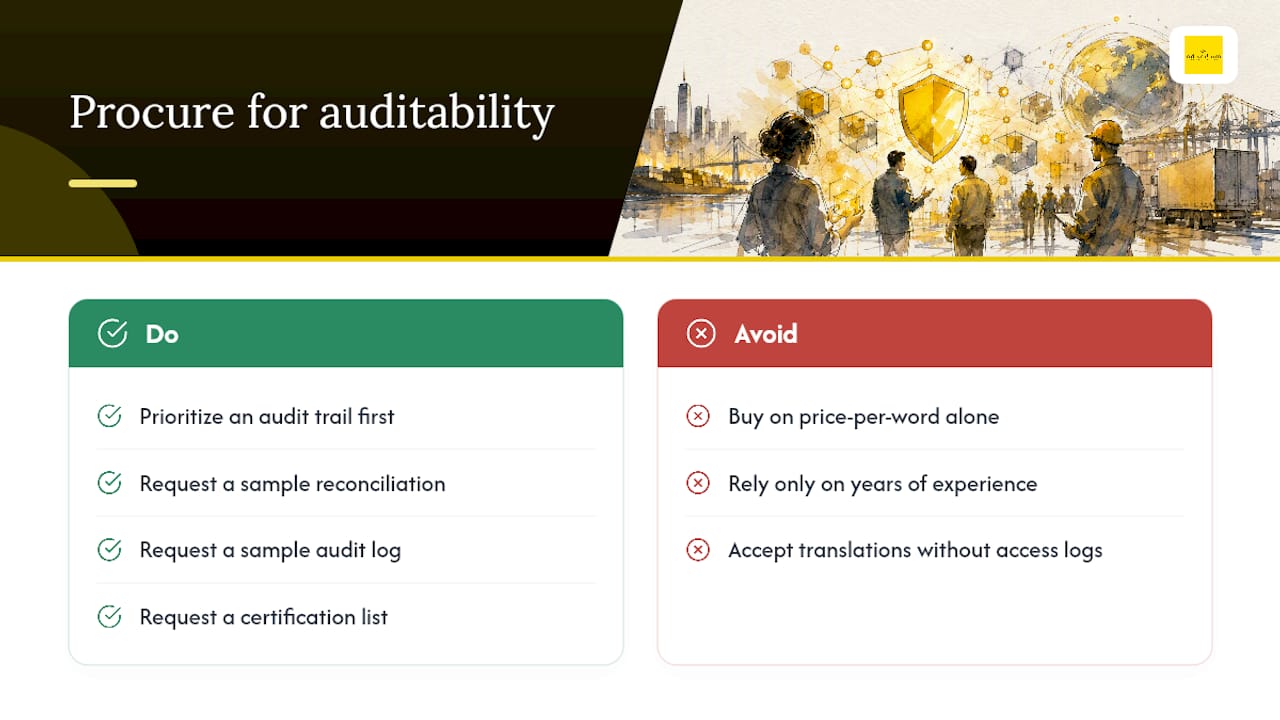
Most procurement conversations about financial translation focus on price per word and turnaround time, and almost never on whether the vendor can prove what happened to the file after they received it. That’s backwards. A translation that arrives fast and cheap but can’t be reconciled against the source numbers, or can’t show who accessed a draft earnings statement, is a liability wearing a low invoice.
The conventional advice, get a native speaker with finance experience, isn’t wrong, but it’s incomplete. A native speaker without a locked glossary will still introduce inconsistent terminology across a filing. A finance-savvy translator without an access log leaves a compliance officer unable to answer basic questions if a regulator asks who touched a document before it was public.
What should come first is the audit trail, not the linguist’s resume, real as that concern is. Ask any vendor to prove their process before you ask about their people. If they can show you a sample reconciliation, a sample audit log, and a certification list before you’ve asked twice, you’re looking at a vendor built for this category. If they can only talk about years of experience, keep looking.
— Eric Brown
Requesting a Scoped Quote From AD VERBUM
Getting an accurate quote starts with sending the right materials, not a vague description of the project. Share sample files, the target languages, your deadline, and any existing Translation Memories or glossaries you maintain, since reused terminology cuts both cost and review time.
A regulated financial content workflow that runs through certified subject-matter expert review and ISO-aligned QA before delivery, and operates on EU-hosted infrastructure with no reliance on outsourced public cloud tooling for core processing, gives compliance teams an audit trail they can actually defend, not just a finished document. Ask for security documentation alongside your quote request, including a sample certificate of accuracy, so your legal or compliance owner can review the process before the project starts. Review AD VERBUM’s translation and localization services or explore multilingual SEO and content solutions for related regulated-content needs, then send your files to start a scoped conversation.
Sources
Recommended