


Terminology Enforcement Process for Regulated Industries

A terminology enforcement process for regulated industries is an auditable governance loop that ensures approved terms appear consistently across every translated and localized artifact, enforced through TM/TB integration, constrained LLM output, certified SME review, ISO-aligned QA gates, and immutable audit logs. The single highest-priority action is to ingest your client Translation Memory ™ and Term Base (TB) into a constrained generation pipeline before any draft is produced, and require a credentialed SME sign-off before release.
Core control elements every regulated localization project needs:
TM integration: locked snapshot of approved translations ingested at project start
TB integration: approved term list with forbidden variants and regulatory definitions
TMS/CAT integration: segment-level enforcement of TB matches during drafting
LLM constraints: terminology governance layer that blocks non-approved term generation
SME review: certified subject-matter expert sign-off for accuracy and regulatory compliance
QA gates: ISO 17100 and ISO 18587 aligned checks before acceptance
Audit logs: versioned, exportable records mapping who changed what and when
Key Takeaways
An auditable terminology enforcement process requires TM/TB locking, constrained LLM generation, certified SME sign-off, ISO-aligned QA, and a complete five-artifact evidence package at every delivery.
Point | Details |
Lock TM/TB at project start | Take a versioned snapshot before any draft is generated; never allow mid-project updates without a new snapshot. |
Require a constraint manifest | Every LLM-generated draft must produce a manifest showing which terms were enforced and which were flagged. |
Mandate SME sign-off with credentials | Reviewer qualification records must be retained alongside the sign-off record for audit reconstruction. |
Track two core KPIs | Monitor terminology mismatch rate per delivery and time-to-sign-off to measure process health over time. |
AD VERBUM for regulated projects | AD VERBUM’s LangOps System and a large certified SME network deliver ISO-aligned, audit-ready localization across many languages. |
Table of Contents
What does “terminology enforcement process” actually mean in localization?
Terminology enforcement in localization means the controlled, auditable use of approved terms across every source and target artifact throughout the document lifecycle. It covers Instructions for Use (IFU), Summary of Product Characteristics (SmPC), labeling, clinical documents, legal contracts, and financial disclosures. Integration points include TMs, TBs, TMS/CAT platforms, and LLM prompt constraints.
This article does not cover government regulatory enforcement actions, fines, sanctions, or license revocations. Those are a separate domain entirely.
Scope by asset type:
High-risk assets (safety labeling, regulatory submissions, clinical trial documents): require human-only translation segments plus dual SME sign-off
Standard regulated assets (IFUs, contracts, technical manuals): AI+HUMAN hybrid translation with single certified SME review
Supporting materials (training content, internal SOPs): AI+HUMAN hybrid with standard QA
Regulators are sharpening expectations on consistency between core documents and patient-facing information, which is pushing sponsors to centralize or tightly control translation assets to avoid clock-stops during submissions.
Pro Tip: Classify any content that directly affects patient safety, regulatory submission status, or legal liability as high-risk at intake. That classification triggers human-only translation for those segments and dual SME sign-off before the file moves to QA.
How to run an auditable terminology enforcement workflow step by step
The sequence is: ingest and classify, synchronize and lock TM/TB, pre-translation QA, constrained generation, SME review, ISO-aligned QA, sign-off with versioned log, deploy, and monitor. Each step produces a required evidence artifact.
Asset ingestion and classification. Receive source files, assign risk tier (high/standard), and log asset metadata. Artifact: intake record with risk classification.
TM/TB synchronization and lock. Import client TM and TB, validate for conflicts, take a timestamped snapshot, and lock both assets for the project duration. Artifact: TM/TB snapshot with version hash.
Pre-translation QA and segmentation rules. Run automated checks for segment structure, tag integrity, and source-term coverage against the TB. Artifact: pre-translation QA report.
Constrained LLM generation or machine-assisted draft. The LLM generates target-language output constrained by the locked TB and style guidance. Non-approved terms trigger a flag, not a suggestion. Artifact: LLM constraint manifest listing enforced terms and flagged deviations.
Human post-edit and SME review. A certified linguist or subject-matter expert reviews for technical accuracy, regulatory compliance, and contextual nuance. For high-risk segments, a second SME independently reviews. Artifact: reviewer sign-off record with credential reference.
ISO-aligned QA checks. Terminology consistency, source-target alignment, and acceptance criteria checked against ISO 17100 and ISO 18587 requirements. MDR-specific checks apply to medical device content. Artifact: QA report with pass/fail per criterion.
Sign-off and versioned audit log. Project lead approves the final deliverable. The audit log records who approved, timestamp, TM/TB snapshot reference, and any deviation justifications. Artifact: exportable audit log entry.
Deployment and post-release monitoring. Deliver the artifact and schedule a post-release terminology drift check against the live TB at the next update cycle. Artifact: delivery confirmation and monitoring schedule.
Pro Tip: Insert a risk-based gate between steps 4 and 5. If the LLM constraint manifest flags more than a defined threshold of non-approved terms in a high-risk segment, route that segment to human-only translation before SME review begins.
What controls and vendor criteria make terminology enforcement audit-ready?
When evaluating tools or vendors for regulatory compliance terminology work, require evidence across four dimensions: certifications, data controls, tool capabilities, and SME credentials.
Certification requirements:
ISO 17100 (translation services process)
ISO 18587 (post-editing of machine translation output)
ISO 27001 (information security management)
ISO 42001 (AI governance and safety)
ISO 13485 (medical devices quality management, where applicable)
Independent audit statements (Bureau Veritas or equivalent)
Data and access controls:
EU-hosted or jurisdiction-specific infrastructure for data sovereignty
GDPR and HIPAA alignment with documented data processing agreements
Role-based access controls with audit trails on who accessed which asset
Immutable, exportable audit logs with retention schedules
Tool capabilities to require:
TM/TB versioning with snapshot and rollback capability
TMS/CAT integration APIs for segment-level TB enforcement
Constrained LLM or terminology filtering that blocks, not just flags, non-approved terms
Exportable evidence packages (QA reports, audit logs, sign-off records)
Vendor trust signals checklist:
Criterion | What to Request |
ISO certifications | Certificates with audit body name and validity date |
Data sovereignty | Infrastructure location declaration and DPA |
SME credentials | Linguist qualification records by domain |
AI governance | ISO 42001 certificate and LLM constraint documentation |
Audit artifacts | Sample evidence package from a comparable project |
QA alignment | Written QA procedure referencing ISO 17100/18587 |
AD VERBUM documents ISO 17100, ISO 18587, ISO 27001, ISO 13485, and ISO 42001 certifications, all independently audited by Bureau Veritas, as procurement trust signals for regulated translation workflows.
Two scenarios where the process applies directly
For more concrete examples across contract and clinical document types, the AD VERBUM examples library covers seven regulated use cases.
Scenario A: Medical device IFU localization
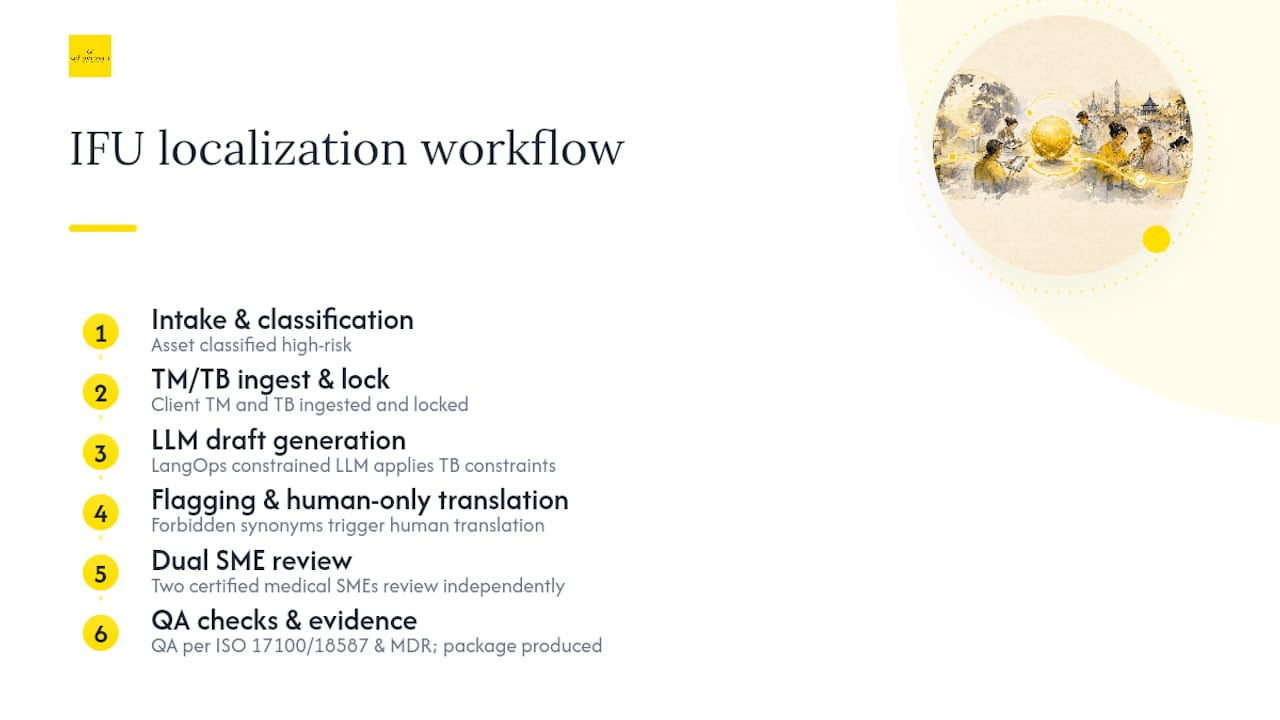
A medical device manufacturer needs an IFU localized into multiple EU languages for MDR submission. The asset is classified high-risk at intake. The client’s existing TM (covering prior IFU versions) and TB (containing approved device terminology and forbidden lay synonyms) are ingested and locked. The LangOps constrained LLM generates drafts; any segment containing a forbidden synonym is flagged and routed to human-only translation. Two certified medical SMEs review independently. QA checks run against ISO 17100, ISO 18587, and MDR Annex I language requirements. The evidence package includes: translated IFU, TM/TB snapshot, LLM constraint manifest, dual SME sign-off records, QA report, and audit log export.
Scenario B: Cross-border financial contract localization
A regulated financial services firm needs a derivatives contract localized into French and German for EU distribution. The TB is locked to jurisdiction-specific legal terms; no paraphrase or synonym is permitted for defined terms. A legal SME with civil law credentials reviews each target-language version. The audit trail for contract terminology must show every term decision with justification. Red flags to watch: affiliate TMs that diverge from the master TB, reviewer credentials that do not cover the target jurisdiction’s legal system, and audit logs that record only final approval rather than individual term decisions.
What goes wrong and how to prevent it
To reconstruct term decision history for any delivered artifact, an auditor needs: the TM/TB snapshot active at delivery, the LLM constraint manifest, the SME sign-off record with credential reference, the QA report, and the versioned audit log. If any of those five artifacts is missing, the audit trail is broken. Terminology management best practices recommend periodic TM/TB validation runs and SME refresh training to prevent drift between project cycles.
How AD VERBUM maps to this process
AD VERBUM’s LangOps System maps directly to each control point in the workflow above. EU-hosted infrastructure addresses data sovereignty requirements. Client TM/TB integration with locked snapshots satisfies the asset-locking and evidence requirements. The proprietary constrained LLM produces output governed by client terminology, not generic NMT suggestions. Certified SME review from a network of 3,500+ subject-matter expert linguists covers medical, legal, engineering, and financial domains. ISO-aligned QA and exportable audit packages satisfy procurement and regulatory audit requirements.
Engage AD VERBUM when your deliverable is high-risk, requires rapid auditable updates across multiple markets, or must satisfy MDR, HIPAA, or GDPR documentation requirements. The AI+HUMAN hybrid translation workflow delivers significantly faster turnarounds than traditional workflows while maintaining full audit artifact production.
Why AD VERBUM designed this process this way
The risk drivers are straightforward: a single unapproved term in a safety label or regulatory submission can trigger a clock-stop, a recall, or a contract dispute. Auditors do not accept “the translator understood the intent.” They require evidence. That is why every step in the AI+HUMAN hybrid translation workflow produces a named, versioned artifact, and why the LangOps System enforces terminology at generation rather than catching errors at review. ISO certifications and Bureau Veritas audits are not marketing credentials here. They are the procurement evidence your legal and compliance teams will ask for before signing.
AD VERBUM’s terminology governance diagnostic for enterprise buyers
Regulated translation projects with audit exposure need more than a quote. AD VERBUM offers a terminology governance diagnostic for enterprise buyers: submit your asset list, risk classification, existing TM/TB exports, and target languages, and receive a scoped proposal with a documented QA plan and evidence package structure.
For procurement teams preparing an RFP or a regulatory submission timeline, that speed advantage does not come at the cost of audit readiness. Every delivery includes the TM/TB snapshot, LLM constraint manifest, SME sign-off records, QA report, and exportable audit log your auditors will request.
Request a scoped proposal and evidence package at AD VERBUM Services.
Sources
Regulatory Submission Translation: Best Practices for 2026 - VEQTA Translations
This article is general information, not a substitute for advice from a qualified lawyer. Consult a qualified legal professional about your own circumstances before acting on anything here.
Recommended